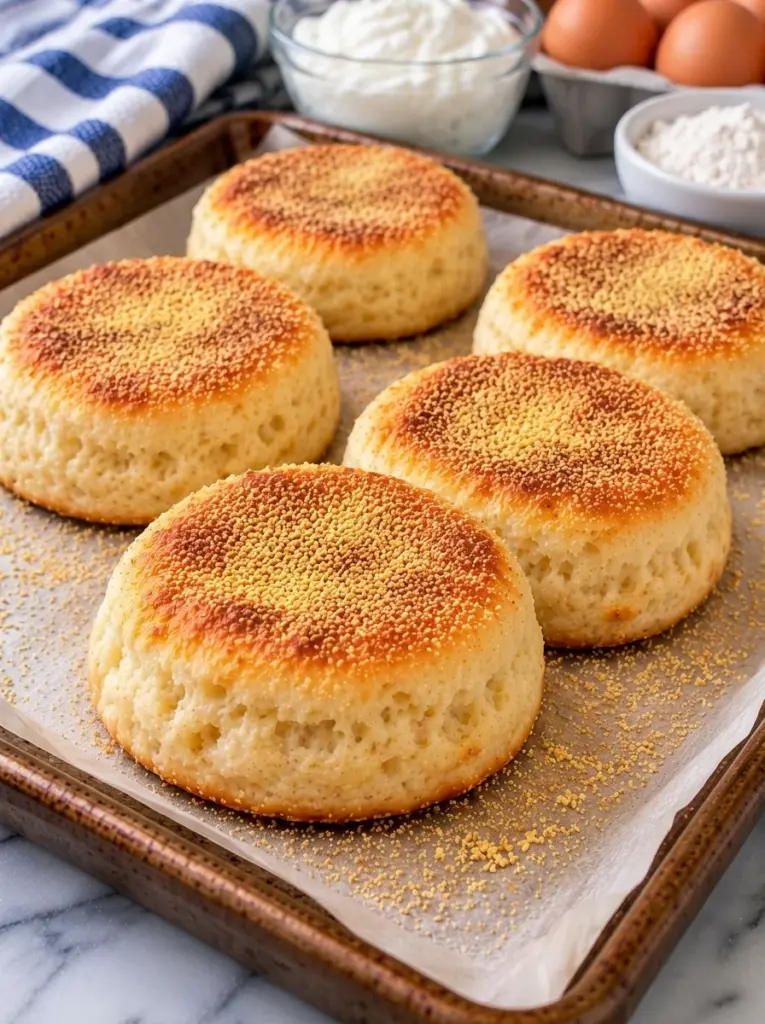
Greek yogurt, eggs, flour, and baking powder make a simple batch of savory breakfast rounds that are easy to split and toast. These 4-Ingredient High-Protein Greek Yogurt English Muffins need no yeast or kneading, and their mild flavor works with eggs, cheese, avocado, or a little butter.
They are an English-muffin-inspired quick bread. The egg-and-yogurt batter produces a tender, close-textured center rather than the distinctive open pockets of a fermented, griddle-cooked English muffin. Toasting the cut sides gives the best contrast between crisp edges and a soft interior.
The supplied mixture can be wetter than a hand-shaped dough, especially with two eggs and a softer yogurt. This method allows for that variation: rest briefly, then scoop shallow rounds onto the sheet rather than adding large quantities of flour to force a dry dough.
The supplied formula has not been kitchen-tested here. Yogurt thickness, egg size, flour measurement, and portion thickness all affect the result. Follow the texture and baking cues rather than relying only on the timer.
Recipe at a Glance
- Preparation: About 10 minutes
- Batter rest: 5 minutes
- Baking: Approximately 20–28 minutes
- Cooling: At least 20–30 minutes, longer if the centers remain hot
- Total: Approximately 55–75 minutes
- Yield: 6 small breakfast rounds
- Best serving method: Split after cooling, then toast
Ingredients
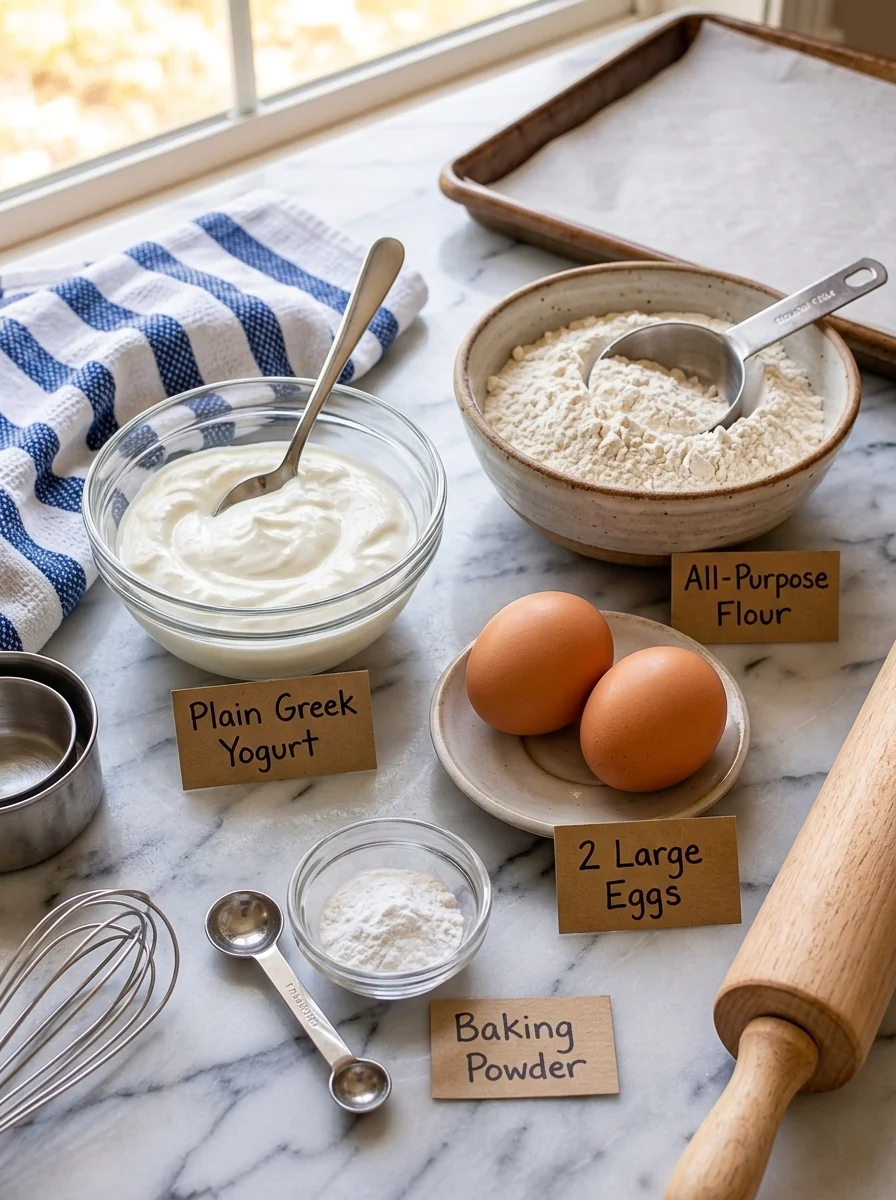
- 1 cup thick plain Greek yogurt
- 2 large eggs
- 1½ cups all-purpose flour, spooned and leveled
- 2 teaspoons baking powder
Optional Toppings and Serving Ingredients
- Everything bagel seasoning or sesame seeds
- A small amount of shredded cheese
- Butter, avocado, eggs, turkey, or other sandwich fillings
Optional toppings and fillings are separate from the four basic ingredients and the base nutrition estimate. The recipe contains no added salt, so its flavor is mild. A pinch of salt can improve flavor if you are comfortable making a five-ingredient version.
What Texture Should You Expect?
These are baked yogurt-and-egg rounds, with a tender crumb and a lightly golden exterior. They will not reproduce all the chew or irregular holes of traditional English muffins.
Fork-splitting can roughen the surface a little, but it cannot create fermentation pockets that are absent from the bread. A serrated knife is often easier for a close crumb.
Toasting improves their usefulness for sandwiches. The cut surface firms up, the flour flavor becomes more rounded, and the edges crisp. Think of them as convenient breakfast breads that suit an English muffin’s role at the table.
Why the Four Ingredients Work
Greek yogurt supplies moisture, tang, and protein. Eggs contribute additional moisture and help the structure set as the rounds bake.
Flour provides the main framework, while baking powder supplies lift without a yeast rise. Because the batter is mixed briefly, the crumb stays more tender than a heavily kneaded dough.
That combination also explains why the mixture may be sticky. Yogurt and eggs together introduce substantial moisture. Gentle scooping and shaping are more practical than repeatedly adding flour until it resembles a traditional bread dough.
Ingredient Notes
Thick Greek Yogurt
Use plain strained Greek yogurt. If a pool of whey has collected on top, pour off the loose liquid before measuring, but do not squeeze the yogurt dry.
Nonfat yogurt often provides a favorable amount of protein relative to calories, while full-fat yogurt gives a richer result. Brand differences in thickness matter as much as fat percentage.
Regular unstrained yogurt is thinner and is not the intended substitute. Sweetened flavored yogurt changes both taste and nutrition and is less suitable for a savory breakfast sandwich.
Eggs
Use two large eggs, as supplied. They help bind the mixture but also make it wetter than some two-ingredient yogurt doughs.
Egg substitutes can set differently and require separate testing. Do not assume a flax mixture or liquid egg substitute will give identical structure.
Flour
Spoon flour into the cup and level it. A packed cup can make the rounds heavier and drier, while an underfilled measure may leave a loose batter.
All-purpose flour is the intended choice. Almond flour, oat flour, and gluten-free blends have different absorption and binding behavior and are not guaranteed direct swaps.
Self-rising flour already contains leavening and usually salt, so it is not a straightforward replacement while keeping the full baking powder amount.
Baking Powder
Use baking powder, not baking soda. There is no need to increase it to chase a larger rise; too much can affect flavor and structure.
Check the package condition and measure level teaspoons. Distribute it evenly through the flour before combining with the wet ingredients.
Equipment
Use two bowls, a whisk, flexible spatula, baking sheet, parchment, and wire rack. A scoop or two large spoons help divide sticky batter evenly.
If you already own oven-safe English muffin rings, they can help contain a soft mixture. Follow their manufacturer’s preparation guidance and do not assume every ring or mold is suitable for the oven.
A thermometer can support the baking check, but visible center doneness matters too. A single temperature reading does not compensate for an obviously wet interior.
How to Make the Muffins
1. Prepare the Oven and Sheet
Heat the oven to 375°F with a rack near the center. Line a baking sheet with parchment rated for that temperature.
Have a small bowl of water nearby for dampening your fingertips if needed. This helps smooth sticky portions without adding another ingredient.
2. Mix the Wet Ingredients
Whisk the yogurt and eggs until evenly combined. Break up yogurt lumps and any visible egg streaks.
No prolonged whipping is necessary. You are making a uniform wet base rather than an egg foam.
3. Combine the Dry Ingredients
In another bowl, stir or whisk flour and baking powder together. Add to the wet mixture and fold until no dry pockets remain.
Scrape the bottom of the bowl. Stop once combined rather than beating repeatedly to make the dough smooth.
4. Rest and Assess
Let stand for 5 minutes so the flour can absorb moisture.
If the mixture is soft and tacky but holds a mound, it is ready to portion. If it is too sticky for your hands, use spoons instead of assuming it needs a large flour addition.
If it flows freely like thin pancake batter, check the yogurt and flour measurements. A small flour adjustment may be needed, but substantial additions change the formula and nutrition.
5. Portion Six Rounds
Divide into six similar mounds with a scoop or two spoons. Leave several inches between them.
With slightly damp fingers or the back of a damp spoon, smooth each mound into a round roughly 3 inches across and about ¾ inch thick, adjusting the diameter to the actual batter volume.
If the mixture is firm enough for hand shaping, use lightly floured hands and minimal bench flour. There is no kneading step.
For a very soft mixture, suitable oven-safe rings are an option. Otherwise keep the portions shallow so the centers can bake through before the exterior becomes too dark.
6. Add Optional Toppings
Sprinkle lightly with seeds, seasoning, or cheese if desired. Press only gently to help them adhere.
Everything seasoning may add salt, while cheese adds fat and protein. Neither is part of the four-ingredient base calculation.
7. Bake Until Set
Bake for about 20–28 minutes, beginning to check at 20 minutes. The surface should be lightly golden, and the center should not look wet or wobble.
A skewer inserted into the center should come out without raw batter. A center reading around 195–205°F can be a supporting guide for a set bread texture.
If browning is rapid before the middle is done, cover loosely with foil and continue in short intervals. Thickness and yogurt moisture can shift the time.
8. Cool Before Splitting
Transfer to a wire rack and cool for at least 20–30 minutes, longer if still hot inside. Warm centers can compress and seem gummy when cut.
These small breads cool faster than a loaf, but a brief five-minute pause is not necessarily enough. Handle gently until they have firmed.
9. Split and Toast
Use a serrated knife to cut horizontally. If the crumb allows it, you can work around the edge with a fork, but do not force it if the round starts to break.
Toast the cut sides until lightly crisp. Fill or top just before eating so wet ingredients do not soften the surface prematurely.
Tips for Better Results
Start with thick yogurt. It gives the most manageable version of this moisture-rich formula.
Rest before correcting. The flour needs a few minutes to hydrate.
Scoop when needed. Sticky batter does not have to become a dry kneadable dough.
Keep the rounds shallow. Thick mounds take longer to set and are easier to underbake.
Cool, then toast. This sequence improves handling and gives a firmer sandwich surface.
Expect quick-bread texture. The method is convenient, but it does not reproduce yeast fermentation.
Troubleshooting
| Issue | Possible cause | Helpful adjustment |
|---|---|---|
| Batter is difficult to handle | Normal stickiness or soft yogurt | Rest, then scoop and smooth with damp fingers. |
| Rounds spread too far | Thin yogurt or undermeasured flour | Use thick strained yogurt and consider suitable rings. |
| Centers are gummy | Thick portions, underbaking, or splitting hot | Make shallow rounds, bake through, and cool longer. |
| Bread is dry | Excess handling flour or overbaking | Add flour sparingly and check from the early time. |
| Flavor is bland | Four-ingredient formula has no added salt | Use savory toppings or add a pinch of salt as an extra ingredient. |
| No traditional muffin pockets | Baking-powder method lacks that structure | Toast the cut surface and enjoy the tender crumb. |
Variations
Everything Breakfast Rounds
Add a light sprinkle of everything bagel seasoning before baking. Check its salt content and adjust sandwich ingredients to taste.
Cheddar Tops
Sprinkle a modest amount of shredded cheddar over the surface. Watch the cheese as the breads bake so it does not become too dark before the centers set.
Garlic Herb
Add a little garlic powder and dried herbs to the flour. These are additional ingredients and change the recipe from its basic four-ingredient version.
Plain Toasting Rounds
Keep the base as written and let your topping supply the flavor. Butter, a fried egg, or a little peanut butter all offer different directions.
These variations have not been kitchen-tested here. Keep additions modest and check the centers carefully.
Serving Ideas
Build an egg-and-cheese sandwich using a toasted split round. A thin layer of avocado or a few tomato slices can add freshness, but assemble shortly before eating.
Turkey, chicken, or tuna salad can make a lunch option. Avoid overloading the tender bread with very wet fillings.
For a sweet breakfast, serve with nut butter or a little jam. Those additions contribute their own calories and carbohydrates.
Pairing the muffin with eggs or another protein source increases the meal’s protein beyond the amount in the bread itself. Do not count sandwich fillings as part of the plain muffin nutrition.
Storage and Freezing
For this moist yogurt-and-egg quick bread, refrigerate after cooling and within 2 hours of baking. Store covered at 40°F or below for up to 4 days.
Cool on a rack before sealing so steam does not create condensation. Do not leave the batch out overnight to finish cooling.
Split cooled muffins before freezing if convenient. Place parchment between halves, wrap well, and freeze in a sealed bag for up to 2 months for best quality.
Toast chilled halves or thaw frozen portions in the refrigerator before warming. A toaster oven with a tray gives control if the rounds are delicate.
Freezing may change the crumb slightly, but toasting helps restore surface firmness. Discard the breads if mold appears rather than trimming only a visible spot.
Protein and Nutrition Notes
The supplied estimate of 170–210 calories and 8–11 grams protein per muffin may overstate many versions of the plain four-ingredient batch.
With 1½ cups flour, two large eggs, and a cup of nonfat Greek yogurt, a more plausible illustrative range is about 145–175 calories and 8–10 grams protein per one-sixth batch. Full-fat yogurt, extra flour, and toppings change that range.
Greek yogurt contributes protein, but the flour still supplies substantial carbohydrate. These are not low-carb or keto English muffins.
For a closer result, add the actual ingredient-label values and divide by six. Count toppings and sandwich fillings separately. Small changes in the amount of extra handling flour can also affect the total.
Frequently Asked Questions
Are these traditional English muffins?
They are quick-bread breakfast rounds inspired by English muffins. They are baked with baking powder and have a different crumb from fermented, griddle-cooked muffins.
Can I use regular yogurt?
It is thinner and may make the mixture too loose. Thick strained Greek yogurt is the intended ingredient.
Can I use only one egg?
That changes moisture and binding. It may create a different dough, but it is not the supplied formula and would need its own testing.
Do I have to shape them by hand?
No. Scooping and smoothing is appropriate when the mixture is too sticky to handle. Avoid adding flour indefinitely to force hand shaping.
Can I make them in a skillet?
This article provides an oven method. A skillet version needs different heat and timing to cook the egg-rich centers without burning the surface.
Can I use self-rising flour?
It already contains leavening and salt. Replacing the flour while retaining all the baking powder is not a straightforward swap.
Why cool before splitting?
The crumb firms as it cools. Splitting too early can compress the center and make the texture seem underbaked.
Can I double the recipe?
Yes. Make twelve similar rounds and bake in batches if necessary. Check each tray individually rather than assuming identical timing.
Recipe Card
4-Ingredient High-Protein Greek Yogurt English Muffins
Tender baked yogurt-and-egg breakfast rounds for splitting and toasting. English-muffin-inspired quick bread; supplied formula not kitchen-tested here.
Prep: 10 minutes | Rest: 5 minutes | Bake: 20–28 minutes | Cool: 20–30 minutes or longer as needed
Yield: 6 rounds
Ingredients
- 1 cup thick plain Greek yogurt
- 2 large eggs
- 1½ cups all-purpose flour, spooned and leveled
- 2 teaspoons baking powder
Instructions
- Heat the oven to 375°F. Line a baking sheet with parchment.
- Whisk yogurt and eggs until smooth.
- Combine flour and baking powder separately, then fold into the wet mixture until no dry pockets remain.
- Rest 5 minutes. Expect a soft, sticky mixture; avoid excessive flour additions.
- Scoop six mounds and smooth with damp fingers into shallow rounds about ¾ inch thick. Use lightly floured hands only if the dough is firm enough.
- Add optional toppings if desired. Bake about 20–28 minutes, until lightly golden and set through the center.
- Cool on a rack at least 20–30 minutes, longer if still hot inside.
- Split gently, toast the cut sides, and serve.
Storage: Refrigerate within 2 hours of baking and keep covered up to 4 days. Freeze split portions up to 2 months for best quality.
Illustrative nutrition: Approximately 145–175 calories and 8–10 grams protein per round with nonfat Greek yogurt, before optional toppings and extra flour. Actual products determine the total.

4-Ingredient High-Protein Greek Yogurt English Muffins
Description
Tender baked yogurt-and-egg breakfast rounds for splitting and toasting. English-muffin-inspired quick bread; supplied formula not kitchen-tested here.
Prep: 10 minutes | Rest: 5 minutes | Bake: 20–28 minutes | Cool: 20–30 minutes or longer as needed
Yield: 6 rounds
Ingredients
- 1 cup thick plain Greek yogurt
- 2 large eggs
- 1½ cups all-purpose flour, spooned and leveled
- 2 teaspoons baking powder
Instructions
- Heat the oven to 375°F. Line a baking sheet with parchment.
- Whisk yogurt and eggs until smooth.
- Combine flour and baking powder separately, then fold into the wet mixture until no dry pockets remain.
- Rest 5 minutes. Expect a soft, sticky mixture; avoid excessive flour additions.
- Scoop six mounds and smooth with damp fingers into shallow rounds about ¾ inch thick. Use lightly floured hands only if the dough is firm enough.
- Add optional toppings if desired. Bake about 20–28 minutes, until lightly golden and set through the center.
- Cool on a rack at least 20–30 minutes, longer if still hot inside.
- Split gently, toast the cut sides, and serve.
Storage: Refrigerate within 2 hours of baking and keep covered up to 4 days. Freeze split portions up to 2 months for best quality.
Illustrative nutrition: Approximately 145–175 calories and 8–10 grams protein per round with nonfat Greek yogurt, before optional toppings and extra flour. Actual products determine the total.