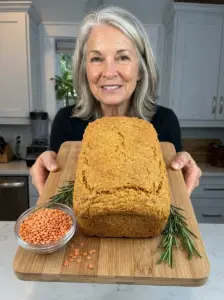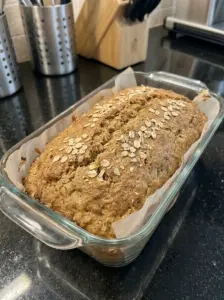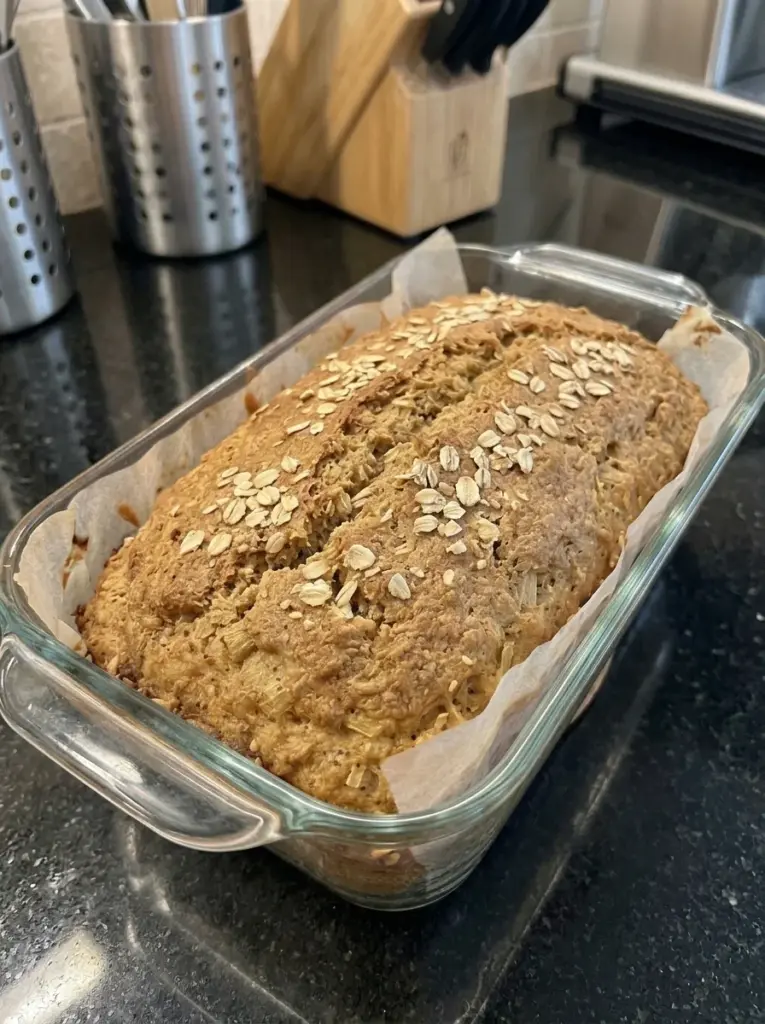
This 3-Ingredient Oatmeal Breakfast Bread turns rolled oats, plain Greek yogurt, and eggs into a small, hearty loaf for breakfast or snacks. There is no yeast, kneading, or long rise. Grind the oats, mix a thick batter, and bake until the center is set.
The flavor is mild, with a gentle oat taste and a little tang from the yogurt. That makes the slices useful with either sweet or savory toppings. Try nut butter and berries, avocado, cottage cheese, or a simple spread of butter.
The three-ingredient version is compact and moist rather than fluffy. It contains no added leavening, and oats do not form the stretchy gluten structure of wheat bread. Expect a short loaf with a close crumb that becomes easier to slice after cooling and firmer when toasted.
A teaspoon of baking powder is an optional fourth ingredient if you want a little more lift. A pinch of salt improves the flavor as another optional addition. Both are listed separately so the basic recipe remains clear.
Recipe Overview
- Yield: 1 small loaf in an approximately 8 × 4-inch pan
- Servings: 8 slices
- Preparation: About 10 minutes, including a short hydration rest
- Baking: About 35–45 minutes, possibly longer depending on the pan and yogurt
- Initial pan rest: 10 minutes
- Cooling: About 45–60 minutes more, or until no longer warm in the center
- Total to slicing: Approximately 1 hour 40 minutes to 2 hours
- Oven: 350°F
The original short total describes preparation and baking rather than a fully cooled, sliceable loaf. Give cooling its own place in the schedule, especially if you plan to make sandwiches or toast neat slices.
This article expands the supplied recipe with texture cues and ingredient notes. The formula has not been independently kitchen-tested for this article, so the final height and baking time may vary.
What the Three Ingredients Do
Ground oats absorb moisture and provide the body of the loaf. Greek yogurt adds liquid, tang, and protein, while eggs bind the mixture and help it set in the oven.
Eggs can contribute some expansion, but they do not make this batter rise like a yeast dough or a baking-powder quick bread. Without added leavening, a low profile is expected.
The loaf should hold together after cooling, but it will not stretch like wheat sandwich bread. Toasting improves the surface texture and can make it more pleasant for toppings.
Ingredients
Three-Ingredient Base
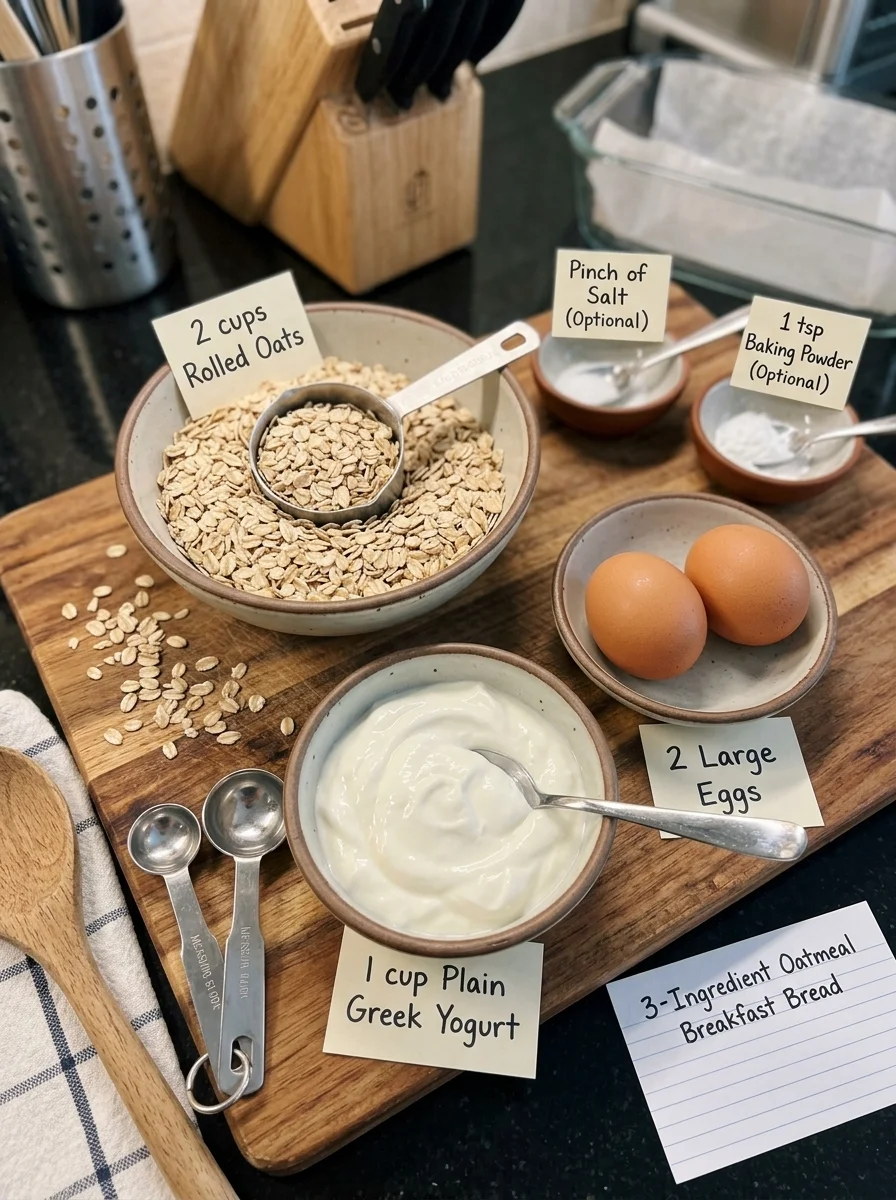
- 2 cups plain old-fashioned rolled oats
- 1 cup plain Greek yogurt
- 2 large eggs
Optional Additions
- A pinch of fine salt, for flavor
- 1 teaspoon baking powder, for a little extra lift
Use parchment to line the pan if you want to avoid adding grease to the ingredient list. Optional toppings and pan grease are separate from the three-ingredient batter.
Ingredient Notes
Rolled Oats
Use plain old-fashioned rolled oats. Blend them into a fine meal or flour-like texture for the most even crumb. A coarse grind leaves a more rustic texture and can make slices more fragile.
Measure the 2 cups before grinding. Two cups of rolled oats and two cups of finely ground oat flour are not interchangeable volume measurements, so do not replace one with the other cup for cup.
Steel-cut oats are not a direct substitute because they are harder and hydrate differently. Quick oats may work differently in this formula, but the stated method is written for rolled oats.
For a gluten-free version, use oats labeled gluten-free and check any optional baking powder or toppings. Oats can encounter wheat, barley, or rye during processing, so the ingredient label matters.
Greek Yogurt
Choose thick, plain Greek yogurt. Regular yogurt is usually thinner and can make the center wetter. Products labeled Greek-style vary in their ingredients and consistency.
Nonfat yogurt is a practical choice for the base version. Higher-fat Greek yogurt adds richness and calories and may change the texture. Use a brand whose flavor you enjoy because the short ingredient list does not hide a strong tang.
If a large amount of loose liquid has collected on top, stir the yogurt as its package recommends or drain obvious excess before measuring. Do not add extra liquid to the batter automatically.
Eggs
Large eggs give a useful starting point for consistency. Much smaller eggs reduce moisture and binding, while very large eggs can make the mixture looser.
The recipe relies on eggs for structure. Omitting them or substituting flax eggs is a substantial change, not an interchangeable adjustment. Use a developed egg-free recipe if you need a dependable alternative.
Optional Baking Powder
One teaspoon can give a little lift, but it will not turn an oat-and-yogurt loaf into airy wheat bread. Mix it evenly into the ground oats before adding the wet ingredients.
Do not replace it with the same amount of baking soda. They behave differently, and a casual substitution can create an unpleasant flavor.
Equipment
Use an approximately 8 × 4-inch metal loaf pan, parchment, a blender or food processor for the oats, a mixing bowl, a spatula, and a wire rack.
A larger 9 × 5-inch pan spreads this small amount of batter thinner, producing a shorter loaf that may bake faster. A smaller, deeper pan may need longer for the center to set. Use the recommended pan when possible.
A thermometer can provide an additional doneness cue, but it should be used alongside the appearance and texture of the center. The three ingredients produce a moist loaf, so cooling is still necessary after baking.
How to Make the Oatmeal Bread
1. Prepare the Oven and Pan
Heat the oven to 350°F. Line the loaf pan with parchment, leaving a little overhang on two sides for lifting.
Keep the paper reasonably smooth in the corners so it does not create deep folds through the loaf. Do not use wax paper in place of baking parchment.
2. Grind the Oats
Add the rolled oats to a dry blender or food processor. Process until they resemble a fine meal, stopping to redistribute if needed.
You do not need a perfectly commercial flour texture, but large intact flakes create a coarser result. Check the bottom as well as the top of the container for uneven grinding.
3. Combine the Ingredients
Transfer the ground oats to a bowl. Stir in optional baking powder and salt if using them.
In another small bowl, beat the eggs with the yogurt until reasonably smooth. Add to the oats and stir until no dry pockets remain. Alternatively, add the yogurt and eggs to the processor after grinding and blend just until combined.
A bowl method makes it easier to judge the texture and scrape in every bit of oat flour. The processor method uses fewer dishes but can leave a thick layer around the blades.
4. Rest the Batter
Let stand for about 5–10 minutes. The oats absorb moisture and the mixture should become a thick, scoopable batter.
It will not resemble a kneadable yeast dough. Do not keep adding oats to make it hold a hand-shaped loaf, and do not add milk merely because it looks thicker than cake batter.
If the mixture contains dry patches after resting, fold thoroughly first. Yogurt consistency and egg size affect the result, so any adjustment should be small and deliberate rather than a large unmeasured addition.
5. Fill the Pan
Spoon into the lined pan and press gently into the corners. Smooth the surface with a spatula.
The batter may occupy only a modest depth in the pan, especially without baking powder. That is normal for this quantity. Do not expect it to fill the pan during baking.
Tap the pan lightly once or twice to settle large gaps, without repeatedly pounding it against the counter.
6. Bake Until Set
Bake for about 35–45 minutes, beginning to check around 35 minutes. The top should be lightly golden and the center should feel set rather than wobbly.
A toothpick inserted into the middle should come out without wet batter. A few moist crumbs are different from a coating of raw mixture. If checking temperature, a center around 195–205°F is an additional baking cue for this moist loaf, rather than a promise of a particular crumb texture.
If the surface colors before the center is ready, tent loosely with foil and continue in short intervals. Pan material, yogurt moisture, and loaf depth can require more time than the starting range.
7. Cool Properly
Rest in the pan for about 10 minutes. Lift out using the parchment and transfer to a rack. Loosen the paper around the sides so steam can escape.
Allow another 45–60 minutes, or until the center is no longer warm, before slicing. A warm oat loaf can appear gummy or break apart because the interior has not finished firming.
For this moist formula, refrigerate promptly after cooling and avoid leaving it out for extended periods. It does not need to sit on the counter for hours to become sliceable.
8. Slice and Toast
Cut into 8 slices using a serrated knife and a gentle sawing motion. Support the loaf rather than pushing hard on its top.
Toast lightly for a firmer surface, or warm in a skillet. Thin, fragile slices are easier to manage in a toaster oven than a deep slot toaster, where pieces can break off.
Texture Tips
Fine grinding gives the most cohesive result. Coarse oat pieces remain more noticeable and can create weak points in thin slices.
Use thick yogurt rather than trying to compensate for a watery product with large amounts of extra oats. Changing the dry-to-wet ratio substantially can leave a heavy or crumbly loaf.
Give the batter time to hydrate before baking. A short rest helps distribute moisture without requiring a long soak.
Keep the loaf’s expected height realistic. Without baking powder, it is a compact breakfast loaf. Low rise alone does not mean it failed.
Cool completely before judging the crumb. If it remains wet or paste-like after full cooling, that is different from normal moisture and may indicate insufficient baking or an overly wet formula.
Troubleshooting
| Problem | Possible reason | What to change |
|---|---|---|
| Loaf barely rises | No added leavening in the base recipe | Expect a compact loaf, or use optional baking powder next time. |
| Center is wet | Thin yogurt, deep pan, or insufficient baking | Use thick yogurt and continue baking until set. |
| Slices crumble | Coarse oats, early slicing, or very thin cuts | Grind finer and cool fully before slicing. |
| Crumb feels gummy while warm | Interior has not set | Wait until completely cool before evaluating. |
| Loaf tastes bland | Only three mild ingredients | Use optional salt or flavorful toppings. |
| Top darkens too quickly | Oven runs hot or rack is high | Move to a central rack and tent loosely if needed. |
| Bread is dry | Overbaking or extra oats added | Measure before grinding and avoid unnecessary dry additions. |
Variations
Four-Ingredient Lighter Version
Add 1 teaspoon baking powder to the ground oats. Keep the rest of the method the same and use doneness cues rather than assuming the loaf needs exactly the same time. The result should still be hearty rather than a fluffy sandwich loaf.
Savory Breakfast Bread
Add the optional pinch of salt and a small amount of dried herbs. These additions increase the ingredient count but can make the simple loaf more flavorful alongside eggs or soup.
Cinnamon Version
Add about ½ teaspoon cinnamon as an optional extra. Cinnamon does not sweeten the loaf, so serve with fruit or a topping if you want a sweeter breakfast.
Seeded Finish
Sprinkle a small amount of seeds over the surface before baking. Avoid a heavy layer that falls off when slicing, and account for added calories and allergens.
Sweet Toppings Instead of Batter Changes
Keep the base plain and add nut butter, berries, or fruit spread after toasting. This lets each serving taste different without changing how the loaf bakes.
Large quantities of fruit, syrup, or shredded vegetables change the batter’s moisture and structure. They are not simple additions to make without further adjustment.
Serving Ideas
For a savory breakfast, toast a slice and add avocado, an egg, or cottage cheese. For a sweet option, try peanut butter and berries or a little butter and jam.
The loaf can accompany soup, but its slices are more delicate than wheat bread. Use thicker slices for dipping and avoid expecting a stretchy, tearable texture.
For sandwiches, cool and chill the loaf, then toast the slices lightly before filling. Keep fillings modest and use a plate if the bread is too tender for a handheld sandwich.
A slice or two can be part of breakfast, but the recipe’s protein per slice is moderate. Pair with another food if you want a larger or more protein-rich meal.
Make-Ahead Planning
Bake the loaf ahead, cool promptly, and refrigerate. Chilling usually makes the slices easier to handle, so an evening bake can be convenient for the next morning.
Grind oats ahead and store the measured ground portion in a sealed container, labeled as the amount produced from 2 cups rolled oats. This prevents confusion with a different volume of commercial oat flour.
Mix the batter close to baking rather than leaving an egg-and-yogurt mixture on the counter. A long hold changes hydration and is not part of the stated method.
For the easiest weekday use, slice the cooled loaf and freeze individual portions with parchment between them.
Storage and Reheating
For this moist, unvalidated egg-and-yogurt loaf, refrigeration after cooling is the conservative storage approach. Do not leave it at room temperature for more than 2 hours, or 1 hour above 90°F. This advice is specific to the intended moist formula, not a claim that every baked bread containing dairy must be treated identically.
Store in an airtight container at 40°F or below for up to 4 days. Let visible steam escape before covering, while keeping the cooling period short enough for prompt refrigeration.
Freeze cooled slices in a freezer-safe bag for up to 2 months for best quality. Separate with parchment and remove only what you need. Thaw in the refrigerator or warm suitable slices from frozen in a toaster oven.
Toast refrigerated slices lightly or warm in a skillet. Microwaving gives a softer result and can make the texture rubbery if prolonged. Add perishable toppings only when serving and refrigerate those according to their own requirements.
Discard the loaf if mold develops or it has other unexpected spoilage signs. Do not cut around a moldy area and keep the remainder.
Nutrition Estimate
Dividing the base loaf into 8 slices gives a rough estimate of 100–125 calories and 6–8 grams of protein per slice, depending on the yogurt and how the oats are measured.
These are illustrative estimates rather than a calculated nutrition label. Nonfat Greek yogurt and full-fat yogurt contribute different calories, and toppings are additional.
The oats contribute carbohydrates and fiber. This is not a keto or carbohydrate-free bread, and a single slice is not automatically a high-protein meal. Check labels and combine it with other foods according to your needs.
The base contains eggs and dairy. Use labeled gluten-free oats when needed and check all optional additions separately.
Frequently Asked Questions
Can I use oat flour instead of rolled oats?
Use the amount of oat flour produced by grinding the measured 2 cups of rolled oats, not 2 cups oat flour automatically. Grinding changes how the ingredient fits into a cup, so a direct volume swap can change the formula.
Can I leave the oats whole?
That gives a different, more textured result and may reduce slice cohesion. Grinding is part of this bread method.
Why is it so short?
The base contains no yeast or baking powder. It sets through the eggs and hydrated oats rather than rising into a tall loaf.
Can I use regular yogurt?
It is usually thinner and may leave the center too wet. Thick Greek yogurt is the recommended ingredient here.
Can I make it without eggs?
Eggs are a key binder. An egg substitute needs separate recipe development and is not guaranteed to work in the same quantity.
Is the optional baking powder necessary?
No, but it changes the rise. The strict three-ingredient version is compact; baking powder makes a four-ingredient variation with potentially a little more lift.
Can I use a larger loaf pan?
It will spread the batter thinner and produce a shorter loaf that may bake faster. Begin checking earlier and do not expect the same slice size.
Can I add mashed banana?
Banana changes moisture, sweetness, and structure. Use a banana oat bread formula rather than adding it freely to this three-ingredient batter.
Recipe Card
3-Ingredient Oatmeal Breakfast Bread
A compact, hearty oat loaf made with Greek yogurt and eggs, suitable for slicing after cooling and serving toasted.
Yield: 1 small loaf, 8 slices
Pan: Approximately 8 × 4 inches
Prep: 10 minutes
Bake: About 35–45 minutes
Pan rest: 10 minutes
Further cooling: About 45–60 minutes
Total to slicing: Approximately 1 hour 40 minutes to 2 hours
Oven: 350°F
Ingredients
- 2 cups plain rolled oats, measured before grinding
- 1 cup thick plain Greek yogurt
- 2 large eggs
Optional: A pinch of fine salt and/or 1 teaspoon baking powder. These increase the ingredient count.
Instructions
- Heat oven to 350°F. Line an approximately 8 × 4-inch loaf pan with parchment.
- Blend the oats into a fine meal or flour-like texture. Transfer to a bowl and stir in optional salt or baking powder.
- Beat yogurt and eggs together, then stir into oats until evenly combined. Alternatively, process with the ground oats just until mixed.
- Rest 5–10 minutes so the oats absorb moisture. The batter should be thick and scoopable, not a kneadable dough.
- Spoon into the pan and smooth. Bake 35–45 minutes, or longer as needed, until the center is set and a toothpick has no wet batter. Tent if browning early.
- Rest in the pan 10 minutes, then lift onto a rack and cool until no longer warm in the center, about 45–60 minutes more.
- Slice into 8 portions. Toast if desired and refrigerate promptly after cooling.
Storage: Refrigerate airtight up to 4 days. Freeze slices up to 2 months for best quality. Keep room-temperature handling within 2 hours, or 1 hour above 90°F.
Estimated nutrition: About 100–125 calories and 6–8 grams protein per slice before toppings. Ingredients vary.
Texture note: Without added baking powder, expect a short, compact loaf rather than fluffy yeast bread. Cool completely before slicing.
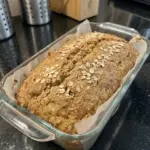
3-Ingredient Oatmeal Breakfast Bread
Description
A compact, hearty oat loaf made with Greek yogurt and eggs, suitable for slicing after cooling and serving toasted.
Yield: 1 small loaf, 8 slices
Pan: Approximately 8 × 4 inches
Prep: 10 minutes
Bake: About 35–45 minutes
Pan rest: 10 minutes
Further cooling: About 45–60 minutes
Total to slicing: Approximately 1 hour 40 minutes to 2 hours
Oven: 350°F
Ingredients
- 2 cups plain rolled oats, measured before grinding
- 1 cup thick plain Greek yogurt
- 2 large eggs
Optional: A pinch of fine salt and/or 1 teaspoon baking powder. These increase the ingredient count.
Instructions
- Heat oven to 350°F. Line an approximately 8 × 4-inch loaf pan with parchment.
- Blend the oats into a fine meal or flour-like texture. Transfer to a bowl and stir in optional salt or baking powder.
- Beat yogurt and eggs together, then stir into oats until evenly combined. Alternatively, process with the ground oats just until mixed.
- Rest 5–10 minutes so the oats absorb moisture. The batter should be thick and scoopable, not a kneadable dough.
- Spoon into the pan and smooth. Bake 35–45 minutes, or longer as needed, until the center is set and a toothpick has no wet batter. Tent if browning early.
- Rest in the pan 10 minutes, then lift onto a rack and cool until no longer warm in the center, about 45–60 minutes more.
- Slice into 8 portions. Toast if desired and refrigerate promptly after cooling.
Storage: Refrigerate airtight up to 4 days. Freeze slices up to 2 months for best quality. Keep room-temperature handling within 2 hours, or 1 hour above 90°F.
Estimated nutrition: About 100–125 calories and 6–8 grams protein per slice before toppings. Ingredients vary.
Texture note: Without added baking powder, expect a short, compact loaf rather than fluffy yeast bread. Cool completely before slicing.