
Introduction
Sugar-Free Fluffy Zero-Carb Yogurt Bread is the requested name for this almond-meal yogurt loaf, but its nutrition language needs a clear correction: it is not literally zero-carb. Almonds and yogurt contribute carbohydrates and natural sugars. This recipe has no added sugar or sweeteners; that is different from a verified sugar-free claim.
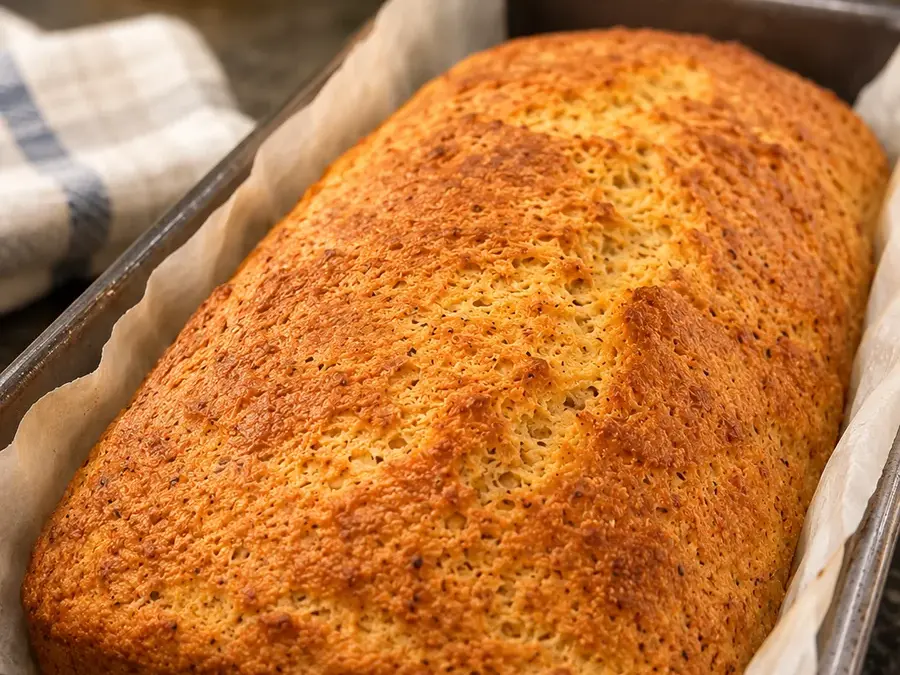
Expect a substantial quick bread with a tender, modestly aerated crumb, a lightly nutty flavor, and gentle yogurt tang. Whipped egg whites lighten the mixture, while whole almond meal gives it a speckled appearance. The loaf does not have the elasticity of wheat sandwich bread. Cut it into manageable slices for breakfast or a small open-faced sandwich, and let it cool fully before judging its texture. Its appeal is a moist, savory-leaning slice with simple ingredients.
Why You’ll Love This Recipe
Five familiar ingredients make the formula easy to organize. There is no separate sweetener, added fat, or yeast mixture to measure, and each ingredient contributes to the finished structure.
Whipping the egg whites gives this substantial almond loaf a little lift. The goal is a tender, gently aerated slice that still has enough body to handle carefully.
Plain Greek yogurt brings moisture and a mild tang without turning the bread into a sweet breakfast cake. The almond flavor remains noticeable and pleasantly rounded.
The loaf freezes in individual slices, so you can thaw only what you need. A small loaf pan also produces useful slice dimensions without requiring an oversized batch.
Ingredients
Weigh the almond meal and yogurt when possible. Almond meal settles differently between packages, and thick yogurt does not level neatly in a measuring cup. The gram amounts define this formula; cup measures are approximations.
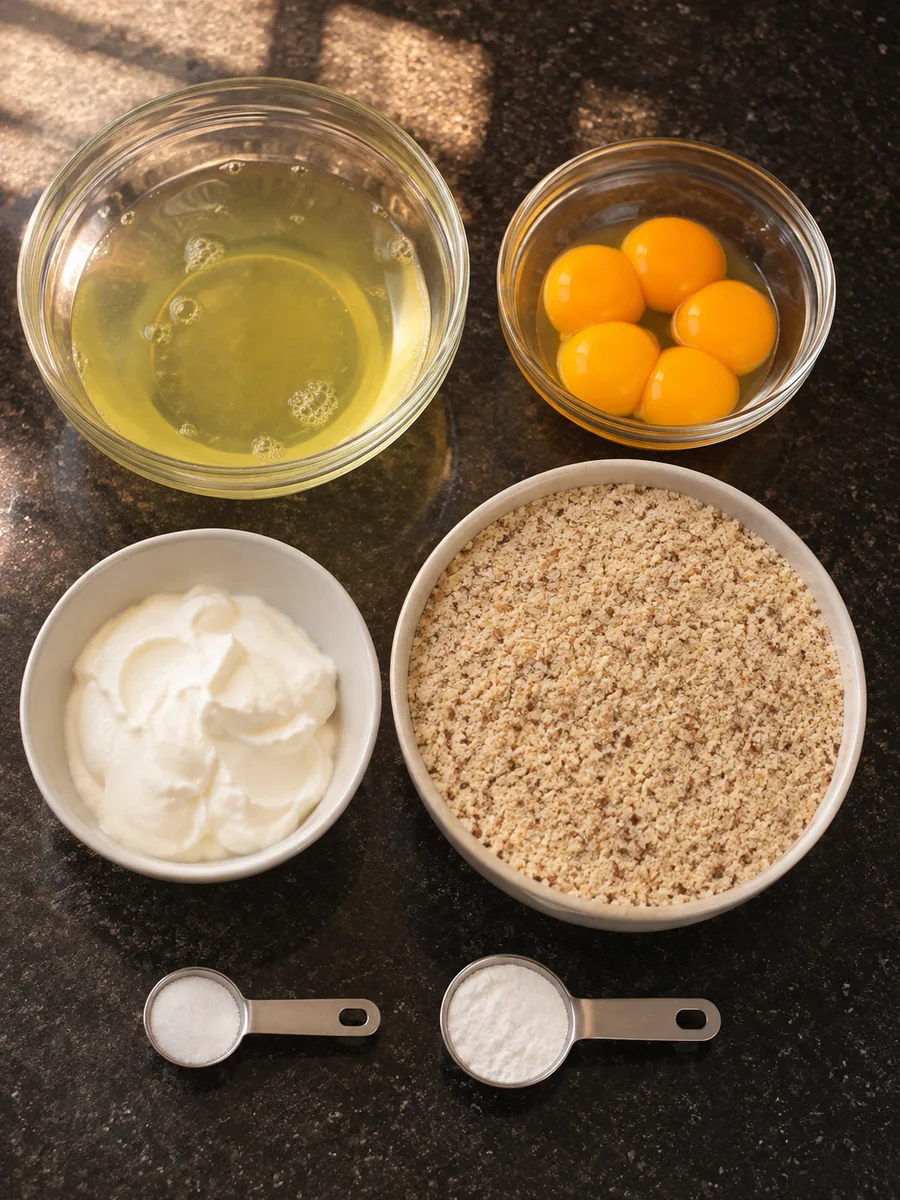
Choose finely ground whole almond meal containing almond skins, rather than coarse chopped almonds. Use plain nonfat Greek yogurt without added sugar or sweeteners. Keep both parts of the eggs: yolks enrich the base, while whites supply foam. Makes 10 servings, with one slice per serving.
- 5 large whole eggs, separated (250 g edible weight without shells)
- About 3/4 cup plus 1 tablespoon plain nonfat Greek yogurt (200 g)
- About 2 1/2 cups finely ground whole almond meal, spooned and leveled (240 g)
- 2 teaspoons double-acting baking powder (8 g)
- 1/2 teaspoon table salt (3 g)
Ingredient Notes and Substitutions
Estimated per serving: 6.3 g total carbohydrates, 1.8 g total sugars, and 10.3 g protein.
These reference-based estimates use whole almonds as the nutritional proxy for whole almond meal, together with the matching egg, nonfat Greek yogurt, salt, and double-acting baking powder records. They are not laboratory results. Brands, yogurt moisture, and uneven slices affect actual servings. Human nutrition review is required before publishing dietary claims.
Natural sugars remain present even though no sugar is added. Neither the requested title nor the absence of sweeteners establishes a verified sugar-free claim. The almond meal supplies carbohydrates as well as the fat that helps keep this loaf tender.
Blanched almond flour may produce a paler, somewhat different crumb; treat an equal-weight replacement cautiously. Regular yogurt is thinner than Greek yogurt and is not a direct substitute. Lowfat or whole-milk Greek yogurt changes the moisture and fat balance and needs separate evaluation. Avoid changing the yogurt and almond product together, because interpreting the resulting texture would become difficult.
How to Make Sugar-Free Fluffy Zero-Carb Yogurt Bread
- Heat the oven to 350°F with a rack in the center. Line an 8 1/2-by-4 1/2-inch metal loaf pan with parchment rated for this temperature, covering the bottom and sides. Leave overhang along the long sides to lift the finished loaf without pulling against its tender edges.
- Separate the whole eggs into clean bowls, keeping the egg yolks out of the egg whites. Use all 250 g of edible egg. Wash hands and food-contact equipment after handling raw eggs. Whisk the almond meal, baking powder, and salt together, breaking apart clumps. In a larger bowl, whisk the yolks with the Greek yogurt until smooth, then stir in the dry mixture. Expect a thick, scoopable paste; scrape underneath it so no dry pockets remain.
- With clean, grease-free beaters, whip the reserved whites to glossy medium peaks whose tips gently bend. Stir one-quarter of the foam into the almond mixture to loosen it. Fold in the remaining foam in two additions, lifting from the bottom and turning the bowl. Stop when broad white streaks disappear. Do not taste raw batter.
- Allow 0 minutes of bench rest: spoon the batter into the lined pan immediately and gently level its surface without pressing it down. There is no proofing. Keep the 701 g of raw batter together as one loaf for 10 eventual slices, each representing 70.1 g of raw batter before baking.
- Bake for 50 minutes at 350°F, checking at 40 minutes. Look for a browned top and set center. Insert an instant-read thermometer into the middle, away from the pan, and confirm the internal target of 200°F before removing the loaf. A tester should show no wet batter.
- Cool in the pan for 10 minutes, then lift the loaf onto a wire rack. Peel parchment away from the sides to release steam.
- Cool on the rack for 50 minutes before cutting into 10 slices. Refrigerate promptly after slicing.
Expert Baking Tips
Use a metal pan of the stated dimensions. A wider pan spreads the batter into a shallower layer, changing both the slice shape and the time needed to set the center.
Keep the whites free of yolk and grease. Separate each egg over a small bowl before adding its white to the mixing bowl, making an accidental broken yolk easier to contain.
Stop whipping at glossy medium peaks. Dry, clumpy foam is difficult to distribute through the almond paste and can leave uneven pockets instead of a consistent crumb.
Loosen the base with the first portion of foam before folding in the rest. This makes the remaining additions easier to incorporate without crushing all their air.
Check temperature in the center rather than against the pan. Surface browning alone cannot tell you whether the moist interior has set sufficiently for slicing.
Plan about 2 hours 15 minutes overall: 25 minutes active preparation, 50 minutes baking, and 60 minutes cooling. Preheating overlaps preparation. Oven differences may require additional baking before the center reaches its target.
Common Mistakes to Avoid
Packing almond meal tightly into a cup can produce a dry, heavy loaf. Weigh it, or spoon it gently into the cup and level the surface without compressing. Do not add extra meal simply because the yolk mixture looks thick before the foam goes in.
Beating the finished batter with an electric mixer removes much of the air you just created. Switch to a flexible spatula for folding, and scrape underneath the mixture so the heavier base does not remain at the bottom.
Expecting a tall wheat-style dome can lead to unnecessary baking. Some settling is reasonable for this egg-and-almond structure. Judge doneness by the center, then allow the full cooling period. Cutting while hot compresses the tender crumb and can make an adequately baked loaf seem gummy or cause the first slices to break.
Variations and Serving Ideas
For a different presentation, cut each cooled serving slice into two narrow fingers. This changes the serving shape without changing the formula or requiring a different baking schedule. Keep both fingers together as one serving when portioning the loaf for storage.
Serve a cooled slice alongside breakfast eggs, or use it for a small open-faced sandwich. Toppings and accompaniments are separate from the recipe and its nutrition estimate. Because the crumb is tender, support the slice while spreading anything firm. For toast, use a toaster oven tray and watch closely; almond-rich edges can brown before the middle becomes crisp. Avoid forcing a fragile slice into narrow toaster slots.
Storage and Freezing
After cooling, refrigerate the loaf in a covered container at 40°F or colder. Refrigerate within 2 hours after baking, or within 1 hour if the surrounding temperature is above 90°F; transfer to refrigeration before rack cooling ends in that situation. Use refrigerated bread within 3–4 days. Do not leave this moist egg-and-yogurt loaf on the counter overnight.
For freezing, separate cooled slices with small pieces of parchment and seal them in a freezer container. Freeze for up to 2 months for best quality. Thaw individual portions in the refrigerator, keeping unused slices frozen. If reheating leftovers, heat the center to 165°F; surface browning does not establish that temperature. Avoid repeatedly warming and chilling the entire loaf.
Frequently Asked Questions
Is this bread actually zero-carb?
No. Almond meal, yogurt, eggs, and baking powder contribute carbohydrates. The requested title does not override the ingredients or establish a verified nutrition claim.
Does no added sugar mean sugar-free?
No. Yogurt and almonds contain natural sugars. This formula adds no sugar or sweeteners, but it does not carry a verified sugar-free claim.
Can I skip separating the eggs?
Whipping the whites is part of this formula’s aeration. Using unbeaten whole eggs would change the texture and likely make the loaf more compact.
Why does the crumb have brown flecks?
Whole almond meal includes almond skins, which create brown flecks and a deeper color. That appearance is expected and does not indicate overbaking by itself.
Does the batter need time to rise?
No. There is no yeast fermentation. Transfer the folded batter directly to the pan and bake promptly to retain as much foam as practical.
Can I slice it straight from the oven?
Wait through the cooling period. The hot crumb is fragile, and trapped steam makes early slices more likely to compress or break apart.
How do I check the middle?
Use a thermometer to confirm the stated internal target and check for a set crumb. Never taste raw batter to assess doneness.
WP Tasty Recipe Card
PrintSugar-Free Fluffy Zero-Carb Yogurt Bread
- Total Time: 135 minutes
Ingredients
5 large whole eggs, separated (250 g edible weight without shells)
About 3/4 cup plus 1 tablespoon plain nonfat Greek yogurt (200 g)
About 2 1/2 cups finely ground whole almond meal, spooned and leveled (240 g)
2 teaspoons double-acting baking powder (8 g)
1/2 teaspoon table salt (3 g)
Instructions
Heat the oven to 350°F with a rack in the center. Line an 8 1/2-by-4 1/2-inch metal loaf pan with parchment rated for this temperature, covering the bottom and sides. Leave overhang along the long sides to lift the finished loaf without pulling against its tender edges.
Separate the whole eggs into clean bowls, keeping the egg yolks out of the egg whites. Use all 250 g of edible egg. Wash hands and food-contact equipment after handling raw eggs. Whisk the almond meal, baking powder, and salt together, breaking apart clumps. In a larger bowl, whisk the yolks with the Greek yogurt until smooth, then stir in the dry mixture. Expect a thick, scoopable paste; scrape underneath it so no dry pockets remain.
With clean, grease-free beaters, whip the reserved whites to glossy medium peaks whose tips gently bend. Stir one-quarter of the foam into the almond mixture to loosen it. Fold in the remaining foam in two additions, lifting from the bottom and turning the bowl. Stop when broad white streaks disappear. Do not taste raw batter.
Allow 0 minutes of bench rest: spoon the batter into the lined pan immediately and gently level its surface without pressing it down. There is no proofing. Keep the 701 g of raw batter together as one loaf for 10 eventual slices, each representing 70.1 g of raw batter before baking.
Bake for 50 minutes at 350°F, checking at 40 minutes. Look for a browned top and set center. Insert an instant-read thermometer into the middle, away from the pan, and confirm the internal target of 200°F before removing the loaf. A tester should show no wet batter.
Cool in the pan for 10 minutes, then lift the loaf onto a wire rack. Peel parchment away from the sides to release steam.
Cool on the rack for 50 minutes before cutting into 10 slices. Refrigerate promptly after slicing.
- Prep Time: 25 minutes
- Cook Time: 50 minutes