
Introduction
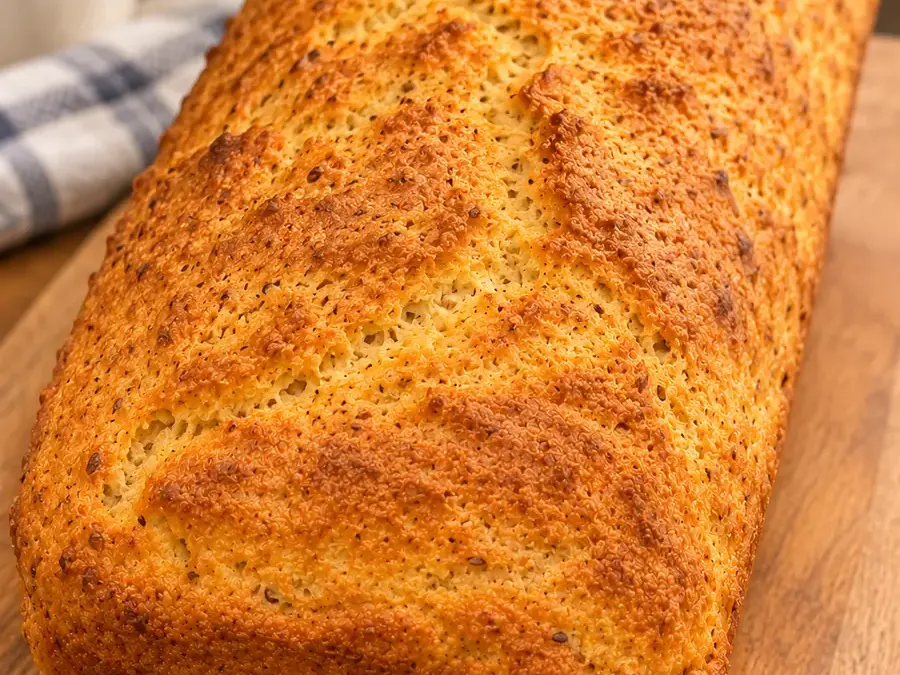
Keto Fluffy Cottage Cheese Yogurt Bread brings together mild dairy flavor, nutty almond meal, and a soft, substantial crumb. Here, fluffy means tender with small air pockets and a modest lift. Expect a moist quick loaf that holds together for slicing after cooling, with more weight and less spring than a traditional sandwich loaf.
Blended cottage cheese supplies moisture without leaving large curds, while thick Greek yogurt adds a gentle tang. A small amount of ground flaxseed helps bind the almond meal so the bread feels cohesive rather than loose and sandy.
Plan on about 2 hours 45 minutes from starting preparation to slicing, including 20 minutes of active work. Cooling takes patience, but it gives this dairy-rich loaf time to settle into a useful breakfast or lunch bread.
Why You’ll Love This Recipe
The batter comes together with a blender, bowl, and spatula. Whole eggs go straight into the wet mixture, so there is no separating eggs or managing a delicate whipped foam.
Cottage cheese and whole-milk Greek yogurt give the loaf a mild, savory character. Neither needs draining, and their measured amounts keep the dairy moisture intentional.
Finely ground whole almond meal contributes a pleasantly nutty flavor and a speckled crumb. Ground flaxseed supports the slices without becoming the main flavor.
One loaf provides 12 practical servings. Refrigerated slices are easy to portion, and freezing them individually lets you take out only what you need for a meal.
Ingredients
Weigh the dairy and almond meal, since cup measurements vary with curd size and how tightly the meal settles. The approximate American measures below are guides; gram weights define this formula.
Choose plain products without sweeteners or flavorings. Whole almond meal includes the skins, giving this loaf its characteristic color. Check that the baking powder is fresh before mixing.
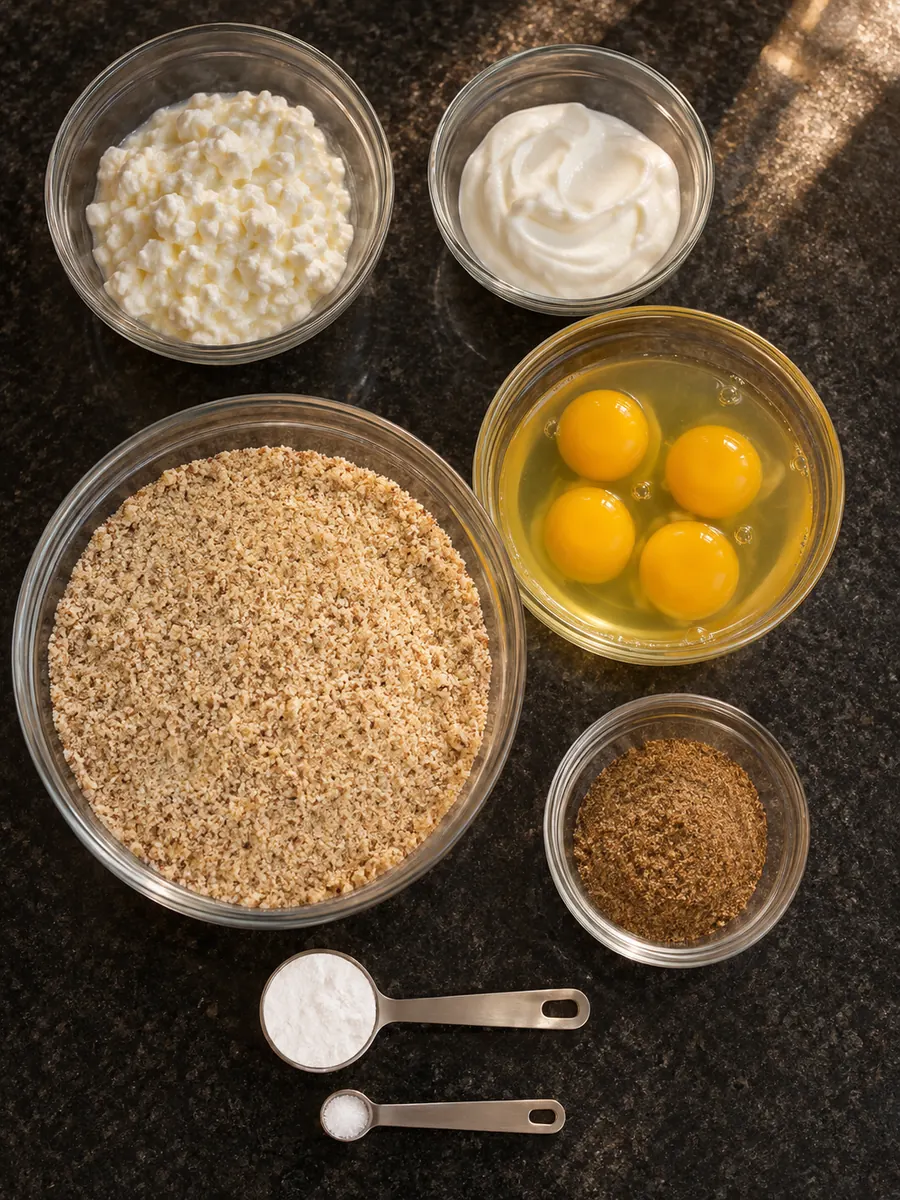
- About 7/8 cup plain undrained 4% milkfat cottage cheese (200 g)
- About 1/3 cup plus 1 tablespoon plain whole-milk Greek yogurt (100 g)
- 4 large whole eggs, without shells (200 g edible weight)
- About 3 cups finely ground whole almond meal, spooned and leveled (300 g)
- About 3 tablespoons ground flaxseed (20 g)
- 1 tablespoon double-acting baking powder (12 g)
- 1/3 teaspoon table salt (2 g)
Ingredient Notes and Substitutions
Use undrained 4% cottage cheese and plain whole-milk Greek yogurt. Their moisture is part of the formula. Stir separated liquid back into each container before measuring. Lower-fat Greek yogurt changes moisture and fat; treat that substitution cautiously rather than expecting identical results.
The almond ingredient is finely ground whole almonds, including their skins. Coarse chopped almonds cannot provide the same continuous crumb. Keep the specified whole almond meal rather than substituting a different grind halfway through preparation.
Ground flaxseed binds more effectively than intact seeds. Buy it ground or grind whole flaxseed before weighing. Whole seeds are not an equivalent substitution.
Estimated per serving: 7.2 g total carbohydrates, 2.0 g total sugars, and 10.3 g protein.
These reference-based estimates vary with brands, moisture, and serving size; they are not laboratory results and require human nutrition review. No sugar is added, but the dairy and almonds contain natural sugars. The keto-oriented title is not certification, medical advice, or a guarantee of ketosis or individual dietary suitability.
How to Make Keto Fluffy Cottage Cheese Yogurt Bread
- Heat the oven to 325°F with a rack in the center. Line an 8 1/2-by-4 1/2-inch metal loaf pan with parchment rated for this temperature, covering its bottom and sides. Leave lifting handles along the long sides. Use the lined pan without greasing.
- Blend the cottage cheese, Greek yogurt, and whole eggs until mostly smooth, scraping down the blender once. Small curd flecks are fine; avoid prolonged blending that makes a large head of foam. Wash hands and food-contact equipment after handling raw eggs.
- Whisk the almond meal, ground flaxseed, baking powder, and salt thoroughly in a large bowl, breaking up compressed lumps. Pour in the dairy mixture. Fold with a flexible spatula until evenly combined, scraping the bottom and corners. Expect thick, scoopable batter that slowly relaxes after stirring, rather than a kneadable dough. Do not taste raw batter.
- Allow 0 minutes of bench rest; transfer the batter immediately to the prepared pan. Spread gently into the corners and level the top. Keep all 834 g together as one loaf. Makes 12 servings, each one slice representing 69.5 g of raw batter before baking. No bulk or final proof is needed.
- Bake for 70 minutes at 325°F, checking at 60 minutes. Tent loosely with foil if the surface is browning heavily. The center should feel set, and a skewer should have moist crumbs without wet batter. Check with an instant-read thermometer inserted into the middle, away from the pan: confirm the internal target of 200°F before removing the loaf.
- Cool in the pan for 15 minutes. Lift carefully onto a wire rack and peel parchment away from the sides to release steam.
- Cool on the wire rack for 60 minutes before slicing. Refrigerate promptly afterward, within the storage deadlines below. In a hot kitchen, finish cooling in the refrigerator to meet the shorter deadline.
Expert Baking Tips
Choose a light-colored metal pan when possible. Dark pans can brown the edges sooner, while glass holds heat differently. Keep the specified pan dimensions so the batter depth stays close to the intended size.
Blend only until the cottage cheese becomes mostly smooth. A few tiny flecks are harmless. Excessive blending incorporates bubbles that can make the batter look lighter without providing dependable structure.
Whisk the dry ingredients thoroughly before adding the wet mixture. Baking powder caught in a pocket can leave uneven lifting or a concentrated bitter bite in an otherwise mild slice.
Use the batter texture as an observation, not an invitation to improvise. It should be thick and scoopable. If it pours freely, recheck the ingredient identities and weights before adding anything.
Measure the center temperature away from the pan wall. A probe touching hot metal gives a misleading reading, and a browned crust alone cannot establish that the moist interior has finished baking.
Slice with a sharp serrated knife using light strokes. Support the loaf with your free hand and avoid pressing down, especially on the first end slice.
Common Mistakes to Avoid
Adding extra yogurt to make the batter resemble cake batter can leave a heavy, damp middle. Almond meal does not build a gluten network that can accommodate casual changes in liquid.
Waiting for a dramatic dome can lead to disappointment or unnecessary extra baking. This formula is intended to rise modestly, and a slight settling as it cools is compatible with its moist structure.
Cutting while hot can compress the crumb and smear the knife. Give the loaf its full cooling period before deciding that the interior is too soft.
Packing almond meal firmly into a measuring cup can produce dry, crumbly slices. Conversely, using substantially less than the listed weight leaves too little solid material to support the dairy. Weighing resolves both problems without guessing at corrections after the batter is mixed.
Variations and Serving Ideas
For a different presentation, cut the fully cooled loaf into thinner slices and serve two smaller pieces in place of one standard slice. Keep the same overall portion if using the stated per-serving nutrition.
Serve a chilled slice plain to appreciate its mild dairy tang and almond flavor. Bringing only the portion you plan to eat out of the refrigerator keeps the rest properly cold.
For toast, reheat a fully cooled slice until the center reaches 165°F, then briefly crisp its surface if desired. Watch closely because almond-rich edges brown quickly. The moist crumb suits small open-faced portions better than heavily loaded sandwiches.
Storage and Freezing
Keep this moist egg-and-dairy loaf refrigerated at 40°F or colder and use within 3–4 days. Refrigerate within 2 hours after baking, or within 1 hour when the surroundings exceed 90°F. If necessary, move it into the refrigerator before the counter cooling period ends.
Once chilled, wrap the loaf or place slices in an airtight container. Avoid sealing a steaming loaf in a tight bag, which traps condensation against the surface.
For longer storage, separate cooled slices with small pieces of parchment, package airtight, and freeze for up to 2 months for best quality. Thaw in the refrigerator. If reheating leftovers, heat the center to 165°F; surface browning in a toaster does not confirm that temperature.
Frequently Asked Questions
Will this rise like sandwich bread?
Expect modest expansion and a close, tender crumb. Without wheat gluten, it lacks the stretch and springiness of a conventional yeast sandwich loaf.
Should I drain the cottage cheese?
No. Measure it undrained after stirring the container. Removing liquid changes the formula and makes the moisture balance harder to reproduce.
Can I use nonfat Greek yogurt?
It changes moisture and fat. Keep whole-milk Greek yogurt for the base recipe; alternatives need a separate trial to assess texture.
Why is the middle still damp?
Possible causes include insufficient baking, unusually wet dairy, inaccurate weights, or early slicing. Check the center temperature and complete the cooling period.
Is this suitable for every keto diet?
Carbohydrate targets differ. Review the estimated nutrition and your dietary needs; the title does not establish medical suitability or guarantee ketosis.
Can I leave it out overnight?
No. Refrigerate within the stated deadline. Its moist dairy-and-egg composition calls for cold storage, even when the crust looks dry.
Do I knead or proof it?
Neither is needed. Baking powder supplies the lift, and the thick batter should enter the oven promptly after mixing and leveling.
WP Tasty Recipe Card
PrintKeto Fluffy Cottage Cheese Yogurt Bread
- Total Time: 165 minutes
Ingredients
About 7/8 cup plain undrained 4% milkfat cottage cheese (200 g)
About 1/3 cup plus 1 tablespoon plain whole-milk Greek yogurt (100 g)
4 large whole eggs, without shells (200 g edible weight)
About 3 cups finely ground whole almond meal, spooned and leveled (300 g)
About 3 tablespoons ground flaxseed (20 g)
1 tablespoon double-acting baking powder (12 g)
1/3 teaspoon table salt (2 g)
Instructions
Heat the oven to 325°F with a rack in the center. Line an 8 1/2-by-4 1/2-inch metal loaf pan with parchment rated for this temperature, covering its bottom and sides. Leave lifting handles along the long sides. Use the lined pan without greasing.
Blend the cottage cheese, Greek yogurt, and whole eggs until mostly smooth, scraping down the blender once. Small curd flecks are fine; avoid prolonged blending that makes a large head of foam. Wash hands and food-contact equipment after handling raw eggs.
Whisk the almond meal, ground flaxseed, baking powder, and salt thoroughly in a large bowl, breaking up compressed lumps. Pour in the dairy mixture. Fold with a flexible spatula until evenly combined, scraping the bottom and corners. Expect thick, scoopable batter that slowly relaxes after stirring, rather than a kneadable dough. Do not taste raw batter.
Allow 0 minutes of bench rest; transfer the batter immediately to the prepared pan. Spread gently into the corners and level the top. Keep all 834 g together as one loaf. Makes 12 servings, each one slice representing 69.5 g of raw batter before baking. No bulk or final proof is needed.
Bake for 70 minutes at 325°F, checking at 60 minutes. Tent loosely with foil if the surface is browning heavily. The center should feel set, and a skewer should have moist crumbs without wet batter. Check with an instant-read thermometer inserted into the middle, away from the pan: confirm the internal target of 200°F before removing the loaf.
Cool in the pan for 15 minutes. Lift carefully onto a wire rack and peel parchment away from the sides to release steam.
Cool on the wire rack for 60 minutes before slicing. Refrigerate promptly afterward, within the storage deadlines below. In a hot kitchen, finish cooling in the refrigerator to meet the shorter deadline.
- Prep Time: 20 minutes
- Cook Time: 70 minutes