
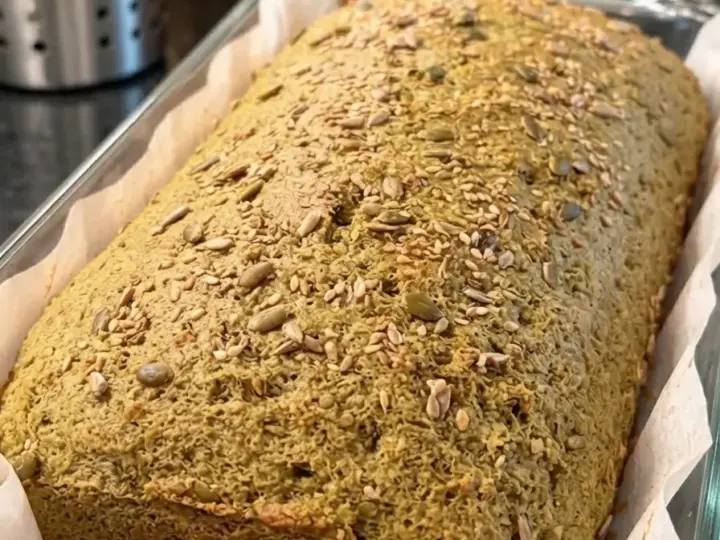
Simple Green Lentil Blender Bread turns soaked green lentils into a savory loaf with a moist, compact crumb. Eggs help the slices hold together, plain yogurt adds a little tang, and olive oil keeps the texture from feeling too dry. There is no kneading, yeast, or long bread-proofing schedule: soak the lentils, blend the batter, and bake.
This is a useful bread-style loaf for toast, open-faced sandwiches, and serving beside soup. Its earthy lentil flavor pairs particularly well with cream cheese, avocado, roasted vegetables, and sharp cheese. It will not have the airy structure or stretchy crumb of a wheat sandwich loaf, so plan on modest slices rather than expecting a tall bakery-style bread.
The most important steps happen before and after baking. Soaking makes the whole lentils easier to blend, draining controls the amount of water in the batter, and complete cooling helps the loaf slice cleanly. Rushing any of those steps can leave a coarse or gummy center.
Development note: This is an untested proposed recipe created for the requested title. The formula, baking range, and serving estimates need a home-kitchen test before publication as a tested recipe. The texture cues below are intended to guide that first bake without promising a result that has not been verified.
What Kind of Bread Is This?
This is a flourless, baking-powder-leavened lentil loaf. Soaked, uncooked lentils are blended with eggs, yogurt, oil, and seasonings, then cooked in the oven. The lentils provide the main bulk, while the eggs help bind the finished crumb.
Without wheat gluten, the batter cannot stretch and trap gas in the same way as a conventional dough. Expect a relatively low loaf, small air pockets, and a moist interior. The color will be muted green-brown rather than the pale cream of white bread.
Toasting is especially helpful. It firms the surface, adds crisp edges, and makes the earthy flavor work well with savory toppings. You can eat cooled slices without toasting, but their texture will be softer and more delicate.
Ingredients
For the Loaf
- 1 1/2 cups dry whole green lentils, measured before soaking
- Water for soaking and rinsing
- 2 large eggs
- 1/3 cup plain Greek yogurt
- 2 tablespoons olive oil
- 2 to 4 tablespoons fresh water, only as needed for blending
- 2 teaspoons baking powder
- 3/4 teaspoon fine salt
- 1/2 teaspoon garlic powder, optional
- 1/2 teaspoon dried oregano or Italian herbs, optional
Optional Topping
- 1 tablespoon pumpkin seeds, sunflower seeds, or sesame seeds
Use an 8-by-4-inch metal loaf pan. The ingredient quantity is intended for one small loaf cut into about 10 slices. Pan dimensions, lentil hydration, and your blender will affect the first-bake result.
Ingredient Notes
Whole Green Lentils
Use ordinary whole green lentils, not canned lentils, lentil flour, or split red lentils. Measure the dry lentils first, then soak that entire quantity. A cup of soaked lentils is not equivalent to a cup measured dry.
Green lentils retain their skins, which contribute color, flavor, and small flecks to the batter. A powerful blender can make them much smoother, but the finished crumb may still show fine speckling.
Sort through the dry lentils before rinsing and remove any stones or debris. Lentils that are very old or unusually hard may hydrate less predictably. Use a fresh pantry package for the first test so you are not troubleshooting stale ingredients at the same time as a new formula.
French green lentils, black lentils, brown lentils, and split red lentils have different characteristics. They are not verified substitutions for this proposed loaf.
Eggs
The eggs provide binding and help the loaf set. Use two large eggs for the intended balance. Adding extra eggs is not a neutral way to increase protein; it also changes the moisture and can create a more eggy texture.
This formula is not vegan. Flax or chia mixtures do not behave exactly like eggs in a loaf built around blended lentils, so an egg-free variation would need separate development.
Greek Yogurt
Plain Greek yogurt adds moisture and tang without as much free liquid as regular yogurt. Either nonfat or a higher-fat plain version can be used for a first test, but keep a note of your choice because the result may differ.
If there is loose whey on top, stir the yogurt to an even consistency before measuring. Avoid sweetened or flavored yogurt, which changes both the savory flavor and the ingredient balance.
Olive Oil
Olive oil adds richness and helps prevent the crumb from seeming dry or chalky. Use a mild oil if you do not want its flavor to stand out. A neutral cooking oil can be used as a flavor substitution.
Do not omit the oil automatically. A flourless loaf can be dense even with the intended ingredients, and removing fat may make the texture less pleasant.
Baking Powder
Baking powder provides some lift, but it cannot create the structure of gluten. Use fresh baking powder and measure level teaspoons. Extra baking powder can leave an unpleasant flavor without solving a dense or overly wet batter.
Baking soda is not a direct replacement. The yogurt’s acidity varies, so an improvised soda substitution would change the recipe’s chemistry.
Water and Seasonings
The added water is deliberately limited because the soaked lentils already carry moisture. Begin with two tablespoons and add more only when necessary to circulate the batter.
Salt brings out the lentils’ savory flavor. Garlic powder and dried herbs are optional additions for toast served with soup or eggs. Keep the first batch simple so you can judge the base texture before introducing cheese, vegetables, or other wet ingredients.
Equipment
A high-powered blender is the most useful tool for this loaf. A food processor may leave a coarser batter and requires more scraping. An appliance that works well for thin smoothies may struggle with a thick lentil mixture.
You will also need a bowl for soaking, a fine-mesh strainer, measuring cups and spoons, a spatula, an 8-by-4-inch loaf pan, parchment paper, and a cooling rack. A serrated knife helps make clean slices once the loaf is fully cool.
Follow your blender’s instructions for thick mixtures. Stop the motor before scraping, and use only the manufacturer’s approved tamper while the machine is running. Never push the batter toward moving blades with a spoon or spatula.
How to Make Green Lentil Blender Bread
1. Sort, Rinse, and Soak
Measure 1 1/2 cups of dry green lentils. Sort them carefully, then rinse under running water in a strainer.
Place them in a roomy bowl and cover generously with cold water, allowing several inches above the lentils for expansion. Cover and refrigerate for about 8 to 12 hours.
This soak is for hydration, not fermentation or sprouting. Do not leave the bowl in a warm kitchen for an extended period to encourage bubbling. After soaking, the lentils should look plumper and be easier to crush or cut than when dry, but they are still uncooked.
2. Drain Thoroughly
Drain and rinse the soaked lentils. Let them sit in the strainer for about 10 minutes, shaking gently to release excess water.
Do not pour the soaking liquid into the blender. The recipe uses a small measured amount of fresh water so the added liquid is more consistent.
There is no need to squeeze every lentil dry, but they should not be sitting in a puddle. Good drainage makes it easier to evaluate the batter later.
3. Prepare the Oven and Pan
Heat the oven to 350°F. Line the loaf pan with parchment, leaving overhang along the long sides so you can lift the loaf out. Lightly grease any uncovered corners.
A metal pan is the intended starting point. Glass, ceramic, and silicone conduct heat differently and can change how quickly the center cooks relative to the outside.
Place the rack near the center of the oven. Give the oven time to finish preheating before mixing in the baking powder.
4. Blend the Base
Add the eggs, yogurt, olive oil, and two tablespoons of fresh water to the blender, followed by the drained lentils. Blend until the mixture is as smooth as your appliance can make it.
Stop and scrape the sides as needed. Depending on the blender, several short cycles may work better than one long run. If the blades spin without moving the mixture, stop and redistribute it.
Add more fresh water only in small increments, up to the listed four tablespoons total. The goal is a thick batter that drops from a spatula, not a thin smoothie. Do not keep adding water simply to avoid scraping.
5. Add the Leavening and Seasoning
Add the baking powder, salt, and optional garlic powder and herbs. Blend briefly until evenly incorporated.
Check for obvious whole lentils or hard pieces. The batter should be finely blended with small skin flecks, not chunky. It may be greenish, tan, or brown depending on the lentils.
Do not taste the uncooked batter. Both the lentils and eggs still need cooking. If you want to assess seasoning during a first test, cook a small spoonful thoroughly in a skillet rather than sampling it raw.
6. Fill the Pan
Scrape the batter into the prepared pan and smooth the top. Tap the pan lightly once or twice to settle large air pockets without repeatedly banging out the leavening.
The pan should not be more than about two-thirds full. If hydration or measuring differences produce excess batter, do not force it into a crowded pan; reserve the extra for a separately monitored small bake.
Sprinkle with the optional seeds and press them lightly into the surface. A modest topping gives texture without weighing down the loaf.
7. Bake Until Set
Bake for approximately 60 to 75 minutes, beginning to check around 55 minutes. This is a proposed range, not a tested guarantee. The exact time depends on moisture, batter depth, pan, and oven accuracy.
Look for a set top, firm sides, and a center that does not wobble when the pan is gently moved. A skewer inserted into the middle should emerge without liquid batter or a thick wet paste. A few moist crumbs are different from an uncooked center.
If the top browns well before the center sets, tent loosely with foil and continue baking. Do not use surface color as the only doneness check.
If the loaf remains wet beyond the expected range, continue checking in short intervals and note that the first-test formula or moisture level may need adjustment. Do not serve a center that is still raw or pasty.
8. Cool Completely
Let the loaf stand in the pan for about 15 minutes. Lift it out with the parchment and place it on a rack, removing the paper from the sides to allow steam to escape.
Cool completely before slicing, usually at least another 60 to 90 minutes depending on the room and loaf. Keep total room-temperature time within two hours after baking, then refrigerate the loaf if it is not being served.
Warm slices may look gummy even when the loaf is cooked because the structure has not finished setting. Resist cutting the center immediately to inspect the crumb.
9. Slice and Toast
Use a sharp serrated knife and cut about 10 moderately thick slices. Saw gently rather than pressing down hard.
For the first serving, toast a slice until its surface is lightly crisp. A toaster oven or skillet can be easier than a slot toaster if the slice is delicate. Let toasted bread cool briefly before adding spreads so it holds its shape better.
Understanding the Batter
A successful first-test batter should be thick but movable. It should fall from a spatula in a heavy ribbon or soft mound rather than stay as a dry lump. It should also hold some shape when spread in the pan rather than level instantly like milk.
Soaking and draining create natural variability. That is why the small amount of fresh water is added cautiously. A powerful blender may handle a thicker mixture than a basic model without requiring additional liquid.
If your blender cannot process the batter within those limits, use a better-suited appliance or stop the test rather than adding large quantities of water. A batter made easy to blend by dilution may be difficult to bake into a sliceable loaf.
Serving Ideas
Spread toasted slices with cream cheese and add cucumber, tomato, or fresh herbs. The tangy spread complements the lentils’ earthy flavor.
For breakfast, serve with an egg, a little avocado, and black pepper. A compact slice makes a good base for an open-faced serving without needing to mimic a large sandwich loaf.
Pair a slice with tomato soup, vegetable soup, or a bean stew. Toast it first if you plan to dip it, since the moist crumb can soften quickly in liquid.
For a simple snack, add hummus and roasted peppers. Use a light hand with wet toppings and assemble shortly before eating.
Variations to Try After the First Bake
Garlic Herb
Use the optional garlic powder and herbs. A teaspoon of chopped fresh rosemary can provide a stronger savory note, but finely chop it so there are no tough needles in the crumb.
Seeded Top
Choose pumpkin, sunflower, or sesame seeds for the topping. Keep additions modest until you know how the base loaf behaves.
Parmesan Flavor
A small amount of finely grated Parmesan can add savoriness, but it also changes salt and moisture balance. Treat this as a separate test rather than a guaranteed variation.
Plain Toasting Loaf
Leave out the garlic and herbs for a more neutral savory loaf. It will still taste like lentils; omitting seasonings does not turn it into white sandwich bread.
Wet vegetables, large amounts of cheese, and purees are not simple add-ins here. They change the hydration of an already moist batter and may require a different formula.
Storage and Freezing
Because this is a moist lentil-and-egg loaf, refrigerate it in a covered container within two hours of baking. Keep the refrigerator at 40°F or below and use within 3 to 4 days.
Do not seal the loaf while it is still releasing heavy steam, which can create condensation. Cool on a rack, then package promptly. If it is still warm near the two-hour mark, refrigerate it rather than waiting longer on the counter.
For freezing, slice the cooled loaf and separate portions with parchment. Freeze in a sealed freezer-safe bag for up to two months for best quality. Remove only the slices you need.
Toast from refrigerated or frozen as appropriate for your appliance, checking that the center warms through. A skillet or toaster oven offers more support for fragile slices than a narrow slot toaster.
Do not store a visibly underbaked loaf with the expectation that refrigeration will fix it. Chilling can firm cooked starches and proteins, but it does not cook raw batter.
Troubleshooting
The Bread Is Dense
Some density is expected in a flourless lentil loaf. Excess water, coarse blending, or weak baking powder can make it heavier. Compare the result to a compact quick bread rather than an airy yeast loaf.
The Center Is Gummy
Possible causes include insufficient baking, too much water, poor drainage, or cutting before cooling. If the center is wet or raw, do not serve it. Record the batter consistency and baking time before attempting another test.
The Bread Crumbles
The mixture may have remained too coarse, the loaf may have been sliced warm, or the slices may be too thin. Blend thoroughly and cool completely. The egg binding in this formula should not be assumed to tolerate every substitution.
The Crumb Has Hard Specks
The lentils may not have hydrated or blended adequately. Longer baking is not a reliable substitute for properly preparing a very coarse batter. Use sound lentils, sufficient soaking, and suitable equipment.
The Top Browns Too Fast
Tent with foil and check the oven temperature. A dark pan or an oven that runs hot can exaggerate browning before the center cooks.
The Flavor Is Strongly Earthy
That is part of green lentils’ character. Herbs, toasting, and savory toppings can complement it. Rinsing and using fresh lentils help, but this will not taste like a neutral flour-based loaf.
Frequently Asked Questions
Can I Use Cooked or Canned Lentils?
Not as a direct substitution. They contain a different amount of water and their starches have already cooked. This formula starts with dry lentils that are soaked, drained, and then baked in the batter.
Can I Skip Soaking?
No. Dry whole lentils are too hard for the intended blending method. Soaking is preparation, while the oven supplies the cooking step.
Is It Gluten-Free?
The formula contains no wheat flour, but check the lentils, baking powder, seasonings, and kitchen equipment for gluten cross-contact if that matters for your needs. Do not assume every packaged ingredient is certified gluten-free.
Is It Low-Carb?
Lentils contain carbohydrates as well as protein and fiber. Flourless does not automatically mean low-carb or keto-friendly. Calculate the recipe from your ingredient labels if you need specific numbers.
Can I Make It Vegan?
The eggs and yogurt are structural ingredients in this proposed formula. A vegan version needs a separately developed binding and moisture system.
Does It Need Yeast?
No. This is a quick loaf using baking powder. There is no kneading or proofing stage, and leaving the finished batter to rise like yeast dough is not part of the method.
Print
Simple Green Lentil Blender Bread
Description
Yield: One small loaf, approximately 10 slices
Hands-on prep: About 20 minutes
Soaking: 8–12 hours in the refrigerator
Baking: Approximately 60–75 minutes
Cooling: Approximately 75–105 minutes, without exceeding two hours at room temperature
Total: Roughly 11–15 1/2 hours including soaking and cooling
Status: Untested proposed formula
Ingredients
-
For the Loaf
- 1 1/2 cups dry whole green lentils, measured before soaking
- Water for soaking and rinsing
- 2 large eggs
- 1/3 cup plain Greek yogurt
- 2 tablespoons olive oil
- 2 to 4 tablespoons fresh water, only as needed for blending
- 2 teaspoons baking powder
- 3/4 teaspoon fine salt
- 1/2 teaspoon garlic powder, optional
- 1/2 teaspoon dried oregano or Italian herbs, optional
Optional Topping
- 1 tablespoon pumpkin seeds, sunflower seeds, or sesame seeds
Use an 8-by-4-inch metal loaf pan. The ingredient quantity is intended for one small loaf cut into about 10 slices. Pan dimensions, lentil hydration, and your blender will affect the first-bake result.
Instructions
- Sort and rinse 1 1/2 cups dry green lentils. Cover generously with water and refrigerate for 8–12 hours.
- Drain, rinse, and drain again for about 10 minutes.
- Heat the oven to 350°F and line an 8-by-4-inch metal loaf pan.
- Blend the lentils with 2 eggs, 1/3 cup Greek yogurt, 2 tablespoons olive oil, and 2 tablespoons fresh water. Add up to 2 more tablespoons water only if needed.
- Briefly blend in 2 teaspoons baking powder, 3/4 teaspoon fine salt, and optional garlic powder and herbs.
- Spread the thick batter in the pan, keeping it no more than about two-thirds full. Add optional seeds.
- Bake approximately 60–75 minutes, until the center is set and a skewer has no wet batter. Tent if browning too quickly.
- Rest in the pan 15 minutes, transfer to a rack, and cool fully before slicing. Refrigerate within two hours of baking.
Estimated nutrition: Approximately 140–170 calories and 8–10 grams protein per slice when divided into 10, excluding optional toppings. These are rough ingredient-based estimates, not a verified nutrition analysis. Lentil labels, yogurt, and slice size change the result.