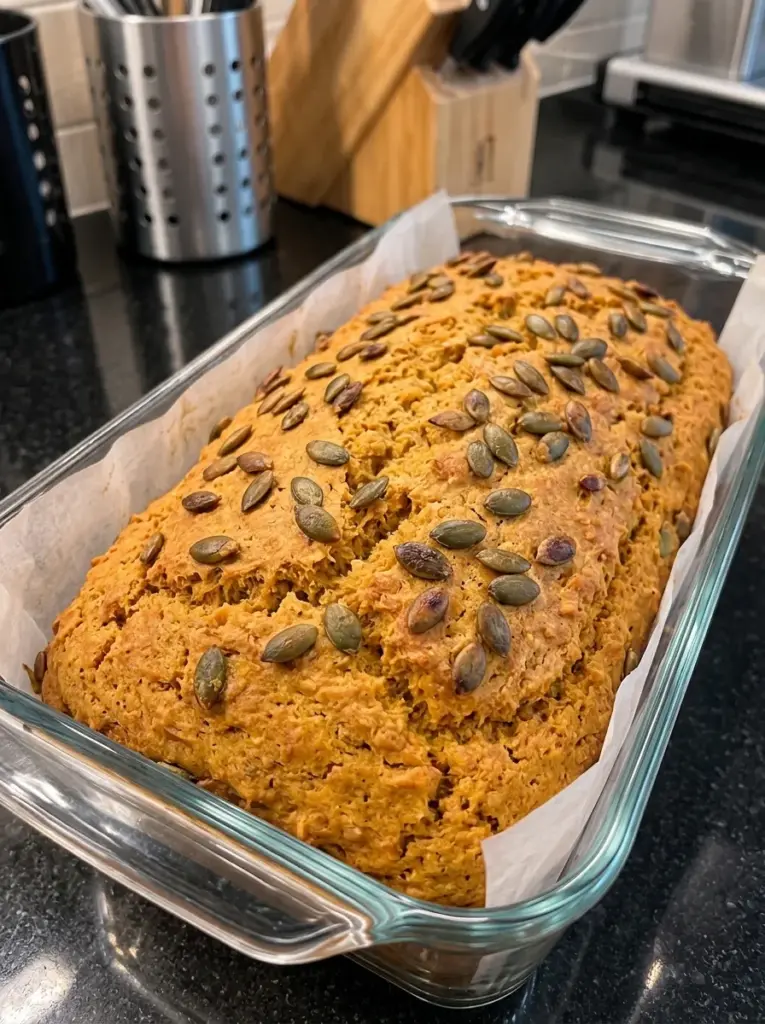
Soft Red Lentil Bread with Pumpkin Seeds is a savory blender loaf made with soaked red lentils, eggs, yogurt, and a little olive oil. Pumpkin seeds add a nutty finish and a gentle crunch against the tender center. There is no yeast to activate and no dough to knead: soak the lentils, blend the batter, fold in the seeds, and bake.
This bread is useful for breakfast toast, open-faced sandwiches, or a simple side to soup. Its flavor is earthy and mild, with a little tang from the yogurt. A thin slice is especially good warmed in a skillet or toasted, then topped with butter, avocado, or a soft cheese.
Because the title did not include an ingredient list, the formula below is a suggested starting recipe rather than a kitchen-tested reproduction. Lentil hydration, blender strength, and pan size can affect the result. Follow the batter and doneness cues, and allow the loaf to cool completely before assessing the texture.
What Kind of Bread Is This?
This is a flourless lentil quick bread. Eggs and baking powder provide lift, while finely blended lentils form the body of the loaf. It will be more compact and moist than a wheat sandwich loaf, with a close crumb rather than large air pockets.
“Soft” describes a tender, sliceable center. It does not mean the bread will have the stretch or airy structure of kneaded yeast bread. Expect a savory loaf that holds together best after cooling and benefits from toasting when used for sandwiches.
The pumpkin seeds add contrast without dominating the flavor. Most go into the batter, while a small portion stays on top. Keeping the topping modest helps the seeds adhere and reduces the chance of loose seeds falling off every slice.
Recipe Overview
| Detail | Suggested guide |
|---|---|
| Yield | 1 small loaf, about 10 slices |
| Pan | 8 × 4-inch metal loaf pan |
| Active preparation | About 15–20 minutes |
| Soaking | 6–8 hours in the refrigerator |
| Baking | Approximately 45–60 minutes |
| Cooling | At least 1 hour, preferably until completely cool |
| Texture | Tender, moist, and close-grained |
| Main ingredients | Split red lentils, eggs, yogurt, and pumpkin seeds |
| Leavening | Baking powder; no yeast |
Plan for approximately 8–10 hours from dry lentils to cooled bread, including the mostly hands-off soaking and cooling stages.
Ingredients
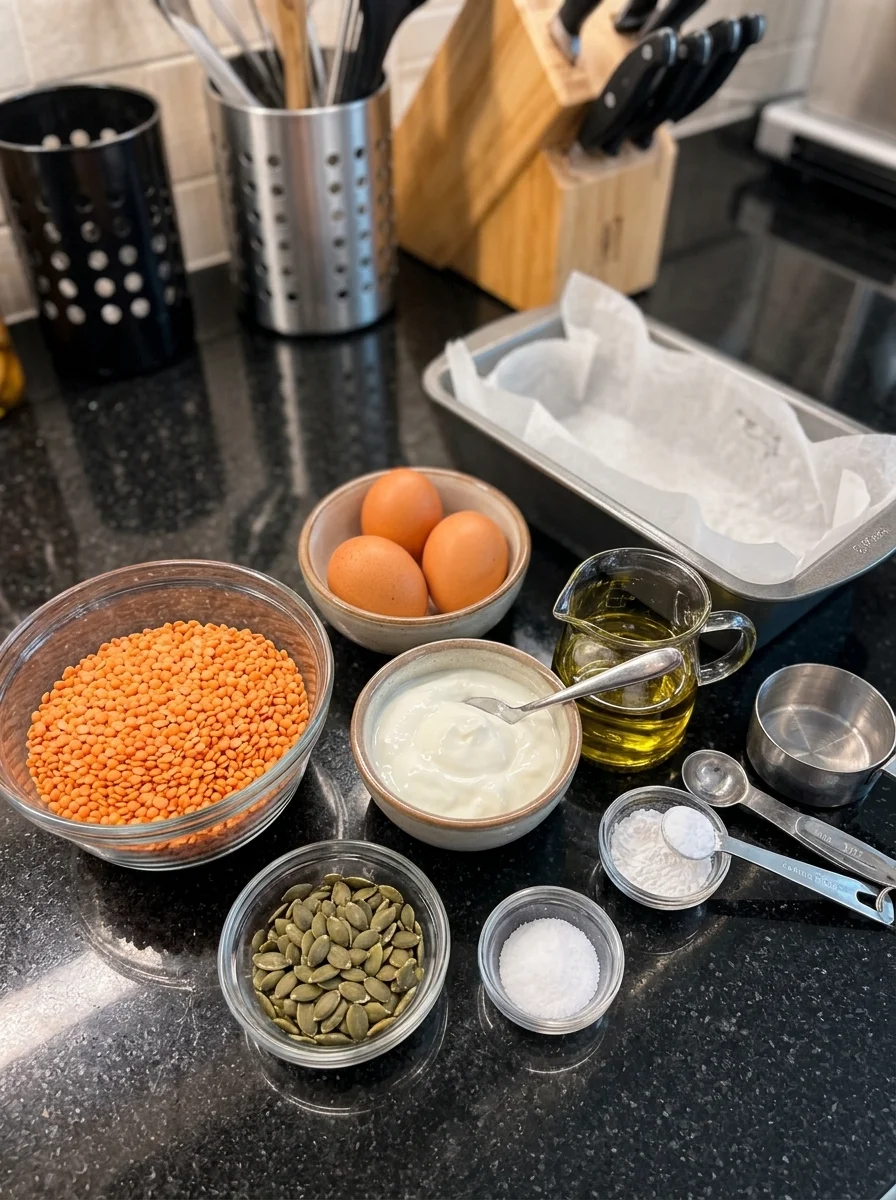
- 1 cup dry split red lentils, measured before soaking
- 3 large eggs
- ¼ cup thick plain Greek yogurt
- 2 tablespoons olive oil
- 2 teaspoons baking powder
- ½ teaspoon fine salt
- ⅓ cup shelled, unsalted pumpkin seeds, divided
- 1–3 tablespoons water, only if needed for blending
Use additional water for soaking and rinsing; drain it away before making the batter. A little oil or parchment is also needed to prepare the pan.
The extra blending water is optional. Begin without it and add only enough to allow the blender to process the lentils smoothly.
Ingredient Notes
Split red lentils
Choose dry split red lentils rather than canned lentils or a different lentil variety. Although they are often sold as red lentils, their color is usually orange or coral and becomes paler after soaking.
Measure 1 cup while dry. The quantity after soaking will be larger, so measuring a cup of already soaked lentils would change the formula.
Soaking softens the lentils for blending; it does not cook them. The batter still needs to bake thoroughly. Do not substitute cooked lentils without expecting a different moisture level and structure.
Eggs
Three eggs provide binding and help the batter set into a loaf that can be sliced. Use large eggs for the suggested formula.
This recipe has not been developed with an egg substitute. Flax eggs and similar replacements will not necessarily provide the same structure, so an egg-free version needs its own tested formula.
Greek yogurt
Thick plain Greek yogurt contributes moisture and a mild tang. A small amount helps keep the loaf tender without adding a great deal of liquid.
Regular yogurt is thinner and may loosen the batter more than intended. If using a thinner yogurt, hold back all optional water and assess the consistency carefully.
The yogurt does not make this a sourdough bread. There is no fermentation step in the method.
Olive oil
Olive oil adds richness and helps soften the crumb. A mild oil lets the lentil flavor remain subtle; a robust extra-virgin oil gives a more noticeable savory character.
A neutral oil can replace it if preferred. Avoid adding extra oil to correct a blender that is struggling, since that changes the balance of the batter.
Baking powder
Baking powder supplies lift. Use a fresh product and measure it level. More is not automatically better: excessive leavener can produce an unpleasant flavor or unstable rise.
Baking soda is not an equal substitute. Keep the suggested baking powder unless you are working from a separately developed variation.
Pumpkin seeds
Use shelled pumpkin seeds, often called pepitas, rather than seeds with tough white hulls. Unsalted seeds make it easier to control seasoning.
Raw pepitas are a straightforward choice. If yours are already roasted, watch the topping closely as it bakes. Reserve about 1 tablespoon for the top and fold the rest into the batter.
Equipment
A high-speed blender or capable food processor helps turn the soaked lentils into a fine batter. You will also need a fine-mesh strainer, a bowl for soaking, measuring cups and spoons, a spatula, parchment paper, and an 8 × 4-inch loaf pan.
A metal pan is the suggested starting point because it conducts heat readily. Glass, ceramic, or silicone can change browning and baking time. A larger pan will produce a lower loaf and may finish sooner.
Line the pan so parchment extends over the long sides. This creates handles for lifting the bread out after its initial cooling period.
How to Make Soft Red Lentil Bread
1. Sort and rinse the lentils
Spread the dry lentils on a plate and check for small stones or other debris. Transfer them to a fine-mesh strainer and rinse under cool running water.
Place them in a bowl with enough cool water to cover them by several inches. They will absorb water and expand, so use a bowl with room to spare.
2. Soak in the refrigerator
Cover the bowl and refrigerate for 6–8 hours. Overnight soaking is convenient, but there is no need to leave them for several days.
Refrigerated soaking gives you a consistent way to prepare them without a long room-temperature hold. The softened lentils should be easier to crush between your fingers, although they will still be raw.
Do not use the soaking liquid in the batter. The recipe relies on drained lentils and measured additions.
3. Drain thoroughly
Pour the soaked lentils into a fine-mesh strainer and rinse again. Let them drain for about 10 minutes, shaking the strainer gently once or twice.
Excess water trapped among the lentils can make the loaf wetter than intended. You do not need to dry every lentil individually, but they should no longer be dripping steadily when added to the blender.
This drainage step is one reason the batter may vary between batches. Be consistent rather than compensating later with arbitrary ingredients.
4. Prepare the oven and pan
Heat the oven to 350°F. Lightly grease an 8 × 4-inch loaf pan and line it with parchment, leaving overhang for lifting.
Position an oven rack near the middle. Make sure the oven is fully heated before adding the baking powder to the batter, so you can move directly from mixing to baking.
5. Blend the lentil base
Add the drained lentils, eggs, Greek yogurt, olive oil, and salt to the blender. Blend until the mixture is as smooth as your machine can make it, stopping to scrape the sides as needed.
Depending on the blender, this may take about 1–2 minutes in several intervals. Follow your appliance’s operating guidance and avoid overheating the motor.
If the blades cannot circulate the mixture, stop the machine, scrape the sides, and try again. Add water 1 tablespoon at a time only if necessary. The batter should be thick but pourable, falling from a spatula in a broad ribbon. It should not resemble a thin smoothie.
Check the texture visually rather than tasting the raw egg-and-lentil mixture. Large lentil pieces can make the finished loaf gritty, so aim for a fine, even batter.
6. Add the leavener and seeds
Add the baking powder and blend briefly, just long enough to distribute it evenly. Avoid a long blending session after this stage.
Transfer the batter to a bowl if needed, then fold in the pumpkin seeds, reserving about 1 tablespoon for the top. Folding keeps the seeds intact and distributes them through the loaf.
Scrape along the bottom so the last portion of batter does not contain a concentrated pocket of seeds or leavener.
7. Fill the pan
Scrape the batter into the prepared pan and smooth the surface. Sprinkle the reserved seeds evenly across the top and press them very lightly into the batter.
Do not pile the seeds into a thick layer. A scattered topping browns more evenly and adheres better after baking.
The pan should have room above the batter for expansion. If using a smaller pan and it is nearly full, bake excess batter separately rather than risking overflow.
8. Bake until the center is set
Bake for approximately 45–60 minutes. Start checking around 45 minutes, while allowing for differences in pans and ovens.
The loaf should be set across the top, lightly browned, and spring back gently when touched. A skewer inserted into the center should come out without wet batter. A few moist crumbs are acceptable; a coating of raw paste means it needs more time.
If the seeds or top brown too quickly, cover loosely with foil and continue baking. The outside can look finished while the center remains underdone, so check the middle rather than relying only on color.
Because this is a suggested formula, treat the time range as a guide. A deeper pan or wetter batter may require longer. Do not cut the loaf open immediately to judge its crumb, since it continues setting as it cools.
9. Cool before slicing
Let the loaf stand in the pan for 10–15 minutes. Use the parchment to lift it onto a wire rack, then peel the paper away from the sides to release steam.
Cool for at least 1 hour and preferably until completely cool. The center will seem softer while hot, and early slicing can compress it into a gummy layer.
Use a serrated knife and a gentle sawing motion. Cut moderately thin slices, especially if you plan to make sandwiches.
Tips for a Soft, Sliceable Loaf
Drain consistently
Different amounts of retained soaking water can change the batter significantly. A short, thorough drain is more useful than guessing how much extra liquid to add.
Blend the lentils finely
A smooth batter gives a more even crumb. Stop and scrape as needed so lentils caught above the blades are processed too.
Add water sparingly
Water helps a blender circulate, but it also increases baking time and can leave a wetter center. Start with the eggs, yogurt, and oil as the liquid ingredients.
Leave the batter thick
This is not a kneadable dough, but it should have substance. A watery batter is a signal to check your measurements and drainage rather than automatically pouring it into the pan.
Let the loaf finish cooling
Cooling is part of the method. A loaf that seems fragile when warm may slice much more neatly once its structure has settled.
Toast for sandwiches
Light toasting firms the cut surfaces and adds flavor. It is particularly useful when adding moist toppings such as sliced tomatoes or mashed avocado.
Troubleshooting
| Problem | Possible reason | Adjustment |
|---|---|---|
| Gummy center | Too much water, insufficient baking, or early slicing | Drain thoroughly, use little optional water, bake until set, and cool fully |
| Gritty texture | Lentils were not softened or blended finely enough | Complete the soak and blend in intervals with scraping |
| Dense loaf | Expected compact crumb, weak leavener, or overly wet batter | Use fresh baking powder and the specified pan; expect a close crumb |
| Loaf sinks | Center underbaked or batter too loose | Check the middle before removing and measure liquids carefully |
| Seeds become too dark | Already roasted seeds or strong top heat | Tent loosely with foil and use a middle rack |
| Slices break apart | Loaf still warm or cut too thickly | Cool completely and use a serrated knife |
| Bread sticks | Pan insufficiently prepared | Use parchment with overhang and lightly grease exposed ends |
| Lentil flavor is stronger than desired | Personal preference or mild seasoning | Serve toasted with savory toppings; add herbs in a future batch |
A dense loaf cannot be turned into airy wheat bread simply by doubling the baking powder. Its structure comes from a different set of ingredients, so judge it against the intended lentil-bread texture.
Flavor Variations
Garlic and herb
Add ½ teaspoon garlic powder and 1 teaspoon dried Italian herbs to the blender with the salt. This creates a savory loaf that suits soup or cream cheese.
Rosemary pumpkin seed bread
Add about 1 teaspoon finely chopped fresh rosemary. Keep the amount modest so the herb does not overpower the lentils.
Lightly cheesy loaf
Fold in ¼ cup finely grated Parmesan with the seeds. Reduce the salt slightly if your cheese is especially salty. This addition changes the nutrition and may affect browning.
Mixed-seed topping
Replace a small portion of the pumpkin seeds with sesame or sunflower seeds. Keep the total seed quantity near the suggested amount rather than adding several extra handfuls.
Cumin and coriander
Add ¼ teaspoon each ground cumin and coriander for a warm savory flavor. Serve with yogurt-based spreads or alongside vegetable soup.
These are optional additions to the base formula. For a first attempt, making the plain version helps you judge the loaf before changing several ingredients at once.
Serving Suggestions
For breakfast, toast a slice and add a little butter, cottage cheese, or a cooked egg. The savory flavor works well with avocado and black pepper too.
For lunch, make an open-faced sandwich with hummus, sliced cucumber, and herbs. If you prefer a two-slice sandwich, keep the filling light and avoid soaking the bread in a thin dressing.
Alongside dinner, serve warmed slices with tomato soup, lentil soup, or a simple vegetable stew. A small amount of olive oil or soft cheese complements the pumpkin seeds.
The bread can also be cut into small cubes and toasted for a salad topping. Watch carefully because small pieces dry and brown faster than full slices.
Make-Ahead Plan
Start the lentil soak the evening before baking. In the morning, drain, blend, and bake the loaf. Allow enough time for cooling before planning to slice it for lunch.
For weekly preparation, bake the loaf, cool completely, and slice before freezing. Individual slices are easier to thaw and toast than a whole frozen loaf.
Do not hold a finished batter containing raw eggs for a prolonged period while waiting for the oven or pan. Prepare your equipment first, add the baking powder near the end, and bake promptly.
Storage and Reheating
Refrigeration
Treat this moist homemade loaf conservatively: refrigerate after cooling rather than keeping it on the counter for several days. Store in an airtight container at 40°F or below and use within 4 days.
Let excess steam escape before sealing, but do not leave the loaf out for extended periods. Aim to refrigerate within 2 hours after baking. A shallow loaf cools more readily on a rack than inside its warm pan.
Place parchment between slices if they tend to stick. Moisture can gather inside a sealed container, so use clean, dry storage and avoid handling the whole loaf repeatedly.
Freezing
Freeze cooled slices in a freezer-safe bag or container for up to 2 months for best quality. Separate them with parchment and remove excess air where practical.
Thaw portions in the refrigerator or toast gently from frozen if your appliance can handle them. A freezer is especially useful if you will not finish the loaf within several days.
Reheating
Toast slices until the surfaces feel firmer, or warm them in a lightly greased skillet over moderate heat. Avoid scorching the pumpkin seeds.
Microwaving briefly will warm the bread but may make the moist crumb feel softer. For a more structured sandwich slice, a toaster or skillet is usually preferable.
Nutrition Notes
This loaf contains protein from lentils, eggs, yogurt, and pumpkin seeds, but the exact amount depends on your ingredient labels and slice size. It also contains carbohydrates from the lentils; flourless does not mean carbohydrate-free or keto.
A broad working estimate for 10 slices is approximately 125–155 calories and 7–9 grams of protein per slice. Added cheese, larger portions, or extra oil will change those figures.
For a more accurate estimate, total the nutrition from the dry lentils, eggs, yogurt, oil, and seeds, then divide by the actual number of slices. Water absorbed during soaking changes weight and volume without adding calories.
The base formula contains no wheat flour, but anyone requiring gluten-free food should check all ingredient labels, including baking powder and packaged seeds, and consider preparation cross-contact.
Frequently Asked Questions
Can I use cooked red lentils?
Not as a direct substitution. Cooked lentils contain a different amount of water and have already broken down, which can change the structure. The suggested formula starts with dry split lentils that are soaked and drained.
Can I skip soaking?
Soaking makes the lentils soft enough to blend into this batter. Dry lentils will not process the same way in the short mixing stage, so do not omit it.
Can I use green or brown lentils?
They have different skins, flavor, and texture. This formula is intended for split red lentils; another type would need its own adjustments.
Does this bread taste like regular sandwich bread?
It has an earthy savory flavor and a closer crumb. Toasting makes it especially useful for breakfast and open-faced sandwiches, but it will not mimic every quality of wheat bread.
Can I leave out the pumpkin seeds?
Yes. The loaf will lose the seed crunch and some richness, but the seeds are not the main structural ingredient. Do not replace them with a large amount of wet vegetables without adjusting the formula.
Why did the top crack?
A shallow crack can occur as the surface sets and the center expands. It is not automatically a problem if the middle is fully baked and the loaf holds together after cooling.
Can I use a 9 × 5-inch pan?
It will produce a lower loaf. Begin checking earlier because the batter is spread more thinly. The suggested baking range is based on the smaller pan.
Can I make muffins?
You can experiment with a greased or lined muffin pan, filling wells about two-thirds full. Start checking much earlier than for a loaf and confirm that the centers are set. This adaptation has not been tested, so an exact time or yield is not guaranteed.
Is the optional water always necessary?
No. Add it only when scraping and restarting the blender are insufficient. The eggs and yogurt may provide enough liquid for your machine.
Can I make it dairy-free?
A thick plain dairy-free yogurt may be worth testing, but formulations vary and the result is not verified. Keep the quantity the same initially and avoid sweetened or strongly flavored products.
Recipe Card
Soft Red Lentil Bread with Pumpkin Seeds
A suggested flourless blender loaf with a tender, close crumb and nutty pumpkin seeds. No yeast or kneading required.
Yield: 1 small loaf, about 10 slices
Prep: 15–20 minutes
Soak: 6–8 hours in the refrigerator
Bake: Approximately 45–60 minutes
Cool: At least 1 hour, preferably until completely cool
Oven: 350°F
Pan: 8 × 4-inch metal loaf pan
Ingredients
- 1 cup dry split red lentils
- 3 large eggs
- ¼ cup thick plain Greek yogurt
- 2 tablespoons olive oil
- 2 teaspoons baking powder
- ½ teaspoon fine salt
- ⅓ cup shelled unsalted pumpkin seeds, divided
- 1–3 tablespoons water, only if needed
Instructions
- Sort and rinse the dry lentils. Cover generously with cool water and refrigerate for 6–8 hours.
- Drain, rinse again, and let drain thoroughly for about 10 minutes. Discard soaking water.
- Heat the oven to 350°F. Grease and parchment-line an 8 × 4-inch loaf pan.
- Blend drained lentils, eggs, yogurt, oil, and salt until very smooth. Scrape as needed. Add water by the tablespoon only if necessary for circulation; keep the batter thick but pourable.
- Add baking powder and blend briefly. Fold in pumpkin seeds, reserving about 1 tablespoon.
- Transfer to the pan, smooth the top, and sprinkle with reserved seeds.
- Bake approximately 45–60 minutes, until set and a center skewer shows no wet batter. Cover loosely with foil if the top browns early.
- Cool in the pan for 10–15 minutes, then lift onto a rack. Cool completely before slicing.
Storage: Refrigerate after cooling and use within 4 days. Freeze separated slices for up to 2 months for best quality.
Estimated nutrition: Approximately 125–155 calories and 7–9 grams protein per slice when cut into 10; ingredient-dependent.
Little tip: Before adding extra water, stop and scrape the blender. Keeping unnecessary liquid out of the batter is one of the simplest ways to avoid a gummy center.
Soft Red Lentil Bread with Pumpkin Seeds
Description
A suggested flourless blender loaf with a tender, close crumb and nutty pumpkin seeds. No yeast or kneading required.
Yield: 1 small loaf, about 10 slices
Prep: 15–20 minutes
Soak: 6–8 hours in the refrigerator
Bake: Approximately 45–60 minutes
Cool: At least 1 hour, preferably until completely cool
Oven: 350°F
Pan: 8 × 4-inch metal loaf pan
Ingredients
- 1 cup dry split red lentils
- 3 large eggs
- ¼ cup thick plain Greek yogurt
- 2 tablespoons olive oil
- 2 teaspoons baking powder
- ½ teaspoon fine salt
- ⅓ cup shelled unsalted pumpkin seeds, divided
- 1–3 tablespoons water, only if needed
Instructions
- Sort and rinse the dry lentils. Cover generously with cool water and refrigerate for 6–8 hours.
- Drain, rinse again, and let drain thoroughly for about 10 minutes. Discard soaking water.
- Heat the oven to 350°F. Grease and parchment-line an 8 × 4-inch loaf pan.
- Blend drained lentils, eggs, yogurt, oil, and salt until very smooth. Scrape as needed. Add water by the tablespoon only if necessary for circulation; keep the batter thick but pourable.
- Add baking powder and blend briefly. Fold in pumpkin seeds, reserving about 1 tablespoon.
- Transfer to the pan, smooth the top, and sprinkle with reserved seeds.
- Bake approximately 45–60 minutes, until set and a center skewer shows no wet batter. Cover loosely with foil if the top browns early.
- Cool in the pan for 10–15 minutes, then lift onto a rack. Cool completely before slicing.
Storage: Refrigerate after cooling and use within 4 days. Freeze separated slices for up to 2 months for best quality.
Estimated nutrition: Approximately 125–155 calories and 7–9 grams protein per slice when cut into 10; ingredient-dependent.
Little tip: Before adding extra water, stop and scrape the blender. Keeping unnecessary liquid out of the batter is one of the simplest ways to avoid a gummy center.