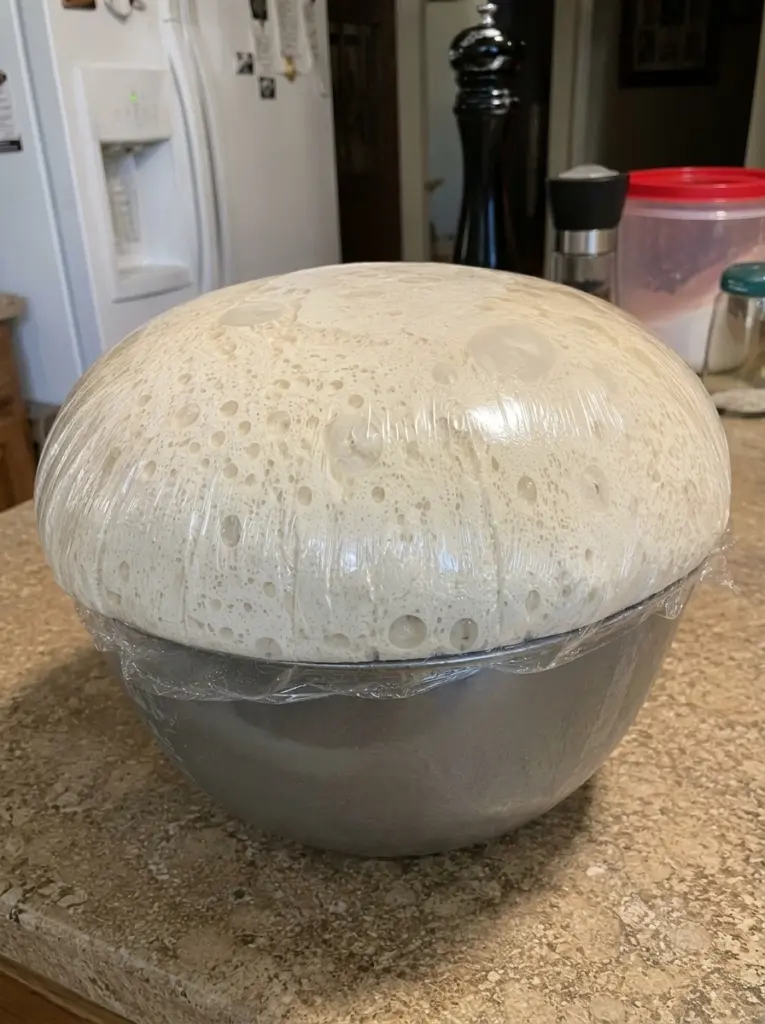
I left my sourdough dough on the counter overnight, and this is what I woke up to. The dough had expanded so much that it completely filled the bowl and pushed tightly against the plastic wrap. At first glance, it looked amazing — lots of fermentation activity and a huge, dramatic rise. If you’ve ever walked into your kitchen the morning after an overnight ferment and found your dough looking like it was trying to escape the bowl, you know exactly the mix of excitement and panic I felt.
But here’s the question every sourdough baker eventually has to ask themselves: does a huge rise always mean your sourdough is ready to bake? Not necessarily. And that’s exactly what this post is about.
When sourdough is left fermenting at room temperature for too long, especially in a warm kitchen, it can continue rising past its ideal fermentation point and eventually become overproofed. That’s precisely what happened to my dough that night, and instead of panicking or tossing it straight into the trash, I decided to walk through what was actually happening, what the signs of overproofing look like, and whether the dough could still be saved. Spoiler alert: it usually can.
If you bake sourdough regularly, an overnight surprise like this is basically a rite of passage. This guide breaks down exactly why it happens, how to recognize it, what your options are once it does, and how to adjust your process so you have more control next time — without needing to babysit your dough around the clock.
Why This Happens (And Why It’s Not a Disaster)
Understanding the “why” behind an overproofed dough makes it a lot less scary, and honestly, a lot more interesting. Sourdough fermentation isn’t a fixed, predictable countdown timer — it’s a living, breathing biological process, and that’s part of what makes it so rewarding (and occasionally unpredictable).
Sourdough starter contains wild yeast and bacteria that ferment the flour and produce gases as a byproduct of their activity. Those gases become trapped inside the gluten structure of your dough, and as more gas accumulates, the dough expands. This is exactly what you want during fermentation — it’s the entire mechanism behind that beautiful open, airy crumb sourdough is known for.
The problem is that fermentation doesn’t stop on its own just because it’s convenient for your schedule. Leaving the dough overnight gives fermentation many hours to continue uninterrupted, and if your kitchen is warm or your starter is especially active, the dough can rise much faster and further than expected. What might take 8–10 hours in a cool 65°F kitchen could easily happen in half that time in a warmer 75–78°F kitchen.
This is why the same recipe, made in the same way, can behave completely differently from one home to the next — or even from one season to the next in the very same kitchen. Fermentation is a moving target, not a fixed appointment.
Signs Your Dough May Be Overproofed
So how do you actually know if your dough has gone past the point of ideal fermentation? A big rise alone doesn’t automatically mean the dough is ruined, but there are some clear signs to watch for:
- Dough that has expanded dramatically, well beyond what you were expecting
- A very soft or loose texture when you touch it
- Lots of bubbles visible across the surface
- Dough that feels extremely fragile or delicate to the touch
- Dough that spreads outward instead of holding its shape
- Difficulty creating surface tension while attempting to shape it
- Dough that deflates easily when handled, losing gas almost immediately
If you’re noticing several of these signs at once, there’s a good chance your dough has fermented past its ideal window. But before you assume the worst, it’s worth remembering that overproofing exists on a spectrum. A dough that’s slightly overproofed can often still produce a good loaf, while a dough that’s severely overproofed will be much harder to work with. The key is learning to read these signs so you can decide on the best path forward.
Can You Still Bake It?
Yes — and this is honestly one of the most important lessons in sourdough baking. Even if you suspect your dough has fermented a little too long, don’t immediately throw it away. Overproofed dough isn’t automatically wasted dough.
Here’s what I recommend doing:
Gently turn the dough onto a lightly floured surface and see whether it can still hold some structure. This tells you a lot right away about how far gone the fermentation actually is. If the dough completely collapses into a puddle and shows no ability to hold any shape at all, it may be too far gone to shape traditionally. But if it holds even a little bit of form, you’re in business.
If possible, carefully shape it without aggressively pressing out all the trapped gas. This is different from your normal shaping routine — instead of building maximum tension, your goal here is simply to create enough structure to hold the loaf together through baking, while preserving as much of the existing gas as you can.
Then bake it and see what happens. The loaf might have less oven spring than a perfectly timed dough, a flatter overall shape, or a tighter, denser crumb instead of that dramatic open texture. But it can still taste delicious. Sourdough flavor develops from the fermentation process itself, so an overproofed loaf often still has wonderful tang and depth of flavor — it just may not win a beauty contest.
Some bakers even repurpose noticeably overproofed dough into other forms entirely, like flatbreads, focaccia-style bakes in a pan (which are more forgiving of a slack dough), or pan loaves where a bread pan provides structural support the dough can’t provide for itself on an open baking sheet.
What Should You Do Next Time?
Once you’ve dealt with the dough in front of you, it’s worth thinking ahead so you have more control the next time you attempt an overnight ferment.
Instead of relying only on a fixed fermentation time, watch the dough itself. This is the single biggest shift in mindset that helps bakers get more consistent results. Fermentation can change dramatically depending on several factors:
- Room temperature — even a few degrees can meaningfully speed up or slow down fermentation
- Dough temperature — dough mixed with warm water ferments faster than dough mixed with cold water
- Amount of starter used — more starter generally means faster fermentation
- Strength of your starter — a vigorous, well-fed starter ferments dough faster than a sluggish one
- Flour type — whole grain flours tend to ferment faster than refined white flours
- Hydration — higher hydration doughs can ferment and change texture differently than stiffer doughs
A dough that needs many hours in a cool kitchen might ferment much faster in a warm kitchen, which is exactly what likely happened here. If you need to leave your dough for a long period, such as overnight, cold proofing in the refrigerator can help slow fermentation dramatically and give you far more control over the timeline. The cold temperature slows down yeast and bacterial activity significantly, which means your dough can sit for 8, 12, or even 24 hours without the runaway fermentation that can happen at room temperature overnight.
If you know you’ll be away from your dough for an extended stretch, like sleeping through the night, defaulting to the fridge instead of the counter is one of the simplest ways to protect yourself from waking up to an overproofed surprise.
Tips for Managing Overnight Fermentation
- Use the fridge as your safety net. If you’re ever unsure whether your dough will be fine on the counter overnight, err on the side of caution and place it in the refrigerator instead.
- Track your kitchen’s actual temperature. Don’t rely on a general sense of “it’s usually fine” — a kitchen thermometer can help you understand exactly how warm your space runs, especially seasonally.
- Do the poke test before committing to a timeline. Regardless of the clock, a gentle poke test (pressing the dough and watching how it springs back) tells you far more about readiness than the hour count does.
- Reduce your starter percentage for long ferments. Using a smaller amount of starter relative to your flour naturally slows fermentation, which can be helpful for overnight rises.
- Consider mixing with cooler water. Using cooler water in your dough slows the initial fermentation pace, buying you more margin for error on a long overnight rest.
- Check on your dough before bed, not just in the morning. A quick look before you go to sleep can help you gauge how quickly things are progressing and whether an adjustment (like moving it to the fridge) makes sense.
Common Mistakes That Lead to Overproofing
- Assuming every recipe’s timeline applies to your kitchen. Recipes are written based on the baker’s specific conditions, which may be very different from yours.
- Leaving dough out overnight without adjusting for a warm home. Warmer temperatures during summer months, or in homes with limited air conditioning, can drastically shorten fermentation time.
- Not accounting for a particularly active or newly fed starter. A starter fed right before mixing tends to ferment dough faster than one that’s a bit further past its peak.
- Skipping the poke test entirely. Relying only on visual size is one of the most common reasons bakers misjudge fermentation.
- Being afraid to use the fridge. Many home bakers avoid cold proofing because they assume it complicates the process, when in reality it often makes overnight fermentation far more predictable and forgiving.
What This Teaches Us About Sourdough
Watch the dough, not just the clock. That’s the biggest, most important lesson to take away from an experience like this. Sourdough doesn’t follow exactly the same schedule every day, even if you’re using the same recipe, the same flour, and the same starter. Small shifts in temperature and starter activity can turn an ordinary overnight fermentation into a bowl of dough that looks like it’s trying to escape the kitchen.
Rather than viewing an overproofed dough as a failure, it’s more useful to treat it as feedback. It tells you something real about your kitchen’s environment and your starter’s current activity level, information you can use to fine-tune your process going forward. Every baker, no matter how experienced, has had a moment like this. It’s part of what makes sourdough such a hands-on, responsive craft rather than a rigid, formulaic one.
Frequently Asked Questions
1. Is overproofed sourdough dough safe to eat? Yes, overproofed dough is generally safe to bake and eat. Overproofing affects texture and rise, not food safety, as long as the dough hasn’t been left out so long that it shows signs of actual spoilage like an off smell or mold.
2. How can I tell the difference between a good rise and overproofing? A well-fermented dough will still hold some shape when handled and pass a gentle poke test with a slow, partial spring back. Overproofed dough tends to feel extremely soft, spreads rather than holds its shape, and may deflate quickly when touched.
3. Can I put overproofed dough in the fridge to slow it down? Yes, moving overproofed dough to the fridge can help slow down further fermentation and give you a chance to assess and shape it with a bit more control, though it won’t reverse fermentation that has already happened.
4. Will overproofed sourdough still taste sour and tangy? Often, yes. Flavor develops throughout fermentation, so an overproofed loaf can still have great tang and depth, even if the texture and rise aren’t ideal.
5. What causes dough to overproof faster in some kitchens than others? Room temperature is one of the biggest factors. Warmer kitchens speed up yeast and bacterial activity significantly, which can shorten your ideal fermentation window by hours compared to a cooler kitchen.
6. Should I punch down overproofed dough and try to reshape it? You can gently reshape it, but avoid aggressively deflating all the trapped gas, since that gas is what gives your loaf lift. A gentle, careful shaping approach preserves more of the fermentation work already done.
7. Is it better to underproof or overproof dough if I have to choose? Slightly underproofed dough is generally easier to work with and more forgiving in the oven, since it still has fermentation capacity left. However, both extremes can be managed with adjusted expectations for the final loaf.
8. Can I use overproofed dough for something other than a classic boule? Yes, overproofed dough often works well for focaccia, flatbreads, or pan loaves, since these formats rely less on the dough’s ability to hold a freestanding shape.
9. How do I prevent this from happening again on my next overnight ferment? Use the refrigerator for overnight fermentation instead of the counter, especially in a warm kitchen. Cold temperatures slow yeast activity significantly, giving you a much wider and safer window for long ferments.
Final Thoughts
Waking up to a dough that has completely taken over its bowl is one of those sourdough moments that feels alarming in the moment but usually turns into a valuable lesson. Whether you decide to bake it as is, gently reshape it, or start fresh, understanding the “why” behind overproofing helps take the mystery (and the stress) out of the process.
Would you bake this dough, or start over? Either way, every overproofed loaf teaches you a little more about your starter, your kitchen, and your own fermentation instincts, and that’s what makes sourdough baking such a rewarding process to keep learning from.