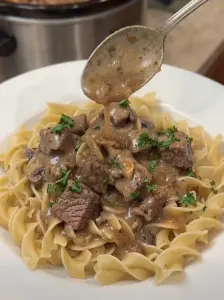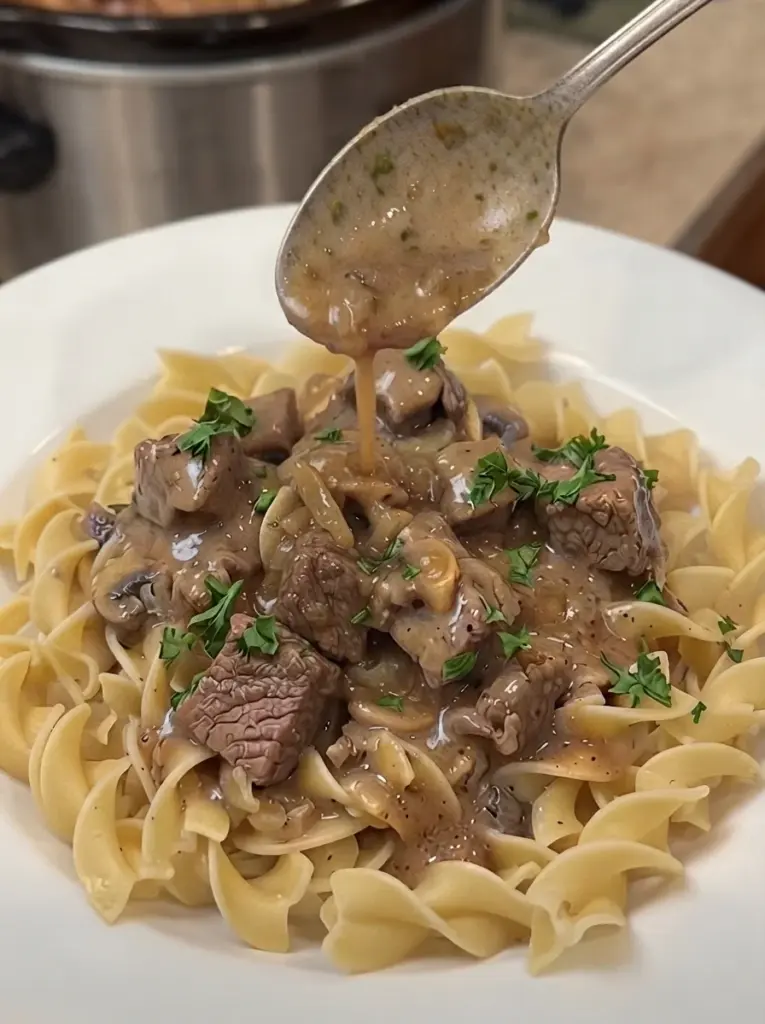
Tender pieces of beef in savory onion gravy make this slow cooker dinner especially welcome over mashed potatoes, rice, or egg noodles. Beef chuck cooks gently with broth, garlic, Worcestershire sauce, and thyme until the pieces yield easily to a fork. A cornstarch slurry thickens the cooking liquid near the end, creating a gravy that coats the beef and spoonfuls of your chosen side.
The preparation is straightforward: brown the beef in batches, soften the onion in the same skillet, and transfer everything to the slow cooker. After that, the main job is allowing enough time for the meat to become tender. The gravy finishes in the cooker or, for more control, in a saucepan on the stove.
This version uses broth and simple seasonings rather than condensed soup or a dry gravy packet. That gives you room to adjust the salt and thickness after the beef has finished cooking.
Recipe at a Glance
- Prep time: About 15 minutes
- Stovetop preparation: About 15–20 minutes
- Slow cooking: About 7–9 hours on LOW or 4–5 hours on HIGH
- Gravy finishing: About 15–25 minutes, depending on the cooker
- Total time on LOW: About 7¾–10 hours
- Servings: 6
- Equipment: 4–6-quart slow cooker, large skillet, tongs, and small bowl
This is a suggested recipe developed from the dish title and has not been kitchen-tested. Slow cookers and beef cuts vary, so judge the meat by tenderness and use the time ranges as a starting point.
Why You’ll Love This Recipe
- A comforting main dish: Rich beef and gravy work with several familiar sides.
- A cut suited to slow cooking: Chuck has connective tissue that softens during a long, moist cook.
- Simple gravy ingredients: Broth, onion, garlic, and a few seasonings build the sauce.
- Adjustable thickness: Add slurry gradually rather than committing to a very thick gravy at the start.
- Useful leftovers: Reheated portions make another easy meal.
- No last-minute meat preparation: Once tender, the beef only needs the gravy finished and seasoning checked.
What Are Beef Tips?
Beef tips is a broad recipe name rather than one precise cut. Packages labeled stew meat or beef tips can contain different muscles, which may not become tender at the same rate.
For this slow cooker version, boneless beef chuck is the intended choice. Cut it into even pieces so the batch cooks consistently. Lean sirloin tips and tenderloin pieces behave differently and should not automatically be given the same long cooking schedule.
The finished dish resembles a boneless beef stew without potatoes or carrots cooked in the pot. The emphasis is on tender meat and a smooth, savory gravy served over a separate side.
Ingredients
For the Beef
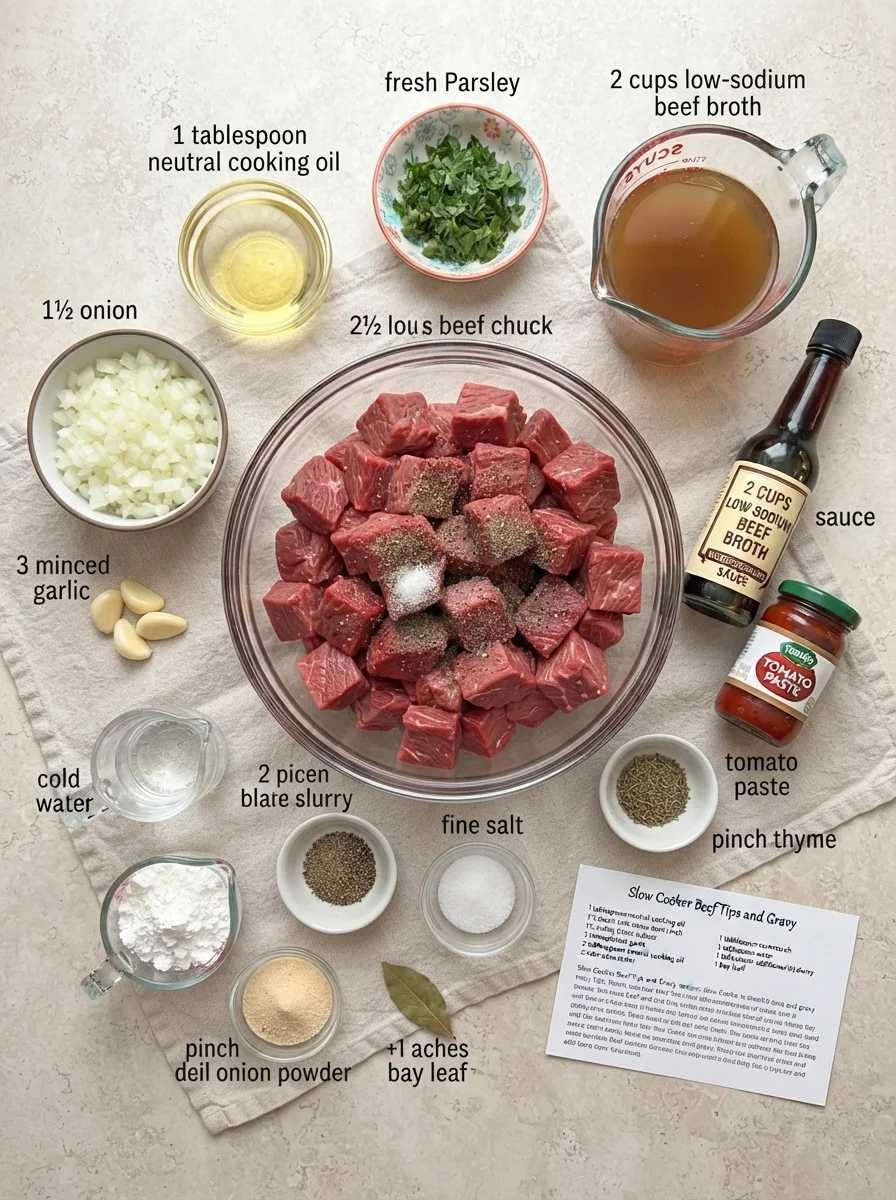
- 2½ pounds boneless beef chuck roast, trimmed of large hard fat deposits and cut into 1½-inch pieces
- 1 tablespoon neutral cooking oil, plus a little more if needed for browning
- 1 medium yellow onion, finely sliced or diced
- 3 garlic cloves, minced
- 2 cups low-sodium beef broth
- 1 tablespoon Worcestershire sauce
- 1 tablespoon tomato paste
- 1 teaspoon dried thyme
- ½ teaspoon onion powder
- ½ teaspoon black pepper
- ½ teaspoon fine salt, divided or adjusted to taste
- 1 bay leaf
For the Gravy
- 2 tablespoons cornstarch
- 2 tablespoons cold water
- Optional additional slurry: 1 tablespoon cornstarch mixed with 1 tablespoon cold water, only if needed
- Chopped fresh parsley, optional, for serving
Ingredient Notes
Beef chuck: Choose a piece with some marbling and connective tissue. Remove large, hard exterior fat pieces, but do not trim away every soft streak of fat. The long cooking time is intended for chuck, not every product sold as beef tips.
Broth: Low-sodium broth makes it easier to season after cooking. The slow cooker retains moisture, and the beef and onion release additional liquid, so do not add enough broth to submerge everything deeply.
Onion and garlic: Onion contributes body and sweetness to the gravy. Slice thinly or dice finely so it softens well. Garlic needs only a short sauté before adding liquid.
Worcestershire sauce: This adds savory depth. Brands differ in salt content and ingredients; check the label if you need to avoid fish or other allergens.
Tomato paste: A tablespoon adds depth without turning the gravy into a tomato sauce. Briefly cooking it in the skillet rounds out its flavor.
Thyme and bay: These provide an herbal background. Remove the bay leaf before thickening and serving.
Cornstarch: Mix with cold water before adding to hot liquid. Cornstarch added dry can clump. The final amount depends on how much liquid the ingredients release and how thick you like the gravy.
How to Make Slow Cooker Beef Tips and Gravy
1. Prepare and Season the Beef
Thaw the beef fully in the refrigerator if frozen. Cut into roughly even 1½-inch pieces and pat dry. Season with the pepper and about half the measured salt.
Drying the surface helps browning. Very wet beef tends to steam in the skillet before it develops much color.
2. Brown in Batches
Heat the oil in a large skillet over medium-high heat. Add enough beef to form a loose single layer, leaving some space between pieces.
Brown on a couple of sides, about 2–3 minutes per side as needed, then transfer to the slow cooker. Repeat with the remaining beef, adding a small amount of oil only if the pan becomes dry.
You are developing surface color, not fully cooking the center. Transfer the browned meat directly into the cooking process rather than partially cooking it to store for another day.
3. Cook the Aromatics
Reduce the skillet heat to medium. Add the onion and cook for about 4–5 minutes, stirring and loosening browned bits. If the pan is very dry, add a small splash of the measured broth.
Stir in the tomato paste and cook for about a minute. Add garlic and cook for another 30 seconds, keeping it from burning.
4. Deglaze and Transfer
Pour in some of the measured broth and scrape the skillet bottom with a wooden spoon or suitable spatula. Add the remaining broth, Worcestershire sauce, thyme, and onion powder. Stir until the tomato paste is dispersed.
Pour over the beef and add the bay leaf. The liquid does not need to cover every piece. Cover the slow cooker and begin cooking promptly.
5. Cook Until Fork-Tender
Cook on LOW for about 7–9 hours or HIGH for about 4–5 hours. Start checking near the earlier end of the range, then continue if the beef is still firm.
The pieces should yield easily when pressed with a fork. A safe minimum internal temperature alone does not indicate the tenderness needed for chuck; the connective tissue requires time to soften.
Keep the lid closed during most of the cooking. Repeated opening releases heat and can lengthen the process. If the meat is still chewy but the cooker is operating properly and the liquid is hot, it may simply need longer.
6. Check the Cooking Liquid
Remove the bay leaf. Skim visible excess fat from the surface if needed. Taste the liquid carefully and add the remaining salt only if necessary.
The amount of liquid varies. Avoid adding the full optional extra slurry automatically; begin with the base amount and assess the result.
7. Thicken the Gravy
Mix 2 tablespoons cornstarch with 2 tablespoons cold water until smooth. Turn the cooker to HIGH if it is not already there. Stir the slurry into the hot liquid, distributing it around the beef.
Cover and cook for about 15–25 minutes, or until the gravy thickens. Some cookers heat more slowly and may need longer. If it is still thin after heating thoroughly, add some or all of the optional additional slurry and cook again before reassessing.
If the cooker does not get hot enough to thicken efficiently, transfer the beef to a covered dish and pour the cooking liquid into a saucepan. Bring the liquid to a gentle simmer and stir in slurry gradually, cooking until thickened. Return the gravy to the beef.
8. Finish and Serve
Taste again after thickening. Add pepper or salt if needed, and loosen with a little warm broth if the gravy is too thick.
Spoon over mashed potatoes, cooked rice, or egg noodles. Sprinkle with parsley if using and serve hot.
Tips for Tender Beef and Balanced Gravy
Match the cut to the method. Chuck is a better fit for this long schedule than a very lean, quick-cooking cut.
Cut consistently. Small pieces can break apart before much larger pieces are tender. Keep them roughly the same size.
Brown without crowding. A little patience in the skillet gives more flavor than piling all the beef in at once.
Use tenderness as the finishing cue. Chuck can be cooked through but still chewy before the collagen has softened. Continue cooking and check again rather than assuming it has failed.
Season after cooking. Broth, Worcestershire sauce, and the beef itself contribute flavor. Final tasting helps prevent an overly salty gravy.
Thicken at the end. Starting with a thick starch-heavy sauce can make heat circulation and consistency harder to manage. Finish the liquid after the meat is tender.
Avoid stirring tender beef aggressively. Once it is soft, fold gently so the pieces stay recognizable rather than shredding into the gravy.
Troubleshooting
| Problem | Likely reason | Helpful adjustment |
|---|---|---|
| Beef is chewy | Chuck has not cooked long enough | Continue cooking and check tenderness again. |
| Beef is dry and stringy | Very lean cut or cooking beyond its best texture | Serve with gravy; choose chuck and check earlier next time. |
| Gravy is thin | Extra liquid released or insufficient heat for slurry | Heat thoroughly, add slurry gradually, or finish in a saucepan. |
| Gravy is too thick | Too much starch for the liquid volume | Stir in warm broth a little at a time. |
| Gravy has lumps | Cornstarch was not mixed with cold water | Smooth the sauce separately if practical; use a fully mixed slurry next time. |
| Sauce seems greasy | Excess rendered fat | Skim before thickening or remove hardened fat from chilled leftovers. |
| Flavor is too salty | Salty broth plus added seasoning | Dilute with unsalted broth, adjusting thickness afterward. |
| Beef falls apart during mixing | Meat is very tender and stirred strongly | Fold gently and thicken the sauce separately if needed. |
Variations
Mushroom Beef Tips
Sauté about 8 oz sliced mushrooms until their released liquid evaporates and they begin to brown. Add to the slow cooker with the onion mixture. Mushrooms may release more liquid during cooking, so assess the gravy before adding extra slurry.
Onion-Forward Gravy
Use a large onion rather than a medium one, slicing it thinly and cooking it until softened before adding. Expect slightly more sweetness and additional moisture.
Creamy Finish
After thickening, stir in a small splash of cream for a richer sauce. Heat gently without prolonged boiling. This changes the flavor, storage texture, and nutrition.
More Herbal Flavor
Add chopped fresh parsley at serving time or a small amount of fresh thyme in place of dried. Avoid combining large quantities of several strong herbs, which can overwhelm the beef.
No-Browning Shortcut
You can omit browning and place the thawed beef, onion, garlic, and other cooking ingredients directly in the cooker. Stir the tomato paste into the broth first. The flavor will be less deeply browned, and the total preparation time will be shorter. Keep the same focus on cooking until tender.
What to Serve with Beef Tips
Mashed potatoes are a natural choice because they hold the gravy well. Egg noodles and rice are equally useful when you want a separate base that cooks near serving time.
Add green beans, broccoli, roasted carrots, or a crisp salad for contrast. The beef and gravy are rich, so a simple vegetable side often needs only light seasoning.
Cook noodles or rice separately rather than adding them to the slow cooker under the same timing. They absorb liquid differently and can make the gravy starchy or uneven.
Make-Ahead Guidance
The finished dish is useful for next-day meals. Cook completely, portion into shallow containers, and refrigerate promptly rather than leaving a full slow cooker insert on the counter to cool for hours.
For preparation the night before, cut the beef and vegetables and refrigerate separately. Combine and begin cooking when ready. Do not partially brown meat and hold it overnight to finish later.
Follow your slow cooker’s instructions about refrigerator-cold inserts and temperature changes. Preparing components separately avoids assuming every ceramic insert is suitable for moving directly from refrigerator to heating base.
Storage and Reheating
Refrigerate leftovers in shallow airtight containers within 2 hours and use within 3–4 days. Store rice, noodles, or potatoes separately when practical so each can be reheated appropriately.
Freeze beef and gravy in freezer-safe portions for up to 3 months for best quality. Thaw overnight in the refrigerator. Cornstarch-thickened gravy can change consistency after freezing; stir gently during reheating and adjust with a little broth if needed.
Reheat on the stovetop over medium-low heat, stirring gently, until the center reaches 165°F. Add broth in small amounts if the gravy has become too firm. Individual portions can also be microwaved, stirring and rearranging for even heating.
Use the stovetop, microwave, or oven for reheating rather than relying on a slow cooker to warm cold leftovers gradually. Heat only the amount you plan to serve.
Frequently Asked Questions
Can I use stew meat?
Yes, but packages vary in the cuts included. Chuck identified on the label gives you a more predictable match for this cooking schedule. Mixed stew meat may contain pieces that soften at different rates.
Can I cook from frozen?
Thaw the beef in the refrigerator first. The recipe is written for thawed meat and should not be treated as a frozen-meat slow cooker method.
Do I need to cover the beef completely with broth?
No. The cooker retains moisture, and the ingredients release more liquid. The listed broth amount is intended for this quantity of beef in a suitable cooker.
Why is the gravy pale?
Color depends on browning, broth, and the tomato paste. Browning in batches and scraping the skillet add color and flavor. A darker color alone is not a measure of doneness or quality.
Can I add potatoes and carrots?
Those additions change the recipe’s volume, cooking behavior, and seasoning needs. For this beef-and-gravy version, cook sides separately. A vegetable-loaded stew needs its own proportions and cooker capacity check.
Can I use flour instead of cornstarch?
Flour needs a different quantity and method and is not a tablespoon-for-tablespoon substitute here. Use the cornstarch slurry as written for this version, or prepare a separate flour-based gravy using an appropriate method.
Is the recipe gluten-free?
Cornstarch itself does not establish that the whole dish is gluten-free. Check broth, Worcestershire sauce, seasonings, and all other ingredients, and serve with a suitable side if needed.
How many calories are in a serving?
Chuck fat content and trimming make a large difference. Calculate the beef, oil, broth, and other ingredients from the amounts and labels used, then divide by six. Mashed potatoes, noodles, rice, and creamy additions are separate. A fixed calorie estimate would be misleading without specifying the cut and trimming.
Recipe Card
Slow Cooker Beef Tips and Gravy
Chuck beef slow-cooked with onion, garlic, broth, and herbs, then finished with a savory cornstarch-thickened gravy.
Prep: 15 minutes | Stovetop: 15–20 minutes
Slow cook: 7–9 hours on LOW or 4–5 hours on HIGH
Gravy finishing: About 15–25 minutes
Servings: 6
Ingredients
- 2½ pounds boneless beef chuck, trimmed and cut into 1½-inch pieces
- 1 tablespoon neutral oil, plus a little more only if needed
- 1 medium yellow onion, finely sliced or diced
- 3 garlic cloves, minced
- 2 cups low-sodium beef broth
- 1 tablespoon Worcestershire sauce
- 1 tablespoon tomato paste
- 1 teaspoon dried thyme
- ½ teaspoon onion powder
- ½ teaspoon black pepper
- ½ teaspoon fine salt, divided and adjusted to taste
- 1 bay leaf
- 2 tablespoons cornstarch mixed with 2 tablespoons cold water
- Optional extra slurry: 1 tablespoon cornstarch mixed with 1 tablespoon cold water
- Chopped parsley, optional
Instructions
- Pat thawed beef dry and season with pepper and half the salt. Brown in batches in hot oil, then transfer to a 4–6-quart slow cooker.
- Cook onion in the skillet for 4–5 minutes. Stir in tomato paste for a minute, then garlic for 30 seconds.
- Add broth, scrape up browned bits, and stir in Worcestershire sauce, thyme, and onion powder. Pour over beef and add bay leaf.
- Cover and cook on LOW for 7–9 hours or HIGH for 4–5 hours, until fork-tender. Allow longer if needed.
- Remove bay leaf and skim excess fat. Turn to HIGH and stir in the base cornstarch slurry.
- Cover and cook for about 15–25 minutes, until thickened. Add optional additional slurry only if needed, allowing it to heat and thicken before reassessing. Finish gravy in a saucepan if necessary.
- Adjust seasoning, garnish if desired, and serve over separately prepared potatoes, rice, or noodles.
Notes
- This suggested formula has not been kitchen-tested.
- Cooking times vary. Use chuck and check for fork-tender texture.
- Thaw beef before slow cooking. Do not partially brown it to store for later cooking.
- Add slurry gradually and ensure the sauce heats sufficiently to thicken.
- Refrigerate leftovers promptly for 3–4 days or freeze for up to 3 months for best quality. Reheat to 165°F.
- Nutrition depends especially on beef fat content, trimming, and serving accompaniments. Calculate from the ingredients used.
Final Thoughts
Beef tips and gravy work best when the cut matches the slow cooking method and the sauce is finished after the meat becomes tender. Brown for flavor, keep the broth measured, and thicken gradually. Serve with a simple starch and vegetables for a comforting meal with useful leftovers.
Print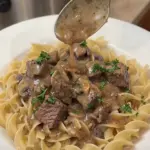
Slow Cooker Beef Tips and Gravy
Ingredients
- 2½ pounds boneless beef chuck, trimmed and cut into 1½-inch pieces
- 1 tablespoon neutral oil, plus a little more only if needed
- 1 medium yellow onion, finely sliced or diced
- 3 garlic cloves, minced
- 2 cups low-sodium beef broth
- 1 tablespoon Worcestershire sauce
- 1 tablespoon tomato paste
- 1 teaspoon dried thyme
- ½ teaspoon onion powder
- ½ teaspoon black pepper
- ½ teaspoon fine salt, divided and adjusted to taste
- 1 bay leaf
- 2 tablespoons cornstarch mixed with 2 tablespoons cold water
- Optional extra slurry: 1 tablespoon cornstarch mixed with 1 tablespoon cold water
- Chopped parsley, optional
Instructions
- Pat thawed beef dry and season with pepper and half the salt. Brown in batches in hot oil, then transfer to a 4–6-quart slow cooker.
- Cook onion in the skillet for 4–5 minutes. Stir in tomato paste for a minute, then garlic for 30 seconds.
- Add broth, scrape up browned bits, and stir in Worcestershire sauce, thyme, and onion powder. Pour over beef and add bay leaf.
- Cover and cook on LOW for 7–9 hours or HIGH for 4–5 hours, until fork-tender. Allow longer if needed.
- Remove bay leaf and skim excess fat. Turn to HIGH and stir in the base cornstarch slurry.
- Cover and cook for about 15–25 minutes, until thickened. Add optional additional slurry only if needed, allowing it to heat and thicken before reassessing. Finish gravy in a saucepan if necessary.
- Adjust seasoning, garnish if desired, and serve over separately prepared potatoes, rice, or noodles.