
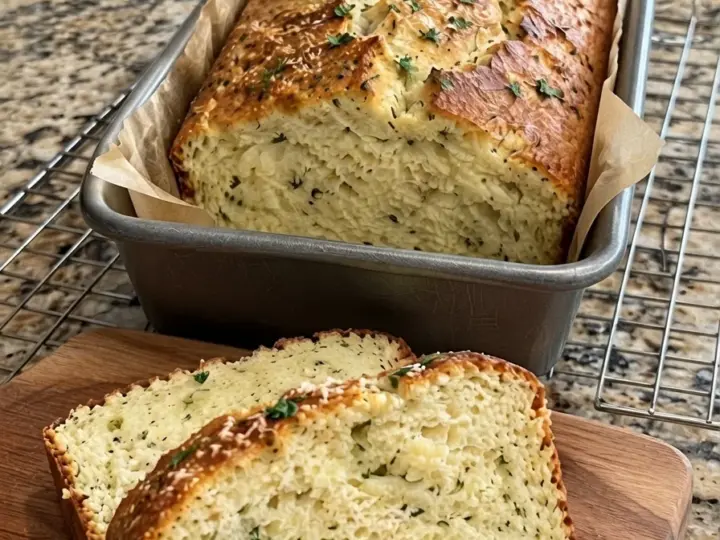
This High-Protein Keto Cottage Cheese Garlic Herb Bread is a savory, almond-flour loaf made with cottage cheese, eggs, Parmesan, garlic, and herbs. It bakes with a lightly golden crust and a moist, tender center that is especially good toasted or served alongside soup.
Blended cottage cheese adds richness without leaving noticeable curds, while eggs help give the loaf structure. Almond flour provides the main dry base, and a small amount of psyllium husk powder helps bind the mixture. Garlic, parsley, and Italian seasoning give each slice a warm, savory flavor.
This is a quick bread, so there is no yeast, kneading, or rising time. Blend the wet ingredients, stir them into the dry ingredients, and bake. The most important finishing step is allowing the loaf to cool completely before slicing.
Expect a compact, tender loaf rather than the airy texture of wheat sandwich bread. Its flavor and texture make it particularly well suited to toast, open-faced sandwiches, and cheesy garlic bread.
What Is Cottage Cheese Garlic Herb Bread?
Cottage cheese garlic herb bread is a savory quick bread that uses blended cottage cheese as part of its wet mixture.
In this version, finely ground almond flour replaces wheat flour. Eggs, Parmesan, and psyllium help support the loaf, while baking powder provides lift.
Because almond flour contains no gluten, the bread does not develop the stretchy structure of a traditional kneaded dough. The batter is thick and spreadable, and the baked loaf has a closer crumb.
The recipe uses ingredients commonly found in low-carbohydrate baking. Whether a particular serving fits your keto plan depends on the products you use, the slice size, and your daily carbohydrate target. Cottage cheese, almond flour, and seasonings all contribute some carbohydrates.
Why You’ll Love This Recipe
There is no yeast required. Baking powder gives the loaf its lift without proofing.
The preparation is straightforward. A blender handles the cottage cheese, and the remaining mixing happens in a bowl.
It has a savory flavor. Parmesan, garlic, and herbs work well with the mild dairy base.
It contains several protein-contributing ingredients. Cottage cheese, eggs, almond flour, and Parmesan all contribute to the finished loaf.
It is easy to portion. Once fully cooled, the bread can be sliced and refrigerated or frozen.
It makes flavorful toast. Toasting firms the crumb and brings out the garlic and herbs.
You do not need a stand mixer. A bowl, spatula, and small blender are enough.
Ingredient Breakdown
Cottage Cheese — 1 Cup, About 225 Grams
Use plain cottage cheese, preferably a thick variety rather than one with a large amount of loose liquid.
Full-fat cottage cheese produces a rich loaf, although lower-fat varieties can also work. Different brands contain different amounts of moisture, which can affect baking time.
If there is obvious liquid pooled on top, pour that off before measuring. Do not squeeze the cottage cheese dry.
Blend thoroughly so the curds become smooth.
Eggs — 4 Large
Eggs help bind the batter and give the loaf structure.
Use large eggs for consistent proportions. Smaller or larger eggs change the amount of liquid in the mixture.
Fine Blanched Almond Flour — 2 Cups, About 224 Grams
Use finely ground, blanched almond flour rather than coarse almond meal.
Fine flour gives a more even crumb, while almond meal produces a rougher texture and darker appearance.
Weighing is useful because almond flour can settle or pack differently in measuring cups.
Finely Grated Parmesan — ½ Cup, About 45 Grams
Parmesan adds savory flavor and helps give the loaf body.
Finely grated cheese distributes more evenly than long shreds. Use a Parmesan you enjoy, since its flavor remains noticeable after baking.
Psyllium Husk Powder — 1 Tablespoon, About 8 Grams
Psyllium absorbs moisture and helps the cooled slices hold together.
Use psyllium husk powder, not whole husks, for the listed quantity. Products vary in absorbency, so weighing is preferable.
Some brands can give baked goods a gray or purple tint. That can be a product-related color change rather than a sign that the bread is underbaked.
Baking Powder — 2 Teaspoons
Baking powder provides lift.
Check that it is fresh, and break up any clumps before mixing. Baking soda is not a direct substitute.
Olive Oil — 2 Tablespoons
Olive oil adds tenderness and complements the herbs.
A mild olive oil works well. Melted, cooled butter can be substituted in the same amount.
Garlic Powder — 1½ Teaspoons
Garlic powder distributes evenly without introducing extra moisture.
It also avoids the concentrated pockets of raw garlic that can occur when large minced pieces are added to bread batter.
Dried Italian Seasoning — 1 Teaspoon
Italian seasoning adds an easy mixture of herbs.
Choose a salt-free blend so you can control the seasoning separately.
Fresh Parsley — 2 Tablespoons, Finely Chopped
Parsley adds freshness and green flecks throughout the loaf.
Wash and dry it well before chopping.
Salt and Black Pepper
Use ¼ teaspoon fine salt and ¼ teaspoon black pepper.
Cottage cheese and Parmesan already contain salt, so the added amount is modest.
Equipment You’ll Need
- An 8½ × 4½-inch loaf pan
- Parchment paper
- A blender or food processor
- Two mixing bowls
- A whisk and flexible spatula
- Measuring tools or a kitchen scale
- A wire cooling rack
A light-colored metal pan gives a useful balance of browning and heat conduction. A larger pan produces a shorter loaf and may change the baking time.
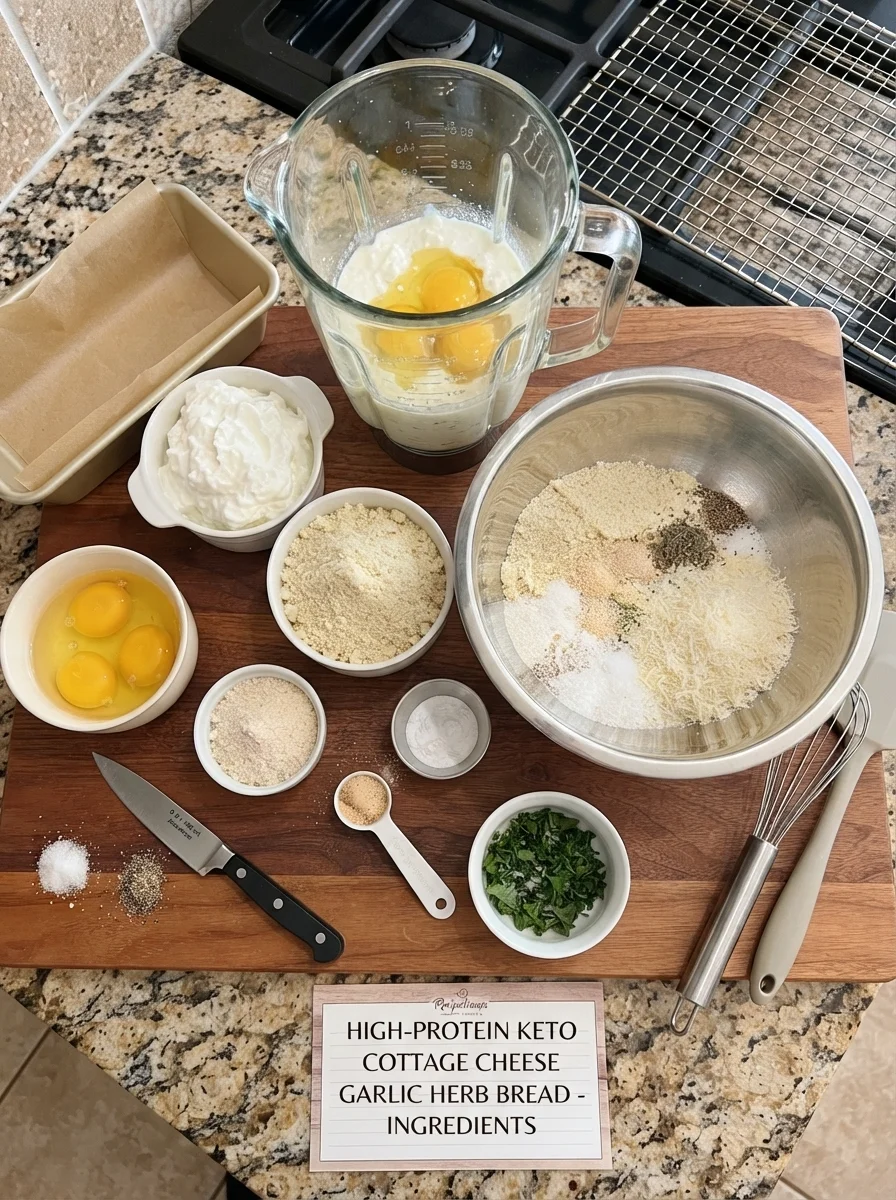
How to Make Cottage Cheese Garlic Herb Bread
Step 1: Prepare the Oven and Pan
Preheat the oven to 350°F (175°C).
Line the loaf pan with parchment, leaving an overhang along the long sides. Lightly grease any exposed areas.
The parchment makes it easier to lift out the delicate loaf after its initial cooling period.
Step 2: Blend the Wet Ingredients
Add the cottage cheese, eggs, and olive oil to a blender or food processor.
Blend until smooth, stopping to scrape down the sides as needed. The mixture should have no obvious cottage cheese curds.
Avoid blending longer than necessary.
Step 3: Mix the Dry Ingredients
In a large bowl, whisk together:
- Almond flour
- Psyllium husk powder
- Baking powder
- Garlic powder
- Italian seasoning
- Salt
- Black pepper
Break up any almond flour lumps so the absorbent ingredients distribute evenly.
Stir in the Parmesan.
Step 4: Combine
Pour the blended wet ingredients into the dry mixture.
Stir with a spatula until evenly combined, scraping the bottom of the bowl. Fold in the chopped parsley.
The mixture should resemble a thick batter rather than a kneadable dough.
Step 5: Let the Batter Hydrate
Let stand for 5 minutes.
The psyllium and almond flour will absorb moisture, and the batter should become thicker while remaining spreadable.
Do not add extra flour simply because it looks softer than traditional bread dough.
Step 6: Fill the Pan
Transfer the batter to the prepared loaf pan.
Spread it into the corners and smooth the top. Avoid leaving a high mound in the center, which can bake more slowly than the edges.
Step 7: Bake
Bake for approximately 50–65 minutes.
Begin checking near 50 minutes. The top should be golden, the center should feel set, and a skewer inserted into the middle should come out without wet batter. A few moist crumbs are fine.
If the top browns before the center is ready, loosely cover it with foil and continue baking.
Cottage cheese moisture and pan material can affect the timing.
Step 8: Cool Thoroughly
Let the bread rest in the pan for 15–20 minutes.
Lift it out using the parchment and place it on a wire rack. Carefully loosen the parchment from the sides to release steam.
Allow to cool completely, approximately 2 hours, before slicing. The crumb firms as it cools; cutting while hot can make it appear gummy.
Tips for the Best Texture
Measure the almond flour carefully. Too much can make the loaf dry and heavy.
Use the specified psyllium form. Powder and whole husks do not behave identically by volume.
Blend the cottage cheese until smooth. This gives the loaf a more consistent texture.
Allow the short batter rest. Hydration makes the mixture easier to spread and helps you avoid unnecessary adjustments.
Bake the center fully. A browned crust can hide a soft middle.
Cool before judging the crumb. Warm almond-flour bread is fragile and retains steam.
Slice with a serrated knife. Use a gentle sawing motion rather than pressing down.
Toast gently. A skillet or toaster oven supports the slices well and adds a pleasant crust.
Variations to Try
Cheddar Garlic Herb Bread
Fold ½ cup shredded sharp cheddar into the batter with the parsley.
The additional cheese creates a richer loaf and may slightly increase baking time.
Rosemary Parmesan Bread
Replace the Italian seasoning with 1 teaspoon finely chopped fresh rosemary.
Chop it very finely so the leaves do not create tough pieces.
Jalapeño Cheese Bread
Add 2 tablespoons finely chopped, well-drained pickled jalapeños and ¼ cup shredded cheddar.
Pat the jalapeños dry before mixing them in.
Sun-Dried Tomato Herb Bread
Add 2 tablespoons finely chopped sun-dried tomatoes.
If oil-packed, drain and blot thoroughly. This variation adds some carbohydrates, which should be included in any nutrition calculation.
Garlic Butter Toast
Toast a cooled slice, then brush lightly with melted butter mixed with a pinch of garlic powder.
Finish with chopped parsley.
Cheesy Open-Faced Toast
Top a slice with mozzarella and warm in a toaster oven until the cheese melts. Add a small amount of tomato sauce if desired.
What to Serve with Garlic Herb Bread
This savory loaf works best with simple accompaniments that complement its garlic and Parmesan flavor.
- Scrambled eggs: Serve a toasted slice alongside breakfast.
- Chicken soup: Use a thick slice for dipping.
- Green salad: Add bread and a protein of your choice for lunch.
- Roasted vegetables: Pair with zucchini, peppers, or mushrooms.
- Cream cheese: Spread thinly over cooled or toasted bread.
- Open-faced sandwiches: Add cooked chicken, turkey, or sliced cheese.
- Tomato soup: The garlic-herb flavor makes a natural pairing.
For sandwiches, toast the slices first and avoid very wet fillings. The bread is more delicate than conventional wheat sandwich bread.
Storage and Freezing
Refrigerator
Once completely cooled, place the bread in an airtight container and refrigerate for up to 4 days.
Separate slices with parchment if you want to remove them individually.
Freezer
Freeze cooled slices in a single layer until firm, then transfer to a freezer-safe bag.
Store for up to 2 months for best quality.
Reheating
Warm refrigerated slices in a skillet over medium-low heat or in a toaster oven.
Frozen slices can be thawed in the refrigerator or warmed gently from frozen. Avoid high heat that browns the outside before the middle warms.
Preventing Condensation
Do not wrap the loaf while warm. Trapped steam makes the crust damp and can leave the surface sticky.
Frequently Asked Questions
Does this taste like cottage cheese?
Blending removes the curds, while Parmesan, garlic, and herbs provide the dominant flavors. The cottage cheese contributes a mild dairy richness.
Is the texture like regular white bread?
It has a closer, more tender crumb. Without wheat gluten, it will not have the same stretch or airy structure as yeast bread.
Can I replace almond flour with coconut flour?
Not in the same quantity. Coconut flour absorbs substantially more liquid and would require a different recipe.
Can I omit the psyllium?
It helps bind the loaf and support clean slices. Leaving it out changes the structure, so the listed method is best followed with it included.
Why is the center gummy?
The loaf may need more baking time or more cooling time. Excessively wet cottage cheese and inaccurate dry measurements can also contribute.
Why did the loaf sink?
Possible causes include an underbaked center, excessive moisture, or inaccurate leavening measurements. A slight settling during cooling is normal.
Can I use fresh garlic?
Garlic powder gives the most even result. If you prefer fresh garlic, try one small, finely grated clove in place of the powder; the flavor will differ.
Can I use fat-free cottage cheese?
It may work, but moisture and texture vary by brand. Expect a potentially less rich result and check the center carefully during baking.
Can I bake it in a larger pan?
Yes, but the loaf will be shorter and may bake faster. Begin checking earlier rather than relying on the full baking time.
Is it suitable for a nut-free diet?
No. Almond flour is made from almonds. A nut-free version requires a separately developed flour blend.
Can I double the recipe?
Yes. Divide the batter between two loaf pans rather than making one extra-deep loaf. Check each loaf individually for doneness.
High-Protein Keto Cottage Cheese Garlic Herb Bread
Description
A savory almond-flour quick bread with blended cottage cheese, Parmesan, garlic, and herbs.
- Prep time: 15 minutes
- Batter rest: 5 minutes
- Bake time: 50–65 minutes
- Cooling time: Approximately 2 hours
- Total time: Approximately 3 hours 10 minutes to 3 hours 25 minutes
- Yield: 1 small loaf, approximately 12 slices
- Course: Bread or side dish
- Difficulty: Easy
Ingredients
Ingredients
- 1 cup plain cottage cheese, about 225 g
- 4 large eggs
- 2 tablespoons olive oil
- 2 cups fine blanched almond flour, about 224 g
- ½ cup finely grated Parmesan, about 45 g
- 1 tablespoon psyllium husk powder, about 8 g
- 2 teaspoons baking powder
- 1½ teaspoons garlic powder
- 1 teaspoon dried Italian seasoning
- 2 tablespoons finely chopped fresh parsley
- ¼ teaspoon fine salt
- ¼ teaspoon black pepper
Instructions
Instructions
- Preheat the oven to 350°F (175°C). Line an 8½ × 4½-inch loaf pan with parchment.
- Blend cottage cheese, eggs, and olive oil until smooth.
- Whisk almond flour, psyllium powder, baking powder, garlic powder, Italian seasoning, salt, and pepper in a bowl.
- Stir in Parmesan.
- Add the blended mixture and stir until combined. Fold in parsley.
- Rest for 5 minutes.
- Spread into the prepared pan and smooth the top.
- Bake for 50–65 minutes, until the center is set and a skewer comes out without wet batter. Tent with foil if needed.
- Cool in the pan for 15–20 minutes.
- Transfer to a rack and cool completely before slicing.
Nutrition Note
Nutrition varies with the cottage cheese, almond flour, Parmesan, and slice size. Calculate the full loaf using your product labels, then divide by the number of slices. Count the finished serving toward your own carbohydrate and protein goals.