
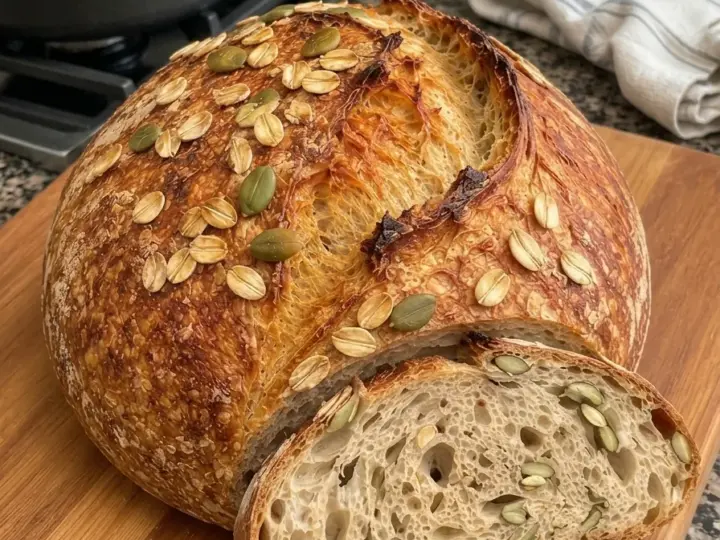
This Higher Protein + Fiber Sourdough Loaf has a deeply golden crust, a chewy center, and toasted pumpkin seeds in every slice. A mix of bread flour and whole wheat flour keeps the loaf light enough for sandwiches, while rolled oats and ground flaxseed add texture and fiber. A handful of oats and pumpkin seeds pressed onto the outside gives the loaf the rugged finish shown in the photo.
The dough gets its rise from an active sourdough starter. You’ll mix and fold it during the day, shape it in the evening, and let it proof overnight in the refrigerator. The next morning, score it straight from the fridge and bake it in a Dutch oven. One long slash gives the loaf room to open and creates that crisp, raised edge across the top.
Cut into 12 equal slices, the loaf provides an estimated 9 to 10 grams of protein and about 3 grams of fiber per slice. The estimate includes the oat-and-seed topping and will vary with your flour, starter, and slice size.
What Adds Protein and Fiber to This Sourdough?
Vital wheat gluten and pumpkin seeds contribute much of the extra protein. The gluten also gives the dough enough strength to hold the oats and seeds as it rises. Whole wheat flour, rolled oats, and ground flaxseed supply most of the added fiber and give the loaf a mild, nutty flavor.
The oats get a quick soak before they go into the dough. They soften while you mix the flour and starter, so they fold in easily and stay tender inside the baked loaf. Use dry oats for the topping so they toast against the crust.
Why You’ll Love This Recipe
The crumb stays chewy and open. Bread flour makes up most of the dough, so there’s room for air pockets around the pumpkin seeds even with whole wheat, oats, and flax in the mix.
The crust gets two kinds of crunch. The Dutch oven helps the scored loaf open early in the bake. Once the lid comes off, the crust browns and the oats and pepitas toast on the surface.
The overnight proof splits up the work. Mix, fold, and shape on the first day. The next day, the cold loaf goes from the refrigerator to the oven as soon as the pot is hot.
It makes good everyday toast. The nutty flavor goes well with jam and butter, and the slices are sturdy enough for eggs, avocado, or a sharp cheddar grilled cheese.
Ingredient Breakdown
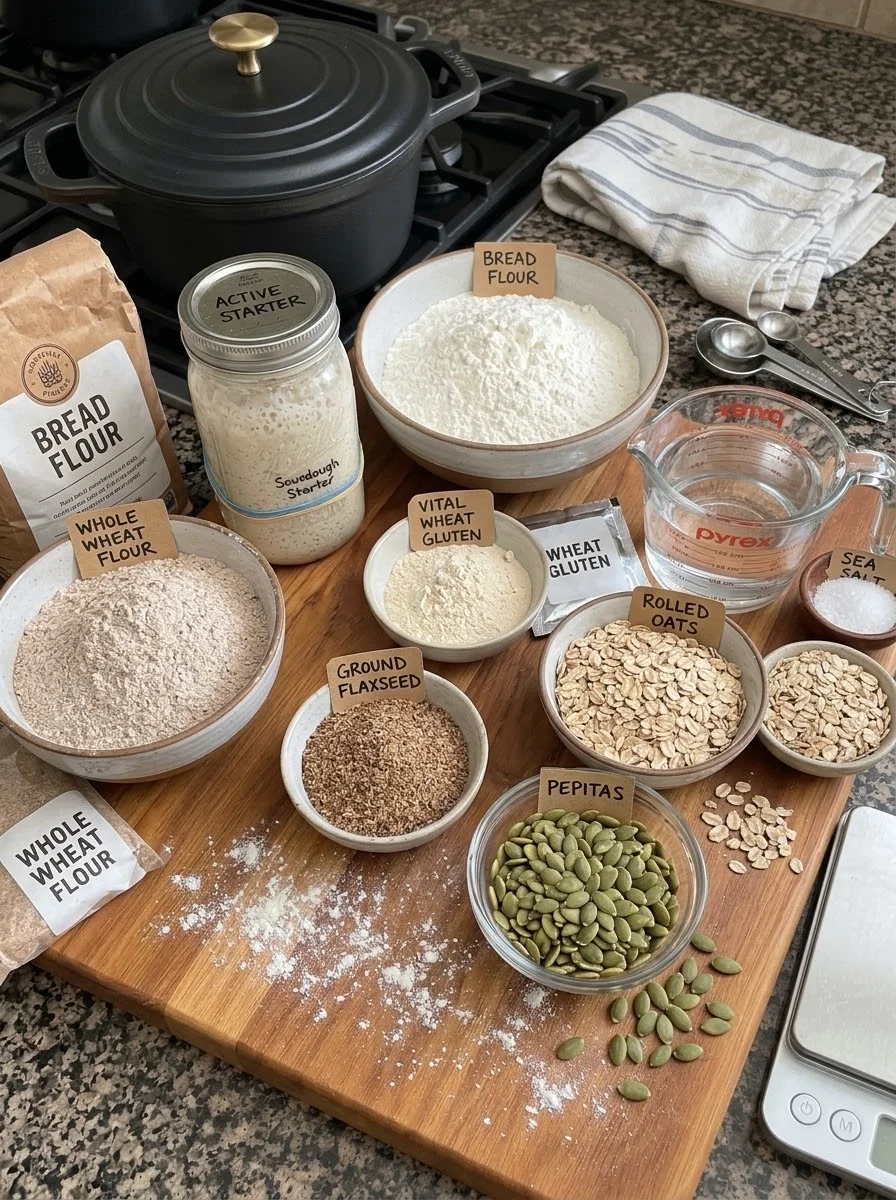
Active sourdough starter. Use 100 grams of starter fed with equal weights of flour and water. Use it when it’s bubbly and near its peak, ideally while the top is still slightly domed. A starter that has barely risen since feeding will take longer to raise the dough.
Bread flour and whole wheat flour. Use 340 grams of bread flour and 110 grams of whole wheat flour. The bread flour helps the loaf hold its shape, while the whole wheat adds a deeper wheat flavor. Weigh both flours if you can, since packed measuring cups can make the dough unexpectedly stiff.
Vital wheat gluten. Use 30 grams and whisk it thoroughly into the flour before adding water. Mixing it with the dry ingredients first prevents rubbery clumps. Vital wheat gluten is concentrated wheat protein.
Ground flaxseed. Use 20 grams of flaxseed meal. It mixes into the dough without leaving noticeable seeds in the crumb and absorbs some of the water as the dough rests.
Old-fashioned rolled oats. Soak 45 grams of oats for the dough and set aside another tablespoon or two, dry, for the crust. Rolled oats hold their shape better than quick oats in the topping.
Pepitas. Use 65 grams of unsalted, shelled pumpkin seeds in the dough. Save a tablespoon or two more for the outside. Raw pepitas work well because the ones on the surface toast during the uncovered bake.
Water and fine sea salt. Use 355 grams of room-temperature water for the dough and another 45 grams of warm water for the oat soak. Hold back a little of the dough water at first. Whole wheat flour and flax absorb water gradually, so you can decide how much to add after the first rest.
How to Make a Higher Protein + Fiber Sourdough Loaf
Step 1. Soak the oats. Stir 45 grams of rolled oats with 45 grams of warm water. Let them sit for about 20 minutes while you start the dough. Use the entire mixture, including any water the oats haven’t absorbed.
Step 2. Mix the dough. Whisk together the bread flour, whole wheat flour, vital wheat gluten, and ground flaxseed. In a large bowl, stir the active starter into 335 grams of room-temperature water. Add the flour mixture and mix until no dry patches remain. Cover and rest for 25 to 30 minutes.
Step 3. Add the salt and oat mixture. Sprinkle the salt over the dough and add 10 grams of the reserved water. Pinch and fold the dough to distribute the salt, then fold in the soaked oats. Add the final 10 grams of water if the dough feels stiff or pulls apart when you stretch it. It should feel tacky and supple by the end of this step.
Step 4. Fold in the pepitas and finish the first rise. After 30 minutes, scatter the pepitas over the dough. With a damp hand, lift one side and fold it over the center. Turn the bowl and repeat on all four sides. Give the dough two more sets of folds, 30 minutes apart. Then leave it covered until it’s visibly puffy, has bubbles along the sides, and has risen by roughly a third to a half. In a kitchen around 75°F, allow about 4 to 7 hours from when you first mixed the starter into the dough, including the rests and folds.
Step 5. Shape the loaf. Turn the dough onto a lightly floured counter. Fold the edges inward and flip it seam-side down. Gently draw it toward you to make a loose round, then let it rest for 15 to 20 minutes. Shape it into a tighter round or a short oval, keeping the smooth surface intact.
Step 6. Add the topping and refrigerate. Mix the dry topping oats and pepitas on a plate. Lightly mist the smooth side of the dough with water and press it gently into the topping. Place it topping-side down in a lightly floured proofing basket or towel-lined bowl, so the seam faces up. Cover and refrigerate for 8 to 16 hours.
Step 7. Score and bake. Preheat the oven to 450°F with a covered Dutch oven inside for about 45 minutes. Use a pot and lid rated for that temperature and approved for empty preheating. Turn the cold dough onto parchment rated for 450°F, so the seeded surface faces up. Make one long slash about ½ inch deep, slightly off center. Lower the loaf into the pot, cover, and bake for 25 minutes. Uncover and bake another 20 to 25 minutes, until the crust is deeply golden. Baking covered first helps the loaf expand before the crust sets.
Step 8. Cool before slicing. Transfer the loaf to a wire rack and cool for at least 2 hours. The oats and flax hold moisture, so give the crumb time to set before cutting into it.
Tips for a Tall Loaf and an Even Crumb
Watch the dough during the first rise. Kitchen temperature and starter strength matter more than the clock. A dough that feels heavy and shows few bubbles usually needs longer. A dough that looks puffy and jiggles softly when you move the bowl is ready to check for shaping.
Work the pepitas in during the first fold. Adding them before the dough is fully risen gives the next two folds time to distribute the seeds without squeezing air out of a mature dough.
Use just enough flour to shape. A light dusting keeps the dough from sticking, but the loaf needs a little grip on the counter to tighten its surface. If the dough slides without tightening, brush away some of the flour.
Score while the dough is cold. Cold dough is easier to cut cleanly. If a cluster of pepitas sits in the path of the blade, move a few aside so you can make one continuous slash.
Check the sides before pulling the loaf. The seeds can look toasted before the bread is done. Look for deep color around the sides and along the raised edge of the score.
Variations and Serving Ideas
Sunflower seed loaf. Replace half the pepitas with unsalted sunflower kernels. The smaller seeds distribute easily and give the crumb a slightly different crunch.
Sesame and pepita crust. Replace the topping oats with sesame seeds. Keep the soaked oats inside for a tender crumb.
Extra-crisp breakfast toast. Toast thick slices and top with salted butter and jam, or serve them with scrambled eggs and avocado.
Soup and sandwich night. Pair slices with tomato soup or use them for a cheddar grilled cheese. For a softer sandwich, slice the loaf thinly and leave the bread untoasted.
Storage and Freezing
Room temperature. Let the loaf cool completely before wrapping. Store it in a bread bag or airtight container for up to 2 days for the best texture. An airtight container will soften the crust a little.
Freeze in slices. Slice the cooled loaf and freeze it in a freezer-safe bag for up to 2 months for best quality. Slip parchment between slices if you want to take out one at a time.
Refresh the crust. Warm a thawed loaf in a 350°F oven for 8 to 10 minutes. Individual slices can go straight from the freezer to the toaster.
Frequently Asked Questions
Can I use sourdough discard? Feed it first and wait until it’s active and bubbly. The starter supplies all the leavening, so cold, unfed discard can make the dough slow to rise.
Can I make the loaf without vital wheat gluten? Yes. Replace it with 30 grams of bread flour and hold back the final 20 grams of dough water until you’ve checked the texture. The loaf will have less protein and may spread a little more during proofing.
Why is my loaf dense near the bottom? The dough may have needed more time during the first rise. Look for bubbles, visible expansion, and a lighter feel before shaping. Let the baked loaf cool fully, too. Slicing it warm can compress the moist crumb.
How do I keep the oats and pepitas from falling off? Lightly mist the dough before pressing it into the topping. Aim for a single layer with a little space between the seeds. Pieces sitting on top of one another tend to fall away when you slice the loaf.
Can I bake it straight from the refrigerator? Yes. Turn it out, score it, and put it into the preheated Dutch oven while it’s still cold. That keeps the dough firm enough to handle and makes the long slash easier to cut.
Higher Protein + Fiber Sourdough Loaf
Description
- Hands-on time — About 35 minutes
- First rise — About 4 to 7 hours, including the folds
- Cold proof — 8 to 16 hours
- Bake time — 45 to 50 minutes
- Cooling time — At least 2 hours
- Total time — About 16 to 27 hours, starting with an active starter
- Yield — 1 large loaf, about 12 slices
- Estimated nutrition — 9 to 10 grams of protein and about 3 grams of fiber per slice when divided into 12 equal portions
Ingredients
Ingredients
For the dough
- 100 grams active sourdough starter (about ½ cup)
- 340 grams bread flour (about 2¾ cups plus 1 tablespoon)
- 110 grams whole wheat flour (about ¾ cup plus 2½ tablespoons)
- 30 grams vital wheat gluten (about ¼ cup)
- 20 grams ground flaxseed (about 3 tablespoons)
- 355 grams room-temperature water (about 1½ cups), divided
- 10 grams fine sea salt (about 1¾ teaspoons)
- 65 grams raw, unsalted pepitas (about ½ cup)
For the oat soak and crust
- 45 grams old-fashioned rolled oats (about ½ cup plus 1 tablespoon)
- 45 grams warm water (3 tablespoons)
- 1 to 2 tablespoons dry rolled oats, for topping
- 1 to 2 tablespoons raw pepitas, for topping
- A little flour, for shaping and dusting the proofing basket
Instructions
Instructions
- Combine the 45 grams of oats and 45 grams of warm water. Soak for 20 minutes.
- Whisk together the bread flour, whole wheat flour, vital wheat gluten, and ground flaxseed. Stir the starter into 335 grams of the room-temperature water, add the flour mixture, and mix until no dry flour remains. Cover and rest for 25 to 30 minutes.
- Add the salt and 10 grams of the reserved water. Pinch and fold until combined, then fold in the soaked oats. Add the last 10 grams of water if the dough feels stiff.
- Rest for 30 minutes. Scatter the pepitas over the dough and fold all four sides toward the center. Repeat the folds twice more at 30-minute intervals. Continue the first rise until the dough is puffy and has expanded by roughly a third to a half, about 4 to 7 hours from initial mixing.
- Preshape the dough into a loose round. Rest for 15 to 20 minutes, then shape it into a round or short oval. Lightly mist the smooth side and press it into the dry oats and pepitas. Place it topping-side down in a floured proofing basket or towel-lined bowl. Cover and refrigerate for 8 to 16 hours.
- Preheat the oven and a covered Dutch oven approved for empty preheating to 450°F for about 45 minutes. Turn the cold dough onto parchment rated for 450°F, score it lengthwise, and lower it into the pot.
- Bake covered for 25 minutes, then uncovered for 20 to 25 minutes, until deeply golden. Cool on a wire rack for at least 2 hours before slicing.