
Introduction
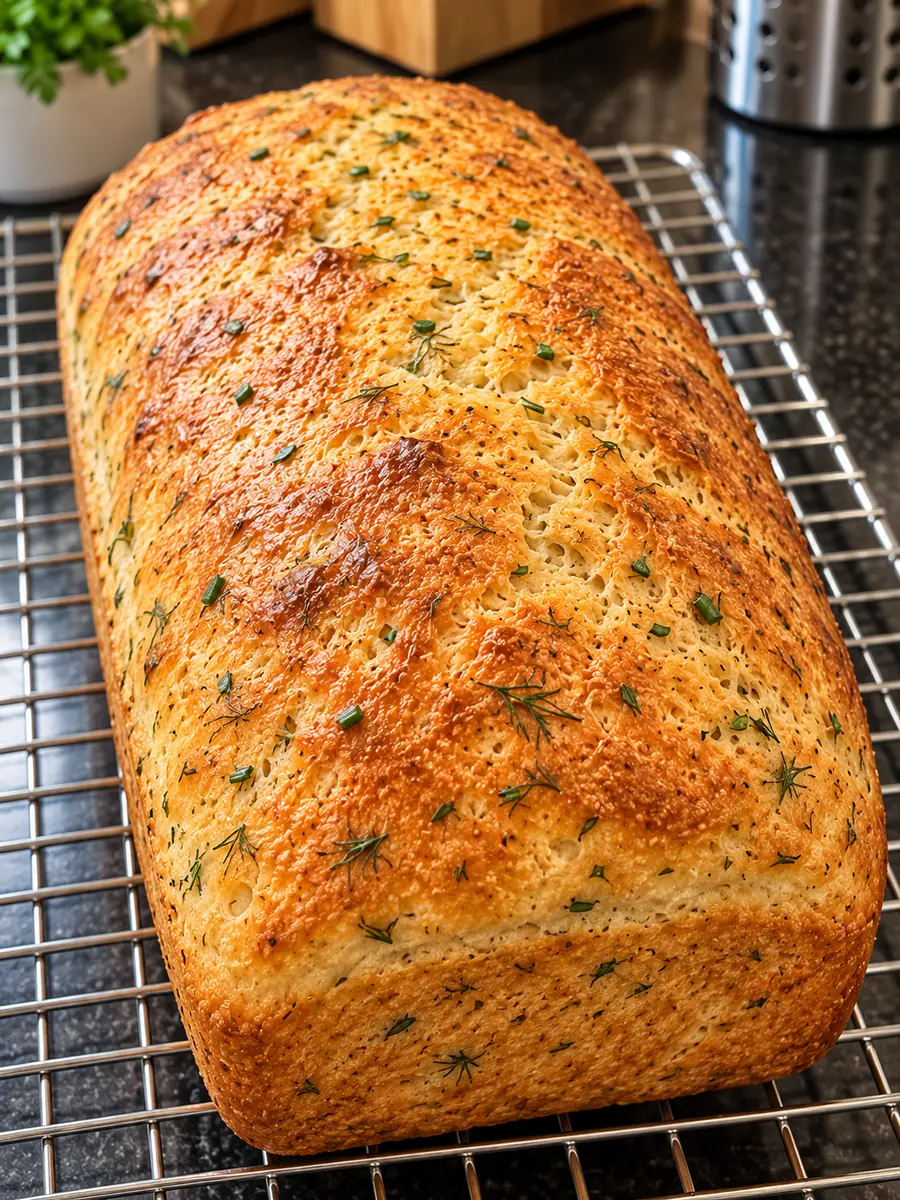
High-Protein Cottage Cheese Chive Dill Bagel Bread brings the familiar pairing of oniony chives and fragrant dill into a sliceable yeast loaf. Blended cottage cheese supplies most of the dough’s moisture, while bread flour gives the crumb enough strength for a satisfying chew. The herbs run through every slice, making the bread especially useful for savory breakfasts and open-faced lunches.
Expect a close, springy crumb and a browned crust rather than the glossy shell of a boiled bagel. This is a pan loaf with bagel-inspired character. Plan on about 5 hours 25 minutes from preparation through cooling, including 30 minutes of active work. That serial estimate allows for both rises, the short shaping rest and a full cooling period; room temperature and dough temperature can shift the proofing schedule.
Why You’ll Love This Recipe
Fresh chives contribute a gentle onion flavor without the moisture or larger pieces that chopped onions would introduce. Fresh dill supplies a separate, grassy aroma that stays recognizable alongside the dairy.
The loaf shape makes breakfast practical: slice the bread evenly, toast what you need and freeze the remaining servings in pairs for another morning.
Blending the cottage cheese distributes its moisture through the dough and reduces obvious curd pockets. You still get its mild dairy flavor without a chunky interior.
Bread flour and kneading provide the structure. The formula uses one egg white and no added butter, giving the crumb a leaner, more substantial character suited to savory toppings.
Ingredients
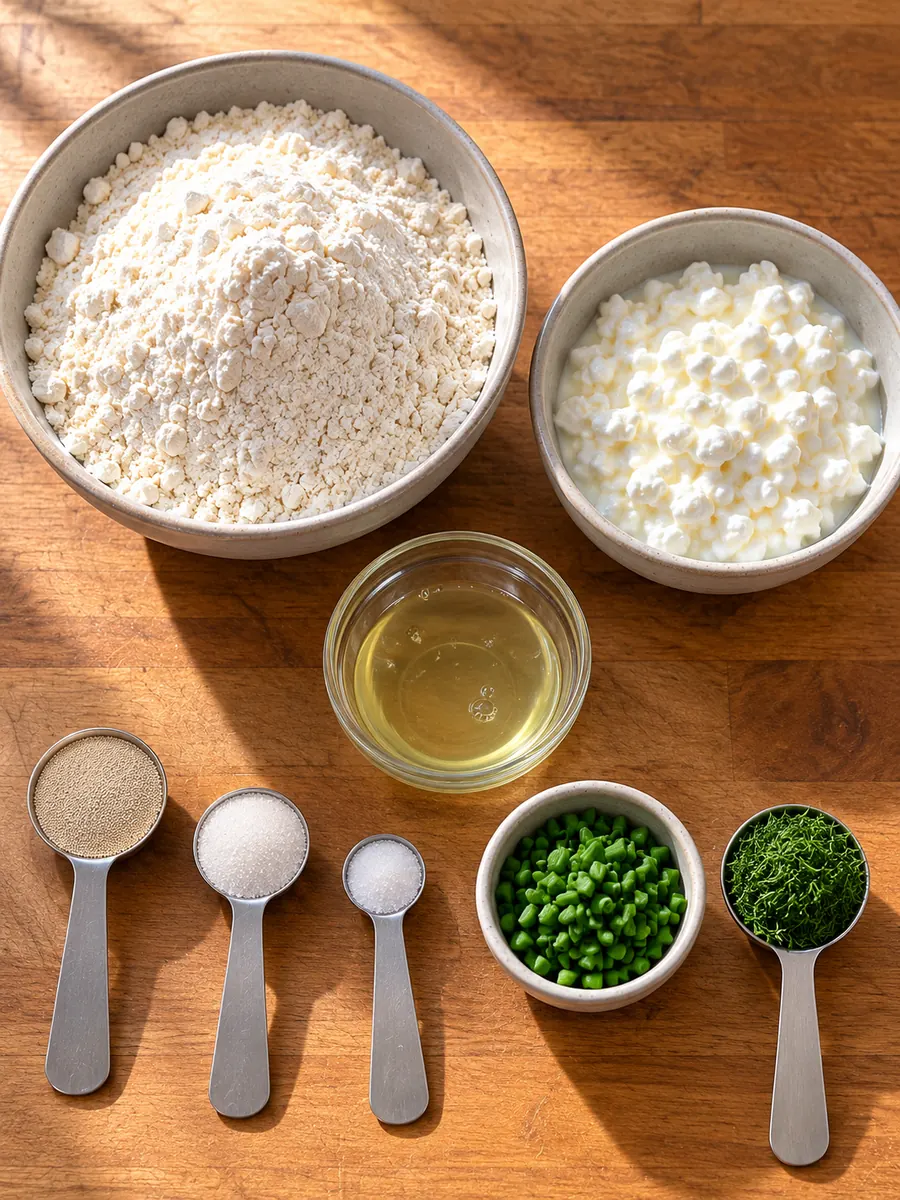
Weigh the flour and cottage cheese for consistent proportions. Cottage cheese volume varies with curd size; stir before measuring. Choose fresh, dry herbs and remove coarse dill stems. Everything below goes into the dough; parchment lines the pan without additional greasing fat.
- 3 1/3 cups bread flour (400 g), spooned and leveled
- About 1 1/4 cups plain, undrained 1% milkfat cottage cheese (280 g)
- 1 large egg white (33 g)
- 2 1/4 teaspoons instant yeast (7 g)
- 2 1/2 teaspoons granulated sugar (10 g)
- 2/3 teaspoon fine table salt (4 g)
- 1/4 cup finely snipped fresh chives (12 g)
- About 1/4 cup finely chopped fresh dill fronds (10 g)
Ingredient Notes and Substitutions
The formula specifies plain, undrained 1% milkfat cottage cheese. Stir the container before weighing so the portion includes both curds and liquid. Substituting 2% or 4% changes moisture, fat and protein; it requires reassessing dough consistency and the nutrition estimate rather than assuming identical results.
Bread flour supports the intended chew. All-purpose flour may produce a softer, less resilient loaf and can absorb moisture differently. Treat that substitution cautiously, and avoid adding flour simply because the dough initially sticks.
Use fresh chives and fresh dill here. Dried herbs have different concentration and texture, so a direct volume replacement would overwhelm the loaf. Instant yeast goes straight into the flour; active dry yeast needs package-specific handling.
Estimated 11.2 g protein per serving is a modeled subtotal excluding unmodeled dill, using the supplied reference values. One serving is two slices. Brands and moisture vary; there is no laboratory analysis, and human nutrition review is required. This estimate does not establish a verified regulatory high-protein claim.
How to Make High-Protein Cottage Cheese Chive Dill Bagel Bread
- Line a 9-by-5-inch loaf pan with parchment rated for 375°F, leaving lifting handles. Pat the fresh chives and fresh dill dry, then chop finely. Blend the cottage cheese and egg white until mostly smooth; a few tiny curds are fine. Wash hands and equipment after handling raw egg.
- Whisk the bread flour, instant yeast, granulated sugar and fine table salt in a large bowl. Add the blended dairy mixture and prepared herbs. Mix thoroughly, scraping the bottom, until no dry flour remains. Expect substantial, tacky dough that gathers into one mass rather than a pourable batter.
- Knead on a clean, unfloured counter for 10 minutes, using a bench scraper to gather sticking dough. It should become elastic and smoother, although herb flecks interrupt the surface. Return to the bowl and cover. Do not taste raw dough.
- Allow 90 minutes for bulk proofing in a comfortably warm place. Look for noticeably expanded, puffy dough approaching twice its starting volume. Cool dough may need additional proofing beyond this planning estimate; judge its expansion before proceeding.
- Rest the gently deflated dough for 10 minutes, covered. Pat into an 8-inch-wide rectangle, roll into a snug log and pinch the seam closed. Set seam down in the prepared pan. This bagel-inspired yeast loaf is baked directly without boiling.
- Allow 60 minutes for the final proof, covered loosely, until the dough crowns near the rim and a gentle indentation returns slowly. During this proof, preheat the oven to 375°F with a rack in the lower-middle position.
- Bake for 45 minutes at 375°F, checking near the end. The top should be deeply golden and the center should register 200°F on a thermometer. Tent with foil if browning quickly. Continue baking if necessary to reach the center temperature.
- Cool in the pan for 10 minutes, then lift out, remove parchment and cool on a wire rack for 80 minutes before slicing. Makes 8 servings. Cut 16 even slices; one serving is two slices.
Expert Baking Tips
Dry the herbs thoroughly after washing. Water clinging to the leaves becomes an uncontrolled addition, and wet clumps are harder to distribute evenly through a relatively substantial dough.
Blend the cottage cheese before judging consistency. Visible liquid around large curds does not tell you how the finished dough will handle once those curds are broken down and incorporated.
Use a bench scraper to lift and fold sticky dough from the counter. A slightly tacky surface is workable; repeated flour additions can make the cooled loaf heavy and dry.
Watch expansion as well as the clock during proofing. A clear bowl or a small piece of tape at the starting dough height makes changes easier to see without repeatedly uncovering it.
Shape with even tension across the log. A loose center can leave a spiral gap, while forceful stretching can tear the herb-speckled surface and create an uneven crown.
Insert the thermometer toward the center, avoiding the pan and any obvious surface crack. Dairy encourages browning, so crust color alone cannot establish that the middle has finished baking.
Common Mistakes to Avoid
Draining the cottage cheese removes moisture the formula depends on. Conversely, pouring extra loose whey into the measured portion changes the balance. Stir first, then weigh a representative portion of the undrained cheese.
Skipping gluten development leaves the dough poorly equipped to hold fermentation gases. Kneading should change its feel from rough and easily torn to more elastic; the herbs mean it will never look completely uniform.
Pushing the final rise until the dough looks dramatically inflated can weaken its support. Use the crown and slow-returning indentation together, and bake when the loaf is ready rather than waiting for a taller dome.
Slicing while warm compresses the moist crumb and can make the knife look gummy even when the loaf reached its baking temperature. Complete the cooling period before evaluating texture or cutting sandwich slices.
Variations and Serving Ideas
For a milder dill variation, replace 2 g of the dill with 2 g additional chives. This changes the herb balance without increasing the total plant material. Keep the remaining dough ingredients unchanged.
Toast two slices and serve with scrambled eggs, cucumber or smoked salmon. Cream cheese also suits the herbs, but the bread has enough flavor to accompany a simple bowl of tomato soup without a topping.
For small lunch sandwiches, slice the fully cooled loaf evenly and keep the filling restrained so the bread remains easy to bite. Any added cheese, seeds or glaze changes the base formula and its nutrition estimate.
Storage and Freezing
Let the loaf finish cooling before wrapping it; trapped steam softens the crust and leaves moisture inside the package. Once cool, refrigerate in a sealed container and use within 4 days. Refrigeration can firm the crumb, so toast slices to refresh their texture.
For longer storage, separate the 16 slices into pairs with small pieces of parchment between them. Pack in a freezer bag, press out excess air and freeze for up to 2 months for best quality. Label the bag with the date and serving size.
Toast frozen slices directly, or thaw a wrapped pair in the refrigerator. Discard bread with visible mold rather than trimming the affected area, and keep any perishable sandwich fillings refrigerated separately.
Frequently Asked Questions
Does this taste like a traditional bagel?
It has a savory flavor and a substantial chew, but the crust differs because the loaf is not boiled. Think of it as a sliceable bread inspired by bagels.
Why is there no added water?
Undrained cottage cheese and the egg white supply the principal dough moisture. Blending distributes that moisture; draining the cheese would change the formula.
Can I leave the cottage cheese chunky?
Blending is preferable here. Large curds can leave uneven moist patches and make it harder to judge whether the surrounding dough has mixed thoroughly.
Can I replace the egg white with a whole egg?
A whole large egg adds more weight, fat and moisture. It is not an equivalent substitution and would require a revised formula and nutrition calculation.
Why did my loaf split along one side?
Possible causes include insufficient final proofing or an unevenly tightened shape. Check dough readiness and keep the seam centered underneath the log.
How thick should I cut the servings?
Divide the cooled loaf into 16 reasonably even slices. One serving is two slices, giving 8 servings for the modeled protein subtotal.
WP Tasty Recipe Card
PrintHigh-Protein Cottage Cheese Chive Dill Bagel Bread
- Total Time: 325 minutes
Ingredients
3 1/3 cups bread flour (400 g), spooned and leveled
About 1 1/4 cups plain, undrained 1% milkfat cottage cheese (280 g)
1 large egg white (33 g)
2 1/4 teaspoons instant yeast (7 g)
2 1/2 teaspoons granulated sugar (10 g)
2/3 teaspoon fine table salt (4 g)
1/4 cup finely snipped fresh chives (12 g)
About 1/4 cup finely chopped fresh dill fronds (10 g)
Instructions
Line a 9-by-5-inch loaf pan with parchment rated for 375°F, leaving lifting handles. Pat the fresh chives and fresh dill dry, then chop finely. Blend the cottage cheese and egg white until mostly smooth; a few tiny curds are fine. Wash hands and equipment after handling raw egg.
Whisk the bread flour, instant yeast, granulated sugar and fine table salt in a large bowl. Add the blended dairy mixture and prepared herbs. Mix thoroughly, scraping the bottom, until no dry flour remains. Expect substantial, tacky dough that gathers into one mass rather than a pourable batter.
Knead on a clean, unfloured counter for 10 minutes, using a bench scraper to gather sticking dough. It should become elastic and smoother, although herb flecks interrupt the surface. Return to the bowl and cover. Do not taste raw dough.
Allow 90 minutes for bulk proofing in a comfortably warm place. Look for noticeably expanded, puffy dough approaching twice its starting volume. Cool dough may need additional proofing beyond this planning estimate; judge its expansion before proceeding.
Rest the gently deflated dough for 10 minutes, covered. Pat into an 8-inch-wide rectangle, roll into a snug log and pinch the seam closed. Set seam down in the prepared pan. This bagel-inspired yeast loaf is baked directly without boiling.
Allow 60 minutes for the final proof, covered loosely, until the dough crowns near the rim and a gentle indentation returns slowly. During this proof, preheat the oven to 375°F with a rack in the lower-middle position.
Bake for 45 minutes at 375°F, checking near the end. The top should be deeply golden and the center should register 200°F on a thermometer. Tent with foil if browning quickly. Continue baking if necessary to reach the center temperature.
Cool in the pan for 10 minutes, then lift out, remove parchment and cool on a wire rack for 80 minutes before slicing. Makes 8 servings. Cut 16 even slices; one serving is two slices.
- Prep Time: 30 minutes
- Cook Time: 45 minutes