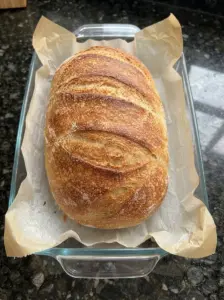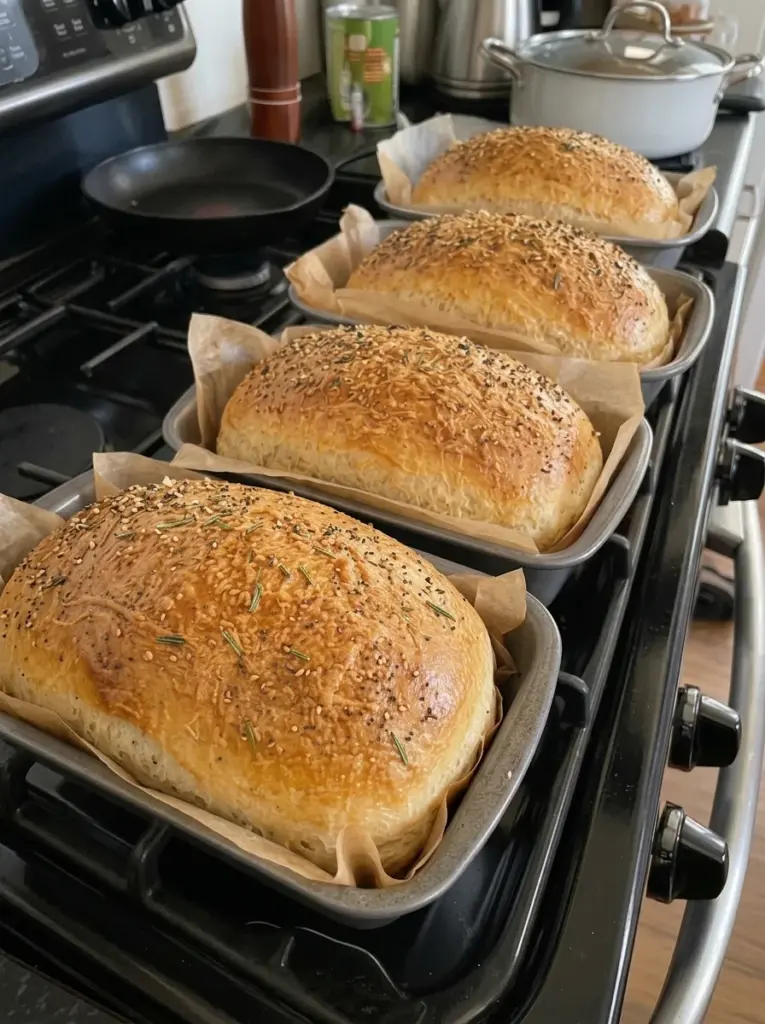
Fresh rosemary, savory garlic, and a golden crust give this cottage cheese loaf a comforting aroma. The batter comes together without yeast, kneading, or boiling, making it a straightforward option for breakfast toast, soup sides, and small sandwiches.
Blended cottage cheese and eggs form the moist base. Flour and baking powder give the loaf structure and lift, while olive oil adds tenderness. A light rosemary-garlic topping finishes the surface, with optional Parmesan or seeds for extra flavor.
Despite the name, this is a savory quick bread rather than a traditional bagel. Expect a tender, fairly close crumb instead of the dense chew and glossy crust produced by boiled yeast dough. Toasting creates crisp edges and makes the bagel-inspired flavors especially noticeable.
The method below expands the supplied recipe and has not been independently kitchen-tested. Cottage cheese moisture, flour measurement, and pan material can affect baking time and texture. Use the center’s doneness rather than the clock alone.
What to Expect
The finished loaf should slice neatly after cooling, with a moist but cooked center and a lightly browned exterior. Small rosemary flecks and garlic seasoning should be distributed throughout rather than concentrated in individual bites.
This is a small loaf, intended for approximately eight slices. An 8 × 4-inch pan helps give the batter useful height. A larger pan spreads the mixture more thinly and produces a lower loaf.
Cottage cheese and eggs contribute protein, but the bread still contains wheat flour and carbohydrates. The protein per slice depends on the dairy label, optional Parmesan, and slice count rather than the title alone.
Recipe Overview
| Detail | Guide |
|---|---|
| Yield | 1 small loaf, about 8 slices |
| Pan | 8 × 4-inch loaf pan |
| Preparation | Approximately 10–15 minutes |
| Baking | Approximately 35–45 minutes, allowing longer if needed |
| Cooling | About 45–60 minutes or until fully cool for tidy slices |
| Total | Approximately 1½–2 hours, including cooling |
| Oven | 350°F |
| Texture | Tender savory quick bread with a close crumb |
The original cooling estimate may be enough for warm serving, but full cooling is preferable if you want clean sandwich slices. A hot moist loaf can compress under the knife.
Ingredients
Bread
- 1 cup plain cottage cheese
- 2 large eggs
- 1 tablespoon olive oil
- 1½ cups all-purpose flour, spooned and leveled
- 2 teaspoons baking powder
- 1 teaspoon garlic powder
- ½ teaspoon onion powder
- 1 tablespoon finely chopped fresh rosemary
- ½ teaspoon dried Italian seasoning
- ½ teaspoon salt, or slightly less with salty toppings
- ¼ teaspoon black pepper
- 2 tablespoons finely grated Parmesan, optional
Topping
- 1 teaspoon olive oil or melted butter
- 1 teaspoon finely chopped fresh rosemary
- ½ teaspoon garlic powder
- 1 tablespoon grated Parmesan, optional
- 1 teaspoon sesame seeds or everything bagel seasoning, optional
Optional cheese and seeds are additions rather than requirements. Everything bagel seasoning may contain salt, so consider its label when seasoning the loaf.
Ingredient Notes
Cottage cheese
Choose plain cottage cheese with a creamy, reasonably thick consistency. Either small or large curds can work because they are blended before mixing with flour.
Stir the container before measuring. If there is an unusual amount of loose liquid, avoid pouring it all into the cup with the curds. At the same time, do not aggressively strain an ordinary product into a dry cheese; that changes the intended moisture balance.
Full-fat cottage cheese provides a richer result, while lower-fat versions can vary in thickness and formulation. The actual consistency matters more than assuming every product behaves identically.
Eggs and oil
Two large eggs help bind and set the batter. Olive oil contributes tenderness without making the loaf heavily enriched.
The suggested formula has not been developed with an egg substitute. Removing eggs or replacing them with flax mixtures can change rise, moisture, and slicing strength.
Flour
Use ordinary all-purpose flour. Stir it lightly in its container, spoon into the measuring cup, and level without pressing down.
Packed flour can make the batter stiff and the finished bread dry. Conversely, adding extra liquid simply because the batter is thicker than cake batter can produce a wet center. A thick, sticky batter is expected.
Self-rising flour is not a direct replacement because it includes salt and chemical leavener. Whole-wheat flour also changes absorption and texture, so avoid a full substitution without adapting the recipe.
Baking powder
Baking powder supplies lift without a rising period. Use a fresh product and measure level teaspoons.
Baking soda is not interchangeable in the same amount. The recipe is written around baking powder rather than an adjusted soda-and-acid formula.
Rosemary
Finely chop fresh rosemary so the needles do not remain long and woody. Measure after chopping for a more even distribution.
For the dough, approximately 1 teaspoon dried rosemary can replace the tablespoon of fresh as a starting guide. Crush it finely and expect a different texture and strength. For the topping, use only a small pinch of dried rosemary instead of the full teaspoon of fresh.
Garlic powder
Garlic powder seasons evenly without adding wet pieces to the batter. It is different from garlic salt; substituting garlic salt without reducing other salt can over-season the loaf.
The topping contains additional powder, so the garlic character will be noticeable. If you prefer a milder loaf, reduce the topping amount rather than adding more oil to dilute it.
Parmesan and seeds
Finely grated Parmesan adds savory depth, but it also adds sodium and calories. It is optional in both dough and topping.
Sesame seeds provide a simple finish. Everything bagel seasoning adds several flavors and may be quite salty, so use a light scattering.
Equipment
Use a blender or food processor, a large bowl, whisk, flexible spatula, an 8 × 4-inch loaf pan, parchment paper, and a cooling rack.
A small metal pan is a practical starting point. Glass, ceramic, and dark nonstick pans can affect the rate of browning, so watch the surface and center rather than assuming an exact finish time.
Line the pan with parchment handles along the long sides. Lightly grease exposed ends to help the loaf release without tearing.
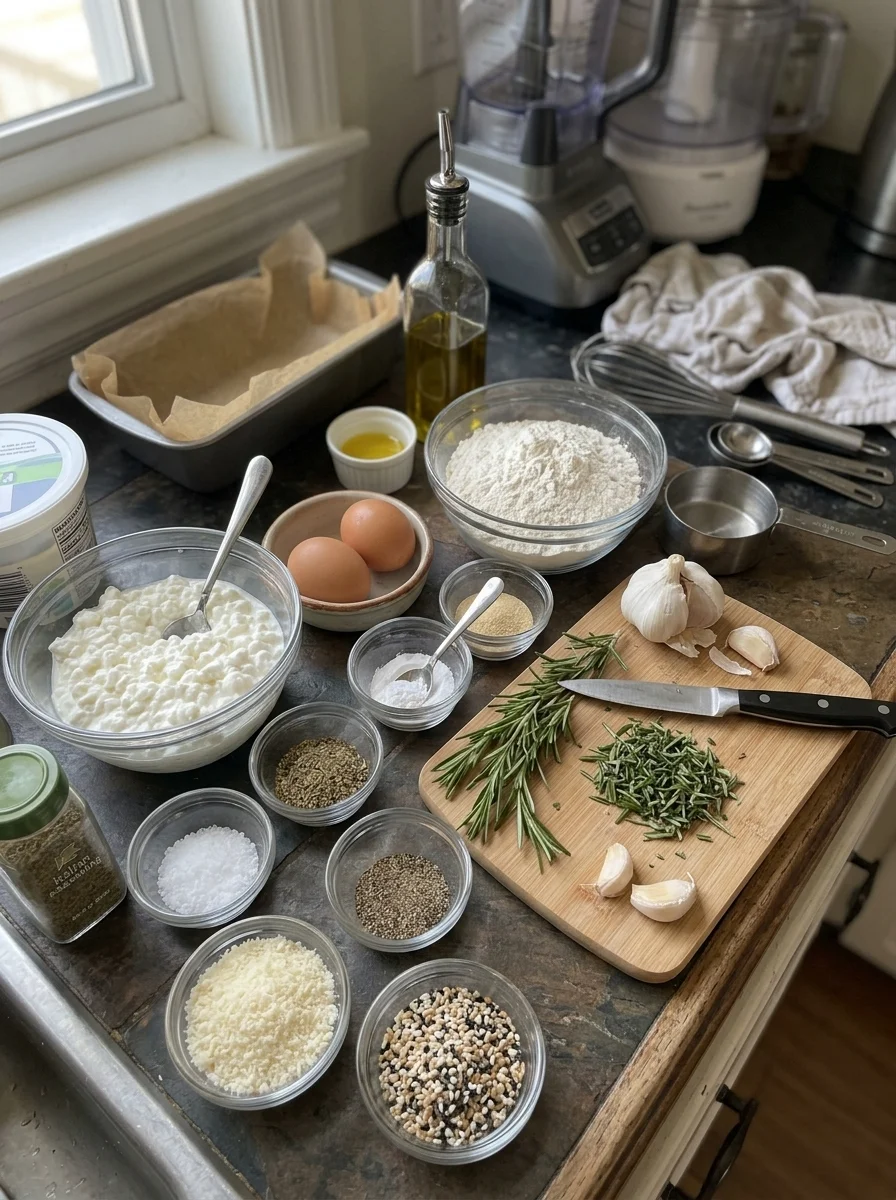
How to Make Rosemary Garlic Cottage Cheese Bread
1. Prepare the oven and pan
Heat the oven to 350°F. Grease and parchment-line the loaf pan.
Have the oven ready before finishing the batter. Once baking powder is moistened, the batter should be baked promptly rather than left waiting through a long preheat.
2. Blend the wet ingredients
Blend cottage cheese and eggs until smooth, stopping to scrape the sides as needed. Add the tablespoon of olive oil and blend briefly or stir it in.
This step removes curds and helps distribute moisture evenly. There is no need to blend so long that the mixture becomes warm.
Do not taste the raw egg mixture. Check smoothness visually before adding it to flour.
3. Whisk the dry mixture
In the large bowl, combine flour, baking powder, garlic powder, onion powder, chopped rosemary, Italian seasoning, salt, pepper, and optional Parmesan.
Whisk thoroughly so the leavener and herbs do not remain in concentrated pockets. Break apart visible lumps of baking powder or cheese.
4. Combine gently
Pour the blended mixture into the dry ingredients. Fold with a spatula, scraping the bottom, until no dry flour remains.
Stop once combined. The batter should be thick and slightly sticky, not smooth and elastic like kneaded bread dough. Avoid beating repeatedly in an attempt to remove every small irregularity.
Do not add extra flour simply to make it handle like bagel dough. This recipe is transferred to a pan as batter, not shaped into rings.
5. Fill the pan
Scrape the batter into the prepared pan. Spread evenly, including into the corners, and smooth the surface lightly.
Mix the topping oil or butter with rosemary and garlic powder. Drizzle or brush gently across the top without pressing down heavily. Scatter optional Parmesan or seeds over the surface.
Because only a teaspoon of topping fat is used, the mixture may be more of a small herb paste than a freely flowing sauce. Dot and spread lightly rather than adding several extra spoonfuls of oil automatically.
6. Bake until the center is done
Bake approximately 35–45 minutes, checking around 35 minutes. Some pans and wetter cottage cheese products may require longer.
The top should be golden and the center set. A skewer inserted into the middle should emerge without wet batter; a few moist crumbs are acceptable.
Check more than a shallow area beneath the crust. The center can remain underdone after the topping has browned. If needed, tent loosely with foil and continue baking in short intervals.
The loaf should not have a liquid wobble or a wet paste line. Avoid relying only on a dark cheese topping to judge completion.
7. Cool on a rack
Let stand in the pan for about 10 minutes. Lift out with parchment and place on a rack, peeling the paper away from the sides so steam escapes.
Cool fully for tidy slicing, often approximately 45–60 minutes or longer depending on the room. If cutting while slightly warm, expect a softer and more delicate interior.
8. Slice and serve
Use a serrated knife with gentle sawing movements. Avoid pressing straight down through the loaf.
Toast slices lightly for a firmer surface and fragrant rosemary-garlic aroma. If a slice is delicate, use a skillet or toaster oven where it remains supported.
Tips for a Tender Loaf
Measure flour lightly
Too much flour changes both the batter and the finished crumb. Spoon and level rather than packing the cup.
Blend before adding flour
The dairy can be processed thoroughly, while the flour benefits from gentler handling. Keeping these stages separate avoids unnecessary mixing of the batter.
Chop herbs finely
Small rosemary pieces spread more evenly and are more pleasant to bite through than long needles.
Let the center finish
Browned edges and toppings are useful cues but do not prove the middle is baked. Check for wet batter and allow more time if necessary.
Cool before judging
A warm quick bread is softer and more fragile. Its final slicing texture is clearer after cooling.
Troubleshooting
| Problem | Possible cause | Adjustment |
|---|---|---|
| Center is gummy | Underbaking, extra moisture, or slicing hot | Bake until set and cool completely |
| Bread is dry | Packed flour or excessive baking | Measure lightly and check promptly |
| Loaf is dense | Overmixing, old leavener, or expected quick-bread crumb | Mix gently, use fresh baking powder, and expect modest rise |
| Top browns early | Cheese, herbs, or pan characteristics | Cover loosely with foil and finish the center |
| Rosemary feels woody | Pieces too large | Chop finely and remove tough stems |
| Flavor is salty | Cottage cheese, Parmesan, seasoning, and salt accumulate | Use less added salt with salty optional toppings |
| Slices crumble | Loaf still warm or rough cutting | Cool fully and use a serrated knife |
| Topping is patchy | Small quantity of oil creates a paste | Dot evenly and spread gently rather than flooding the top |
A compact crumb does not necessarily mean failure. This is chemically leavened quick bread, not a boiled yeast bagel or a fluffy milk loaf.
Variations
Mild garlic finish
Use only a pinch of garlic powder in the topping while keeping the dough seasoning. This gives rosemary more room in the flavor.
Parmesan herb loaf
Include the optional Parmesan in the dough and on top. Adjust salt thoughtfully and watch surface browning.
Sesame crust
Use plain sesame seeds instead of everything bagel seasoning when you want a simpler topping with less added salt.
Dried rosemary adaptation
Use about 1 teaspoon finely crushed dried rosemary in the dough and a small pinch on top. Do not replace fresh rosemary tablespoon for tablespoon.
Garlic butter toast
Toast a cooled slice and brush with a small amount of freshly prepared garlic butter immediately before eating. This is an optional serving addition with separate calories.
For the first batch, avoid adding large quantities of grated vegetables or extra cheese. Wet additions change moisture, while heavy additions can reduce the loaf’s ability to rise and slice.
Serving Ideas
For breakfast, pair a toasted slice with scrambled eggs, cottage cheese, or avocado. The savory herbs complement a simple egg dish without requiring a complicated filling.
For lunch, use thin slices for small sandwiches, keeping fillings modest. Toasting helps when adding moist vegetables, but it does not make the bread resistant to prolonged soaking.
Serve alongside tomato soup, a vegetable stew, or a crisp salad. A light spread of butter or cream cheese is enough if the rest of the meal already contains rich ingredients.
Day-old slices can be cut into cubes and toasted gently for a salad topping. Watch the herbs and Parmesan because small pieces brown quickly.
Make-Ahead Plan
Bake ahead, cool completely, then slice for storage. Portioning before freezing lets you remove only what you need.
You can measure the dry ingredients ahead, but keep chopped fresh herbs appropriately refrigerated and add them during preparation. Blend and mix the batter when the oven and pan are ready.
Do not hold the finished raw egg batter at room temperature while waiting for a later meal. Baking promptly also makes the leavening stage more predictable.
Storage and Reheating
Refrigerator
For this moist cottage cheese quick bread, use conservative refrigerated storage. Cool on a rack and refrigerate within 2 hours of baking, keeping at 40°F or below. Use within 4 days.
The recommendation is specific to this moist formula; the presence of eggs or dairy alone does not mean every fully baked bread requires identical storage.
Let heavy steam escape before sealing, while avoiding a prolonged counter hold. Store in a clean airtight container and separate slices with parchment if they stick.
Freezer
Freeze cooled slices in a freezer-safe bag or container for up to 2 months for best quality. Separate with parchment and remove excess air where practical.
Thaw in the refrigerator or warm gently from frozen on a supported surface. A little toasting helps refresh the edges.
Reheating
Toast until warm and lightly crisp, or warm in a skillet over moderate-low heat. A toaster oven is useful for fragile slices.
For a softer texture, microwave briefly in short intervals. Long heating can make bread tough as it cools.
Store assembled sandwiches according to their fillings. Plain loaf storage guidance does not replace the needs of chicken, spreads, or other perishable toppings.
Nutrition Notes
The supplied 9–10 grams protein per slice may be optimistic for some brands when the loaf is divided into eight. Cottage cheese, two eggs, flour, and optional Parmesan together may give roughly 55–70 grams protein for the full loaf, or approximately 7–9 grams per slice.
A broad calorie estimate is approximately 145–185 per slice, depending on cottage cheese fat level, Parmesan, topping choice, and actual slice count. Use your labels and include all additions for a closer calculation.
This bread contains wheat flour and is not low-carb or gluten-free as written. Protein comes from both dairy and eggs, as well as a smaller contribution from flour.
The optional everything bagel seasoning may contain sesame and other allergens. Check labels when serving anyone with dietary restrictions.
Frequently Asked Questions
Is this a real bagel?
It is bagel-inspired in flavor, but the method and texture are those of a savory quick bread. There is no yeast development or boiling stage.
Do I need to drain the cottage cheese?
Ordinary thick cottage cheese generally needs only stirring before measuring. Avoid adding an unusual puddle of loose liquid, but do not strain it into a dry cheese without expecting a change in texture.
Can I use dried rosemary?
About 1 teaspoon finely crushed dried rosemary is a starting substitute for the tablespoon fresh in the dough. Use much less for the topping.
Can I omit Parmesan?
Yes. It is optional in both places. The loaf still contains dairy because of the cottage cheese.
Can I use a 9 × 5-inch pan?
It produces a lower loaf and may bake sooner. Check earlier and judge the center rather than using the same time automatically.
Can I make individual rolls?
That requires a different shaping and baking plan. This thick batter is written for a loaf pan and may spread differently on a tray.
Why is the center soft when hot?
Moist quick breads continue setting during cooling. Bake fully, then allow time before slicing. Cooling cannot correct raw batter in an underbaked loaf.
Can I replace all-purpose flour with almond flour?
Not directly. Almond flour lacks the same structure and absorbs moisture differently. A suitable gluten-free version needs separate formulation.
Recipe Card
High-Protein Cottage Cheese Rosemary Garlic Bagel Bread
A savory quick loaf with blended cottage cheese, eggs, rosemary, and garlic. Bagel-inspired flavor with a tender, close crumb.
Yield: 1 small loaf, approximately 8 slices
Prep: 10–15 minutes
Bake: 35–45 minutes, allowing longer if needed
Cool: Approximately 45–60 minutes or until fully cool
Total: About 1½–2 hours
Oven: 350°F
Pan: 8 × 4 inches
Ingredients
- 1 cup cottage cheese
- 2 large eggs
- 1 tablespoon olive oil
- 1½ cups all-purpose flour, spooned and leveled
- 2 teaspoons baking powder
- 1 teaspoon garlic powder
- ½ teaspoon onion powder
- 1 tablespoon finely chopped fresh rosemary
- ½ teaspoon Italian seasoning
- ½ teaspoon salt, or slightly less with salty toppings
- ¼ teaspoon black pepper
- 2 tablespoons grated Parmesan, optional
Topping: 1 teaspoon olive oil or melted butter, 1 teaspoon chopped fresh rosemary, ½ teaspoon garlic powder, optional 1 tablespoon Parmesan, and optional 1 teaspoon sesame seeds or everything bagel seasoning.
Instructions
- Heat oven to 350°F. Grease and parchment-line an 8 × 4-inch loaf pan.
- Blend cottage cheese and eggs until smooth. Mix in olive oil.
- Whisk flour, baking powder, seasonings, rosemary, salt, pepper, and optional Parmesan in a bowl.
- Fold wet mixture into dry ingredients just until no dry flour remains. Transfer thick batter to the pan and smooth.
- Mix topping oil or butter with rosemary and garlic powder. Dot or spread gently over the surface. Add optional cheese or seeds.
- Bake approximately 35–45 minutes, until set and a center skewer shows no wet batter. Tent with foil if browning early and continue as needed.
- Rest in the pan 10 minutes, then lift onto a rack. Cool completely for cleaner slices. Serve plain or lightly toasted.
Storage: Refrigerate after cooling and within 2 hours; use within 4 days. Freeze separated slices up to 2 months for quality.
Estimated nutrition: Approximately 145–185 calories and 7–9 grams protein per slice, depending on ingredients and additions.
Little tip: Blend the dairy thoroughly, then handle the flour gently. That combination gives a smooth base without overworking the batter.

High-Protein Cottage Cheese Rosemary Garlic Bagel Bread
Description
A savory quick loaf with blended cottage cheese, eggs, rosemary, and garlic. Bagel-inspired flavor with a tender, close crumb.
Yield: 1 small loaf, approximately 8 slices
Prep: 10–15 minutes
Bake: 35–45 minutes, allowing longer if needed
Cool: Approximately 45–60 minutes or until fully cool
Total: About 1½–2 hours
Oven: 350°F
Pan: 8 × 4 inches
Ingredients
- 1 cup cottage cheese
- 2 large eggs
- 1 tablespoon olive oil
- 1½ cups all-purpose flour, spooned and leveled
- 2 teaspoons baking powder
- 1 teaspoon garlic powder
- ½ teaspoon onion powder
- 1 tablespoon finely chopped fresh rosemary
- ½ teaspoon Italian seasoning
- ½ teaspoon salt, or slightly less with salty toppings
- ¼ teaspoon black pepper
- 2 tablespoons grated Parmesan, optional
Topping: 1 teaspoon olive oil or melted butter, 1 teaspoon chopped fresh rosemary, ½ teaspoon garlic powder, optional 1 tablespoon Parmesan, and optional 1 teaspoon sesame seeds or everything bagel seasoning.
Instructions
- Heat oven to 350°F. Grease and parchment-line an 8 × 4-inch loaf pan.
- Blend cottage cheese and eggs until smooth. Mix in olive oil.
- Whisk flour, baking powder, seasonings, rosemary, salt, pepper, and optional Parmesan in a bowl.
- Fold wet mixture into dry ingredients just until no dry flour remains. Transfer thick batter to the pan and smooth.
- Mix topping oil or butter with rosemary and garlic powder. Dot or spread gently over the surface. Add optional cheese or seeds.
- Bake approximately 35–45 minutes, until set and a center skewer shows no wet batter. Tent with foil if browning early and continue as needed.
- Rest in the pan 10 minutes, then lift onto a rack. Cool completely for cleaner slices. Serve plain or lightly toasted.
Storage: Refrigerate after cooling and within 2 hours; use within 4 days. Freeze separated slices up to 2 months for quality.
Estimated nutrition: Approximately 145–185 calories and 7–9 grams protein per slice, depending on ingredients and additions.
Little tip: Blend the dairy thoroughly, then handle the flour gently. That combination gives a smooth base without overworking the batter.