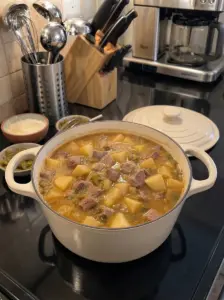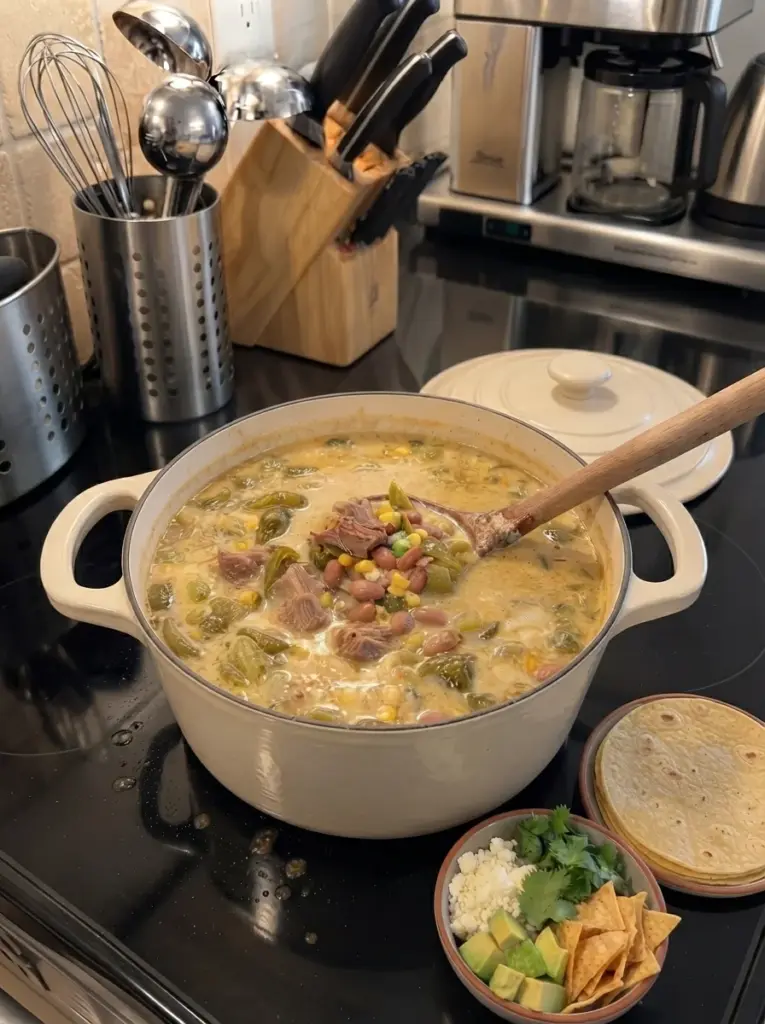
Roasted green chiles, tender pork, pinto beans, and melted Monterey Jack make this a rich, warming chowder. Corn adds sweetness, while masa harina gives the broth body and a gentle tamale-inspired corn flavor. Milk, cream, and cream cheese round out the finish.
The soup is built in stages so each ingredient gets the cooking it needs. Pork shoulder simmers until tender before the beans, corn, masa, and dairy finish the pot. That order protects the beans from unnecessary cooking and lets you thicken the broth before adding cheese.
There are no whole tamales or dumplings in this recipe. The name refers to the masa flavor in the creamy broth. It is a New Mexican-inspired Southwestern variation rather than a claim to a traditional regional chowder.
The method below expands the supplied recipe and has not been independently kitchen-tested. Allow the pork to become fork-tender, even if it takes longer than the original schedule, and keep the heat gentle during the dairy finish.
Flavor and Texture
The finished chowder should be creamy and substantial but still easy to ladle. Pinto beans offer a soft bite, corn adds contrast, and the pork should yield easily to a fork.
Roasted Hatch green chiles supply the central pepper flavor. Their heat varies widely, so use mild chiles for the full two-cup amount unless you know the product and want a hotter batch.
Masa harina contributes corn flavor and modest thickening. The cream cheese and shredded cheese also add body, so assess the finished consistency before deciding that the pot needs extra masa.
Recipe Overview
| Detail | Guide |
|---|---|
| Yield | 6 generous or 8 smaller servings |
| Preparation | Approximately 20–25 minutes with prepared chiles |
| Pork simmer | Usually 1½–2 hours, allowing longer if needed |
| Finishing stages | Approximately 25–35 minutes |
| Total time | Roughly 2½–3¼ hours, including browning and preparation |
| Main texture | Creamy, cheesy broth with tender pork and beans |
| Best freezer method | Freeze the base before the dairy finish |
The timing assumes the chiles are already roasted, peeled, seeded, and chopped. Batch browning and the particular shoulder cut affect the schedule.
Ingredients
Pork and green chile base
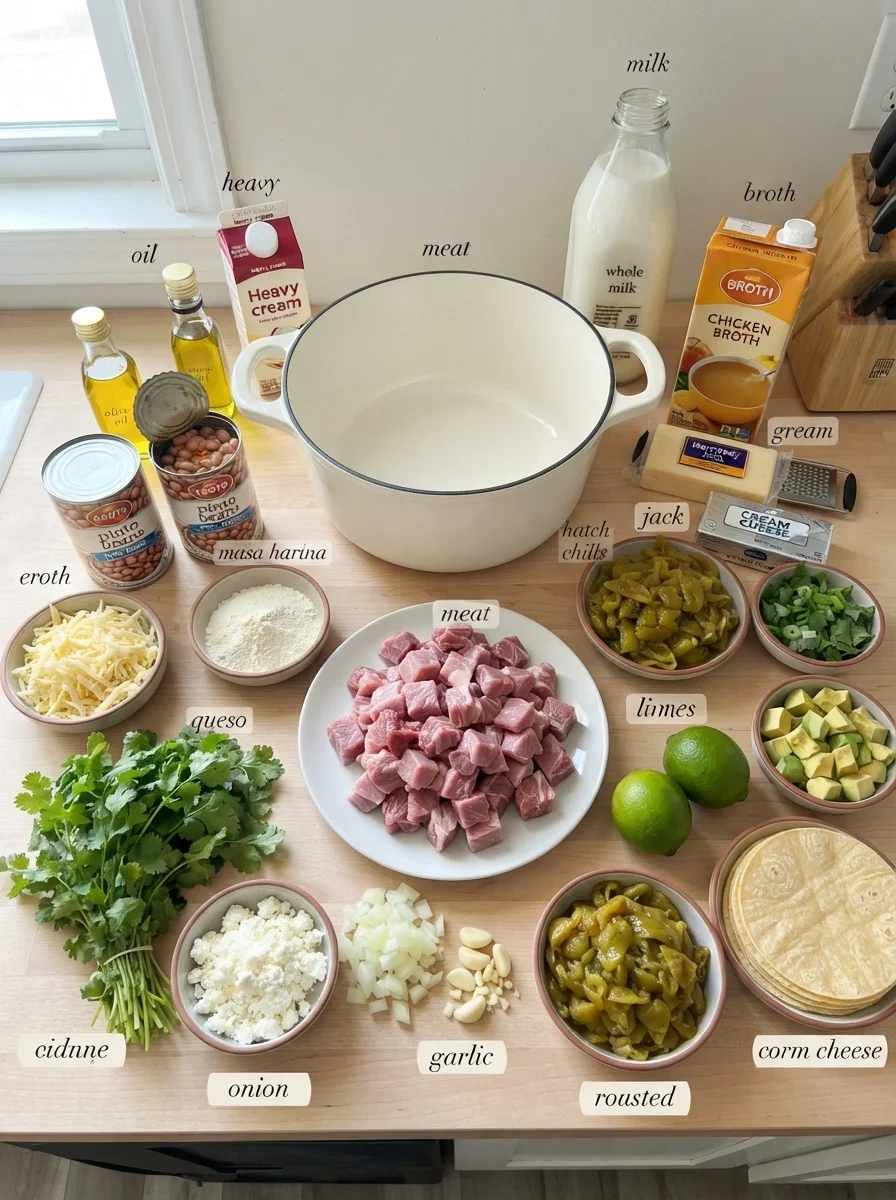
- 1½ pounds boneless pork shoulder, cut into small, even cubes
- 1 tablespoon olive oil, plus a little more if needed
- 1 medium yellow onion, diced
- 4 garlic cloves, minced
- Up to 2 cups prepared roasted mild Hatch green chiles, chopped; use less for hotter chiles
- 2 cans pinto beans, 15 ounces each, drained and rinsed
- 1 cup corn kernels, fresh, frozen, or drained canned
- 4 cups lower-sodium chicken broth, plus more as needed
- 1 teaspoon ground cumin
- 1 teaspoon smoked paprika
- ½ teaspoon dried Mexican oregano
- ½ teaspoon chili powder
- ½ teaspoon black pepper
- Up to 1 teaspoon salt, to taste
Masa and queso finish
- 3 tablespoons masa harina
- ½ cup cool water
- 1 cup whole milk
- 1 cup heavy cream
- 4 ounces block cream cheese, softened and cubed
- 1½ cups freshly shredded Monterey Jack
- 1 tablespoon fresh lime juice, or to taste
- 2 tablespoons chopped fresh cilantro
Optional toppings
- Additional Monterey Jack
- Crumbled queso fresco
- Sliced green onions
- Chopped cilantro
- Diced avocado
- Crushed tortilla chips or warm corn tortillas
The slurry water is additional to the broth. Toppings are separate from the base recipe and should be counted separately when estimating nutrition.
Ingredient Notes
Pork shoulder
Shoulder is the most predictable choice for this long, gentle simmer. Generic pork stew meat can contain different cuts, so it may not soften in the same time or produce the same texture.
Trim large exterior fat deposits while retaining some marbling. Cut evenly so pieces become tender at a similar rate.
The pork is ready when it yields easily to a fork. Fully cooked meat can still be chewy before connective tissue softens, so do not move to the dairy stage while shoulder remains tough.
Hatch green chiles
Use prepared chiles with a known heat level. Mild, medium, and hot products can give dramatically different results at the same volume.
For hotter or unfamiliar chiles, start with ½–1 cup and increase gradually. Dairy adds richness but does not guarantee that two cups of hot chiles will become mild.
Frozen roasted chiles are convenient; thaw in the refrigerator. Canned prepared chiles can also work, though their salt and liquid content differ. Roasting fresh chiles adds preparation time beyond the listed schedule.
Pinto beans and corn
Canned beans are already cooked and can be added after the long pork simmer. This keeps more beans intact and avoids unnecessary breakdown.
Uncooked dry beans are not a direct substitute. They need a separate cooking plan rather than the same liquid and timing.
Corn also needs only a short finish. Drain canned corn, or add fresh or frozen kernels near the bean stage and cook until tender and heated through.
Masa harina
Use masa harina intended for tortillas or related masa preparations. It is not interchangeable with cornmeal, cornstarch, or ordinary corn flour in equal amounts.
Whisking it with cool water prevents dry clumps. Simmer it before the dairy so it can cook and hydrate without requiring prolonged heat under the cheese.
Dairy and cheese
Whole milk and heavy cream provide different levels of richness. Replacing cream with additional milk makes a lighter but less rich result and may change stability and thickness.
Block cream cheese should be softened enough to disperse easily. Small cubes melt more readily than one cold block.
Freshly shredded Monterey Jack generally melts more smoothly than some pre-shredded products. Cheese should be added gradually with the burner very low or off while the pot retains enough heat to melt it.
Salt and lime
Broth, cheese, cream cheese, and canned foods all contribute seasoning. Begin with less salt and adjust after the cheese has melted.
Add lime gradually at the end. A little acidity brightens the richness, but there is no need to pour in more than tastes balanced.
Equipment
Use a large heavy Dutch oven or soup pot, tongs, a wooden spoon or spatula, a small bowl and whisk, a grater, and a clean plate for the meat.
A heavy base helps maintain a quiet simmer and reduces scorching once masa and dairy enter the pot. Even then, stir along the bottom during the finishing stages.
How to Make the Chowder
1. Prepare ingredients
Dice onion, mince garlic, drain beans, and measure chiles. Grate the cheese and cut softened cream cheese into small cubes.
Pat pork dry and season with some salt and black pepper. Keep raw meat utensils separate from garnishes and serving equipment.
2. Brown pork in batches
Heat olive oil over medium-high heat. Add an uncrowded layer of pork and brown several sides, approximately 5–7 minutes per batch. Transfer to a plate and repeat.
The meat finishes cooking in broth. Do not crowd the pan or repeatedly stir every piece before it has a chance to color.
If the residue becomes black, reduce the heat and avoid incorporating burnt material. Browning builds flavor; scorching creates bitterness.
3. Cook the aromatics
Reduce heat to medium. Cook onion for 4–5 minutes until softened, stirring regularly.
Add garlic, cumin, paprika, oregano, and chili powder. Stir for about 30 seconds until fragrant.
4. Build the pork base
Add prepared green chiles and broth. Return pork and collected juices, then scrape up the browned base gently.
Bring just to a boil, reduce to a quiet simmer, and partially cover. Hold back the beans and corn until later.
5. Simmer until tender
Cook approximately 1½–2 hours, stirring occasionally and allowing longer if needed. Test a piece with a fork before proceeding.
With only 4 cups broth initially, keep an eye on evaporation. Add broth when needed so the pork remains comfortably surrounded and the base does not become overly concentrated.
A rolling boil is unnecessary and makes liquid control harder. Gentle simmering and enough time are the useful tools here.
6. Add beans and corn
Stir in drained beans and corn. Simmer gently for approximately 10 minutes, until heated through and any fresh corn is tender.
Taste the chile flavor. If adding more prepared chile, do so now rather than after the cheese finish, then warm through.
7. Add masa slurry
Whisk masa harina with ½ cup cool water until smooth. Re-whisk if it stands before use.
Pour gradually into the simmering base while stirring. Cook uncovered for 8–10 minutes, stirring regularly along the bottom, until the masa is hydrated and the broth gains a little body.
It does not need to look like the final chowder yet. Dairy and cheese will contribute more richness and thickness.
8. Add milk, cream, and cream cheese
Reduce heat to low and let vigorous bubbling stop. Stir in milk and heavy cream, then add small cream cheese cubes gradually.
Stir gently until incorporated, allowing a few minutes. If a piece resists melting, press it lightly against the side of the pot rather than raising the heat sharply.
Avoid a hard boil after adding dairy. If the pot is very hot, move it off the burner briefly while stirring.
9. Melt the Monterey Jack
Add shredded cheese a handful at a time over very low heat or off the burner. Stir until each addition melts before adding the next.
Do not keep boiling in an attempt to make cheese smoother. Excess heat can encourage graininess and oil separation.
If the chowder needs loosening, add warm broth gradually. If it seems slightly thin, allow a short stand before considering extra thickener.
10. Finish and serve
Stir in cilantro and add lime juice to taste. Adjust salt only after the cheeses are incorporated.
Ladle into bowls and add optional toppings. Keep tortilla chips separate until the last moment for crunch.
Tips for a Smooth Queso Finish
Cook the masa first
The slurry needs time at a simmer, while cheese benefits from gentler heat. Keeping these stages separate reduces the need to hold dairy hot unnecessarily.
Soften and cube cream cheese
Small softened pieces are easier to disperse than a cold block. Prepare them while the pork simmers.
Shred cheese finely
Smaller shreds melt more readily. A block of Monterey Jack gives control over the size and avoids some coatings used on pre-shredded products.
Add cheese gradually
A large cold mound drops the temperature and encourages uneven melting. Handfuls are easier to incorporate.
Adjust thickness at the end
Masa, beans, cream cheese, and shredded cheese all add body. Wait until the recipe is complete before deciding to add another tablespoon of masa.
Troubleshooting
| Problem | Possible cause | Adjustment |
|---|---|---|
| Pork is tough | Shoulder needs more simmering | Continue the base stage before adding masa and dairy |
| Chowder is grainy | Cheese added over excessive heat | Lower heat or remove from burner; add gradually next time |
| Cream cheese lumps remain | Pieces too cold or large | Soften, cube small, and stir gently |
| Bottom catches | Thick mixture held over strong heat | Use gentle heat and stir across the base |
| Soup becomes too thick | Reduction plus masa and cheese | Add warm broth gradually |
| Beans turn mushy | Long cooking or rough stirring | Add cooked beans late and stir gently |
| Flavor is too salty | Broth and cheeses plus early salt | Use lower-sodium broth and season at the end |
| Heat is excessive | Hot chiles used at full volume | Begin with mild chiles or less of an unfamiliar product |
Once cheese has separated severely, whisking may improve appearance but may not restore the original smoothness. Preventing overheating is more effective than trying to repair it later.
Variations
Lighter finish
Reduce optional cheese toppings and serve smaller portions. Changing the cream and cream cheese in the base produces a different formula, so do not assume the same richness or texture.
More pronounced corn flavor
Try the stated masa amount first. If you want more in a future batch, add a small extra slurry before dairy and simmer fully. Excess masa can make the broth heavy rather than velvety.
Spicier individual bowls
Offer hotter prepared chiles or a suitable hot sauce at the table. This lets diners choose their own heat without making the full pot intense.
Cheese topping variation
Use queso fresco on individual bowls for a crumbly contrast. It is not a direct melting replacement for Monterey Jack in the pot.
Extra vegetable serving
Pair the chowder with a crisp salad or roasted vegetables rather than crowding the creamy pot with many additions. This keeps its pork, chile, and corn balance clear.
Serving Ideas
Warm corn tortillas are useful for dipping, while crushed tortilla chips supply crunch. Choose a modest amount of one or the other if you want to avoid overwhelming a rich bowl.
Cilantro and green onions add freshness. Avocado gives another creamy component and may be unnecessary if you already plan extra cheese and sour cream.
For a gathering, keep toppings separate and serve smaller bowls with refills available. Maintain appropriate serving temperatures rather than leaving a large dairy-based pot cooling on a table.
Make-Ahead Plan
Cook the pork and green chile base ahead, stopping once the pork is tender. Cool promptly and refrigerate in shallow containers.
When ready to serve, reheat the base thoroughly, add beans and corn if held separately, then cook the masa slurry before adding dairy and cheese over gentle heat.
This approach is also useful for freezing. Holding back dairy gives you a fresher cheese finish after thawing and reduces the texture changes common in frozen creamy soups.
Storage and Reheating
Refrigerator
Refrigerate within 2 hours of cooking, or within 1 hour above 90°F. Divide the chowder into shallow containers instead of waiting for a deep pot to become completely cold.
Store at 40°F or below and use within 3–4 days. Follow the original preparation date when finishing a base made ahead; adding dairy does not restart its storage period.
Freezer
For the best texture, freeze the pork, chile, and bean base before adding milk, cream, cream cheese, and Monterey Jack. You may also hold the masa until reheating for easier control of thickness.
Freeze up to 3 months for quality and thaw in the refrigerator. Finish with the reserved ingredients using the same gentle sequence.
A fully finished chowder can change texture after freezing, becoming separated or grainy. It will not necessarily return to the same smoothness after stirring.
Reheating
Warm over low to medium-low heat, stirring frequently and adding broth as needed. Heat leftovers throughout to 165°F without prolonged vigorous boiling.
For microwave portions, use a vented microwave-safe cover, stir partway through, and check several spots. Thick pork-and-bean mixtures can heat unevenly.
Reheat only what you need where practical. Add fresh toppings after warming.
Nutrition Notes
This is a rich chowder. Heavy cream, cream cheese, Monterey Jack, and pork shoulder contribute substantial calories before toppings.
A broad estimate is about 550–700 calories per serving when divided into six, or approximately 410–525 when divided into eight, depending particularly on pork fat content and dairy brands. Extra cheese, avocado, and tortillas increase the total.
Use labels and actual portions for a more accurate calculation. The same pot cannot have an identical per-serving value when divided into six bowls versus eight.
Beans, corn, milk, and masa provide carbohydrate. This is not a low-carbohydrate recipe as written. It contains dairy; check other labels and preparation practices if specific dietary suitability matters.
Frequently Asked Questions
Does it contain actual tamales?
No. Masa harina gives the broth a tamale-inspired corn flavor. There are no whole tamales, wrappers, or dumplings in the supplied recipe.
Can I use pork stew meat?
Only with attention to the cut. Shoulder is suited to this long simmer, while leaner pieces may behave differently. Ask what the package contains when possible.
Why add beans later than the original directions?
Canned beans are already cooked. Adding them after the long pork simmer helps them remain intact.
Can I use cornmeal instead of masa harina?
It is not a direct substitution. Texture, flavor, and hydration differ, so use masa for this method.
Can I use pre-shredded cheese?
It may work, but coatings and formulations vary. Freshly shredded Monterey Jack is a more predictable starting point for a smooth finish.
Can I add lime while the dairy boils?
Avoid boiling the dairy stage. Add a modest amount of lime at the end and taste as you go.
Why does the chowder thicken in the refrigerator?
Masa and beans continue affecting the liquid, while dairy fat firms as it cools. Reheat gently and add broth gradually.
Is a slow cooker method the same?
No. Browning, liquid reduction, thickening, and dairy timing need an adapted sequence. Do not place every ingredient into a slow cooker and assume the stovetop directions apply.
Recipe Card
Hatch Green Chile Pork & Pinto Bean Queso Tamale Chowder
A rich green chile pork chowder with pinto beans, corn, masa harina, and a gentle cream-and-cheese finish.
Servings: 6 generous or 8 smaller
Prep: 20–25 minutes with prepared chiles
Total: Approximately 2½–3¼ hours, allowing longer for pork if needed
Ingredients
- 1½ pounds boneless pork shoulder, evenly cubed
- 1 tablespoon olive oil
- 1 diced yellow onion
- 4 minced garlic cloves
- Up to 2 cups prepared roasted mild Hatch green chiles; less if hot
- 2 cans pinto beans, 15 ounces each, drained and rinsed
- 1 cup corn
- 4 cups lower-sodium chicken broth, plus more as needed
- 1 teaspoon cumin
- 1 teaspoon smoked paprika
- ½ teaspoon Mexican oregano
- ½ teaspoon chili powder
- ½ teaspoon black pepper
- Up to 1 teaspoon salt, to taste
- 3 tablespoons masa harina
- ½ cup cool water
- 1 cup whole milk
- 1 cup heavy cream
- 4 ounces softened cream cheese, cubed
- 1½ cups freshly shredded Monterey Jack
- 1 tablespoon lime juice, to taste
- 2 tablespoons chopped cilantro
Instructions
- Pat pork dry and season with some salt and pepper. Brown in oil in uncrowded batches, about 5–7 minutes each. Transfer to a plate.
- Cook onion over medium heat 4–5 minutes. Add garlic and dried spices; stir 30 seconds.
- Add chiles and broth. Return pork and juices, scrape browned bits, and bring just to a boil.
- Simmer gently, partially covered, approximately 1½–2 hours or longer until fork-tender. Add broth as needed.
- Add beans and corn; simmer about 10 minutes until heated through.
- Whisk masa with cool water. Stir into the simmering base and cook 8–10 minutes, stirring along the bottom.
- Reduce heat to low. Stir in milk, cream, and cream cheese gradually until incorporated. Avoid boiling.
- Add Monterey Jack a handful at a time over very low heat or off the burner, stirring until melted.
- Add cilantro and lime to taste. Adjust salt and consistency, then serve with optional toppings.
Storage: Refrigerate promptly and use within 3–4 days. Freeze the base without dairy for up to 3 months for quality. Reheat leftovers to 165°F.
Little tip: Finish the pork and masa cooking before adding dairy. The queso stage needs gentle warmth, not the long simmer that tenderizes shoulder.

Hatch Green Chile Pork & Pinto Bean Queso Tamale Chowder
Description
A rich green chile pork chowder with pinto beans, corn, masa harina, and a gentle cream-and-cheese finish.
Servings: 6 generous or 8 smaller
Prep: 20–25 minutes with prepared chiles
Total: Approximately 2½–3¼ hours, allowing longer for pork if needed
Ingredients
- 1½ pounds boneless pork shoulder, evenly cubed
- 1 tablespoon olive oil
- 1 diced yellow onion
- 4 minced garlic cloves
- Up to 2 cups prepared roasted mild Hatch green chiles; less if hot
- 2 cans pinto beans, 15 ounces each, drained and rinsed
- 1 cup corn
- 4 cups lower-sodium chicken broth, plus more as needed
- 1 teaspoon cumin
- 1 teaspoon smoked paprika
- ½ teaspoon Mexican oregano
- ½ teaspoon chili powder
- ½ teaspoon black pepper
- Up to 1 teaspoon salt, to taste
- 3 tablespoons masa harina
- ½ cup cool water
- 1 cup whole milk
- 1 cup heavy cream
- 4 ounces softened cream cheese, cubed
- 1½ cups freshly shredded Monterey Jack
- 1 tablespoon lime juice, to taste
- 2 tablespoons chopped cilantro
Instructions
- Pat pork dry and season with some salt and pepper. Brown in oil in uncrowded batches, about 5–7 minutes each. Transfer to a plate.
- Cook onion over medium heat 4–5 minutes. Add garlic and dried spices; stir 30 seconds.
- Add chiles and broth. Return pork and juices, scrape browned bits, and bring just to a boil.
- Simmer gently, partially covered, approximately 1½–2 hours or longer until fork-tender. Add broth as needed.
- Add beans and corn; simmer about 10 minutes until heated through.
- Whisk masa with cool water. Stir into the simmering base and cook 8–10 minutes, stirring along the bottom.
- Reduce heat to low. Stir in milk, cream, and cream cheese gradually until incorporated. Avoid boiling.
- Add Monterey Jack a handful at a time over very low heat or off the burner, stirring until melted.
- Add cilantro and lime to taste. Adjust salt and consistency, then serve with optional toppings.
Storage: Refrigerate promptly and use within 3–4 days. Freeze the base without dairy for up to 3 months for quality. Reheat leftovers to 165°F.
Little tip: Finish the pork and masa cooking before adding dairy. The queso stage needs gentle warmth, not the long simmer that tenderizes shoulder.