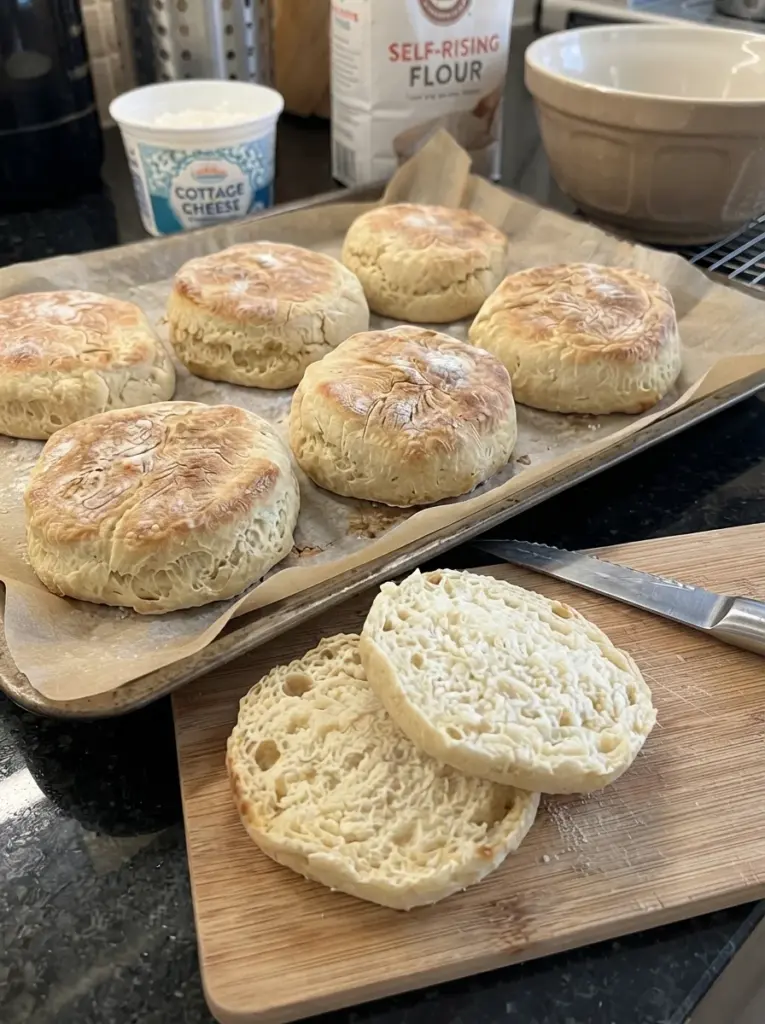
Cottage cheese, eggs, oat flour, and baking powder come together in a simple savory loaf that needs no yeast or kneading. Blending the cottage cheese with the eggs creates a smooth base, while oat flour gives the bread a hearty, tender crumb. Mix, transfer to a small loaf pan, and bake until the center is set.
This 4-Ingredient High-Protein Cottage Cheese Bread is designed for toast, open-faced sandwiches, or a slice alongside eggs. The flavor is mild, with a little tang from the cottage cheese. Because the loaf contains no wheat flour or yeast, expect a moist, close-textured bread rather than a lofty, stretchy sandwich loaf.
The protein comes primarily from cottage cheese and eggs, with an additional contribution from the oats. You do not need protein powder, and there is no added sugar in the basic formula. Ingredient labels and slice size determine the actual nutrition.
This is a suggested starting recipe rather than a kitchen-tested formula. Cottage cheese moisture, oat flour texture, and pan dimensions can change the baking time and finished crumb. The guidance below explains what to look for as you mix, bake, and cool the loaf.
Recipe at a Glance
- Preparation: About 10 minutes
- Batter rest: 10 minutes
- Baking: Approximately 45–60 minutes
- Cooling: About 1–1½ hours, including the pan rest
- Total: Approximately 2 hours 5 minutes to 2 hours 50 minutes
- Yield: One small loaf in an 8 × 4-inch pan
- Servings: 8 slices
- Method: Quick bread; no yeast or kneading
The cooling period is part of the recipe. A warm oat-based loaf is fragile and can seem gummy before the crumb has had time to settle.
The Four Ingredients
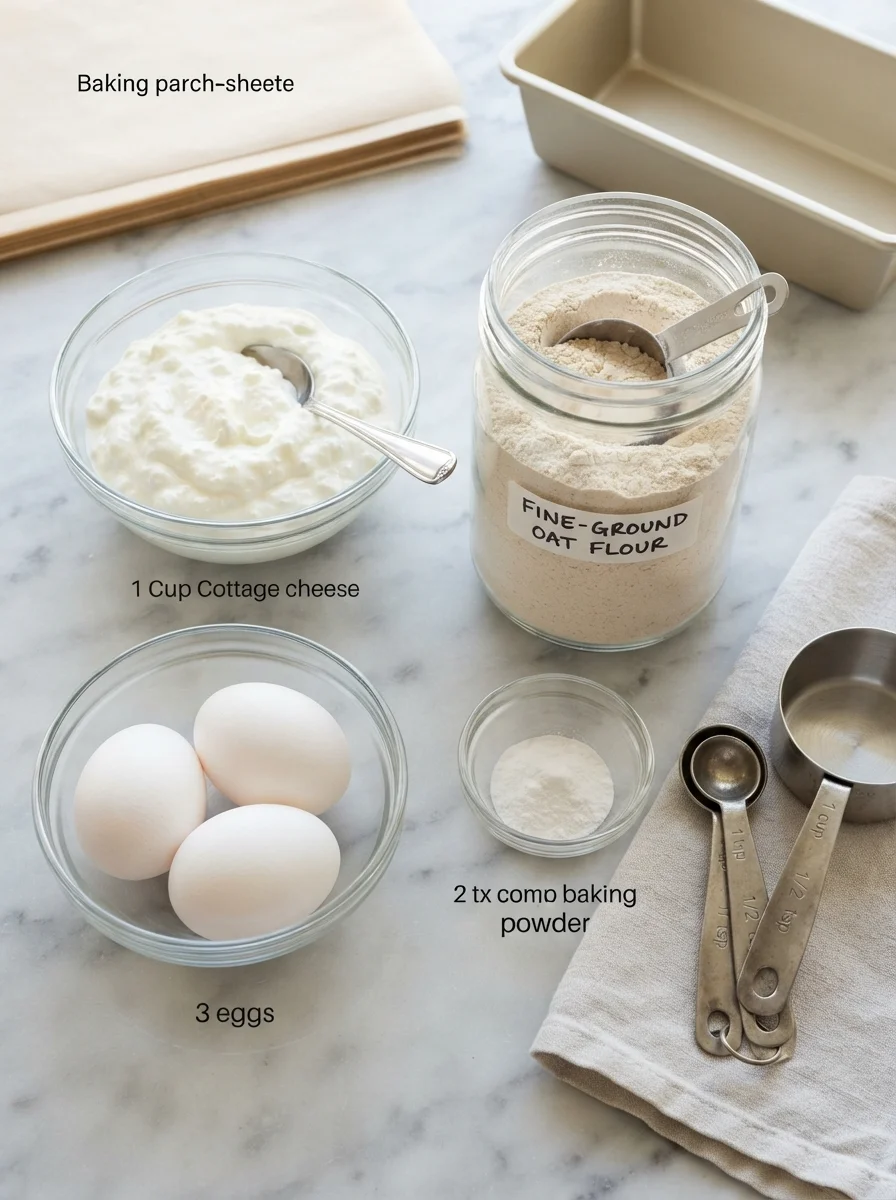
- 1 cup thick cottage cheese, preferably 2% or full-fat
- 3 large eggs
- 2 cups finely ground oat flour
- 2 teaspoons baking powder
Use parchment to line the pan so oil is not required as a fifth recipe ingredient. Any butter, sandwich fillings, seeds, or seasonings you add are optional extras.
What Kind of Bread Does This Make?
This is a cottage cheese and oat quick bread. It rises with baking powder and the structure formed as the eggs and batter bake, rather than through fermentation.
Oats do not create the elastic gluten network found in wheat bread. The loaf will therefore be more delicate, with a tighter crumb and less flexibility than conventional sandwich bread. A thick, cooled slice is more reliable for an open-faced sandwich than a very thin slice carrying a heavy filling.
Toasting helps the surface firm up and brings out the oat flavor. The bread is also suitable for serving beside soup or with a savory breakfast, provided you enjoy a hearty rather than fluffy texture.
Why These Ingredients Work Together
Cottage cheese supplies moisture, protein, and a little salt. Blending removes the curds so the dairy distributes throughout the batter.
Eggs help bind the oat flour and support a sliceable structure as the loaf bakes. They also contribute richness and protein without requiring oil in the basic formula.
Oat flour absorbs moisture during the short rest. It gives the loaf its substance and a gently nutty flavor. Fine flour is useful because a coarse homemade grind can make the crumb more uneven.
Baking powder provides lift. It cannot turn this batter into wheat sandwich bread, but it helps prevent the loaf from baking into an overly compact block when the other ingredients are balanced appropriately.
Ingredient Notes
Choose Thick Cottage Cheese
Use cottage cheese with some body rather than a product floating in a large amount of loose liquid. If whey has collected on top, pour off the loose surface liquid before measuring. Do not squeeze the cheese dry; the recipe needs its normal moisture.
A 2% or full-fat product is a practical starting point. Nonfat cottage cheese may behave differently because of its moisture and stabilizers, so a swap can change the finished texture.
Small and large curds can both work because they are blended. The more important factors are moisture and flavor. Taste the cottage cheese before using it; its saltiness will be noticeable in a recipe with so few ingredients.
Use Three Large Eggs
The egg quantity is part of the loaf’s structure. Smaller eggs may supply less moisture, while substantially larger eggs may loosen the batter.
Egg substitutes do not necessarily bind and set in the same way. A flax or chia replacement would require separate development rather than a guaranteed direct substitution.
Measure Oat Flour Carefully
Use two cups of oat flour, spooned into the measuring cup and leveled. Do not assume two cups of whole oats will produce exactly two cups of flour.
If making your own, grind plain rolled oats until fine, then measure the resulting flour. Let the powder settle before opening the blender so it does not scatter.
Commercial oat flour often gives a more consistent texture than a coarse home grind. Avoid instant oatmeal packets containing sugar or flavorings.
For a gluten-free version, use certified gluten-free oat flour and suitable baking powder, with attention to the other ingredient labels and preparation surfaces. Oats can be exposed to gluten during processing.
Check the Baking Powder
Use baking powder rather than baking soda. The two are not interchangeable in this formula.
Measure level teaspoons and check that the product is in good condition. Adding extra baking powder is not a dependable fix for a heavy batter and can leave an unpleasant flavor.
Equipment
Use an 8 × 4-inch loaf pan, parchment paper, blender or food processor, mixing bowl, spatula, measuring cups and spoons, and a wire rack.
A larger 9 × 5-inch pan makes a lower loaf and changes baking time. The small pan is important for producing slices with enough height to use as bread.
A light-colored metal pan is a practical starting point. Dark metal, glass, and ceramic may brown differently, so follow the loaf’s condition rather than expecting an exact finish time.
How to Make Cottage Cheese Bread
1. Prepare the Oven and Pan
Heat the oven to 350°F with a rack near the center. Line the small loaf pan with parchment, creasing it into the corners and leaving a little overhang for lifting.
Keep the paper below any heating elements and follow its temperature rating. A neat lining helps the batter settle evenly.
2. Blend Cottage Cheese and Eggs
Add the measured cottage cheese and eggs to a blender or food processor. Blend until smooth, stopping to scrape as needed.
Use the eggs to help the cottage cheese move through the blades rather than adding milk. Extra liquid changes the four-ingredient formula and can make the center harder to set.
Stop once the curds are no longer apparent. There is no need to keep blending in an attempt to create a whipped foam.
3. Mix the Dry Ingredients
In a bowl, whisk or stir together the oat flour and baking powder. Distributing the baking powder now helps prevent concentrated pockets in the loaf.
Add the blended mixture and stir with a spatula until evenly combined. Scrape the bottom and sides to remove dry flour pockets.
4. Rest the Batter
Let the batter stand for 10 minutes so the oats can absorb moisture. It should become thick and spoonable, holding a soft mound before gradually settling.
The rest is particularly useful with homemade flour. Do not decide immediately that the batter needs a large addition of flour or liquid.
If it is dramatically thinner than expected after resting, check whether the cottage cheese was especially watery or the flour was undermeasured. Small adjustments may be needed in practice, but they move the result away from this starting formula.
5. Fill the Pan
Spoon the batter into the lined pan and spread it into the corners. Smooth the surface gently.
Tap the pan lightly once or twice to settle large gaps. Avoid repeatedly pounding it on the counter, which is unnecessary for this batter.
6. Bake Until Set
Bake for approximately 45–60 minutes, starting to check at 45 minutes. The top should be lightly golden and the center should feel set rather than wobbling.
A toothpick or skewer inserted into the middle should come out without wet batter. A few moist crumbs are acceptable, but a sticky smear of raw mixture means it needs longer.
If the top is sufficiently browned while the center still needs time, tent loosely with foil and continue in short intervals. Cottage cheese moisture and pan material can shift the timing.
Do not rely on a dark crust alone. This moist loaf needs enough time for the interior to bake through.
7. Cool in the Pan Briefly
Rest the loaf in the pan for about 15 minutes. Lift out carefully using the parchment, then transfer upright to a wire rack.
If the sides seem fragile, support the loaf as you move it. Remove the paper when practical so steam can escape from the bottom.
8. Cool Through Before Slicing
Allow another 45–75 minutes, or longer as needed, until the center is no longer hot. The crumb becomes easier to handle as it cools.
Slice with a serrated knife using a gentle sawing motion. Begin with moderately thick slices rather than trying to create very thin sandwich slices.
Toast or warm the cut portions if you want to eat them warm. This preserves the loaf’s structure better than cutting immediately after baking.
Tips for a Better Loaf
Blend the wet ingredients smoothly. Even distribution helps avoid curd pockets and inconsistent texture.
Measure flour after grinding. Whole oats and oat flour do not occupy the same volume reliably.
Use the small pan. A lower loaf in a larger pan can still taste pleasant, but it will not have the same slice height.
Let the batter rest. The oats need time to hydrate before you assess consistency.
Avoid unnecessary extra liquid. The eggs and cottage cheese already supply moisture.
Cool fully. This is especially useful for an oat-based loaf without wheat gluten.
Troubleshooting
| Problem | Possible cause | Helpful adjustment |
|---|---|---|
| Center is wet or gummy | Underbaking, excess dairy moisture, or slicing hot | Bake until no wet batter remains and cool completely. |
| Loaf is very low | Oversized pan, weak leavener, or a loose batter | Use an 8 × 4-inch pan and check measurements and baking powder. |
| Slices crumble | Coarse flour, incomplete cooling, or very thin cutting | Grind flour finely, cool thoroughly, and cut thicker slices. |
| Texture is dry | Packed flour or overbaking | Spoon and level flour and begin checking at the early end of the range. |
| Top browns early | Pan or oven browning quickly | Tent loosely with foil while the middle finishes. |
| Flavor is too salty | Salty cottage cheese or seasoning additions | Choose a less salty product next time and avoid extra salt. |
Optional Flavor Variations
The basic loaf contains four ingredients. Each variation below adds ingredients and should be labeled accordingly.
Garlic and Herb
Add a small amount of garlic powder and dried herbs to the dry ingredients. Begin lightly so the mild cottage cheese and oat flavor remain pleasant.
Cheddar Loaf
Fold in a modest amount of finely shredded cheddar. It adds richness, salt, and calories, and may affect the crumb. Avoid a large addition that crowds the batter.
Everything-Seasoned Top
Sprinkle a little everything bagel seasoning over the surface before baking. Use a restrained amount because the cottage cheese may already supply enough salt.
Cinnamon Breakfast Bread
Add cinnamon and a little sweetener if you want a sweeter breakfast direction. This changes the recipe and does not create the same flavor as a traditional sugar-and-butter quick bread.
These variations have not been kitchen-tested here. Keep additions modest and reassess baking and texture as needed.
Serving Ideas
Toast a slice and serve with eggs for breakfast. The firmer toasted surface also works well with avocado, tomato, or a thin spread of cream cheese.
For lunch, make an open-faced turkey or chicken sandwich. This is often easier than relying on two thin, flexible slices to hold a heavy filling.
Serve beside soup or a chopped salad. If adding a wet topping, assemble shortly before eating so the bread does not become saturated.
A warmed slice with butter is another option, although butter is an accompaniment rather than one of the four loaf ingredients. Count additions separately if tracking nutrition.
Storage and Reheating
For this moist cottage cheese loaf, refrigerate after cooling rather than planning several days of counter storage. Cool on a rack and refrigerate within 2 hours of baking; do not leave it out overnight to finish cooling.
Store in an airtight container at 40°F or below for up to 4 days. If condensation forms, let surface moisture dissipate briefly in the refrigerator before sealing fully.
Freeze cooled slices with parchment between them in a freezer-safe bag. Use within 2 months for best quality. Individual slices are easier to thaw and toast than a whole frozen loaf.
Warm gently in a skillet or toaster oven, or toast from chilled. Start with a short heating time and add more as needed to avoid drying the edges.
Freezing can change the texture slightly, but toasting may help. Discard the bread if mold appears rather than cutting away the visible area.
Protein and Nutrition Notes
With one cup of cottage cheese, three eggs, and two cups of oat flour, a reasonable illustrative estimate is approximately 10–12 grams of protein per slice when the loaf is divided into eight slices. Calories may be around 180–210 per slice, depending on the products and how the oat flour is measured.
These estimates are not a verified analysis. Cottage cheese brands, egg size, and flour density can change them. Total the nutrition for your measured ingredients and divide by the actual slice count for a closer result.
The bread contains oats and therefore a meaningful amount of carbohydrate. It is not a low-carb or keto loaf simply because it contains cottage cheese and eggs. It also contains dairy and eggs.
The basic formula has no added sugar, but that is different from having no naturally occurring sugar. Toppings and variations change the nutrition further.
Frequently Asked Questions
Can I use rolled oats instead of oat flour?
Grind them into fine flour first, then measure two cups of the flour. Stirring whole rolled oats directly into the mixture creates a different texture and moisture balance.
Can I use almond flour?
Not as a guaranteed direct replacement. Almond flour has a different fat content and binding behavior, so it needs a separately balanced formula.
Can I use self-rising flour?
That would make a different wheat-based bread. It would also change the leavener and salt balance. Follow a recipe developed for self-rising flour rather than swapping it into this one.
Does it taste like cottage cheese?
There is a mild dairy tang, but blending removes the curd texture. Oats and eggs are also noticeable, particularly in a simple four-ingredient loaf.
Do I need a blender?
A food processor works too. Hand mixing leaves curds, which changes the finished texture. The smooth blended base is the intended method.
Why is it not fluffy like store-bought sandwich bread?
It has no yeast or wheat gluten network. Baking powder gives some lift, but the oat-and-egg structure remains closer and more delicate.
Can I double it?
Make two loaves in separate pans rather than one oversized loaf. Check each independently because baking time can vary with oven position.
Can I make it ahead?
Yes. Cool, refrigerate, and slice the next day, or freeze portions. The cooled loaf generally handles more easily than the warm one.
Recipe Card
4-Ingredient High-Protein Cottage Cheese Bread
A moist, hearty oat-based quick bread made with cottage cheese and eggs. Suggested starting formula; not kitchen-tested here.
Prep: 10 minutes | Rest: 10 minutes | Bake: 45–60 minutes | Cool: 1–1½ hours
Yield: One small 8 × 4-inch loaf | Servings: 8 slices
Ingredients
- 1 cup thick cottage cheese, preferably 2% or full-fat
- 3 large eggs
- 2 cups finely ground oat flour, spooned and leveled
- 2 teaspoons baking powder
Instructions
- Heat the oven to 350°F. Line an 8 × 4-inch loaf pan with parchment.
- Blend cottage cheese and eggs until smooth.
- Mix oat flour and baking powder in a bowl. Stir in the blended mixture until evenly combined.
- Let stand for 10 minutes to hydrate. The batter should be thick and spoonable.
- Transfer to the pan and smooth the surface.
- Bake for about 45–60 minutes, checking from 45 minutes. Tent with foil if needed. The center should be set and a skewer should show no wet batter.
- Rest in the pan for 15 minutes, then transfer to a rack and cool through before slicing.
- Serve in moderately thick slices, preferably toasted for a firmer surface.
Storage: Refrigerate within 2 hours of baking and keep covered for up to 4 days. Freeze slices for up to 2 months for best quality.
Illustrative nutrition: Approximately 180–210 calories and 10–12 grams protein per slice, based on eight slices. This oat-based loaf is not low-carb.
Print
4-Ingredient High-Protein Cottage Cheese
Description
A moist, hearty oat-based quick bread made with cottage cheese and eggs. Suggested starting formula; not kitchen-tested here.
Prep: 10 minutes | Rest: 10 minutes | Bake: 45–60 minutes | Cool: 1–1½ hours
Yield: One small 8 × 4-inch loaf | Servings: 8 slices
Ingredients
- 1 cup thick cottage cheese, preferably 2% or full-fat
- 3 large eggs
- 2 cups finely ground oat flour, spooned and leveled
- 2 teaspoons baking powder
Instructions
- Heat the oven to 350°F. Line an 8 × 4-inch loaf pan with parchment.
- Blend cottage cheese and eggs until smooth.
- Mix oat flour and baking powder in a bowl. Stir in the blended mixture until evenly combined.
- Let stand for 10 minutes to hydrate. The batter should be thick and spoonable.
- Transfer to the pan and smooth the surface.
- Bake for about 45–60 minutes, checking from 45 minutes. Tent with foil if needed. The center should be set and a skewer should show no wet batter.
- Rest in the pan for 15 minutes, then transfer to a rack and cool through before slicing.
- Serve in moderately thick slices, preferably toasted for a firmer surface.
Storage: Refrigerate within 2 hours of baking and keep covered for up to 4 days. Freeze slices for up to 2 months for best quality.
Illustrative nutrition: Approximately 180–210 calories and 10–12 grams protein per slice, based on eight slices. This oat-based loaf is not low-carb.