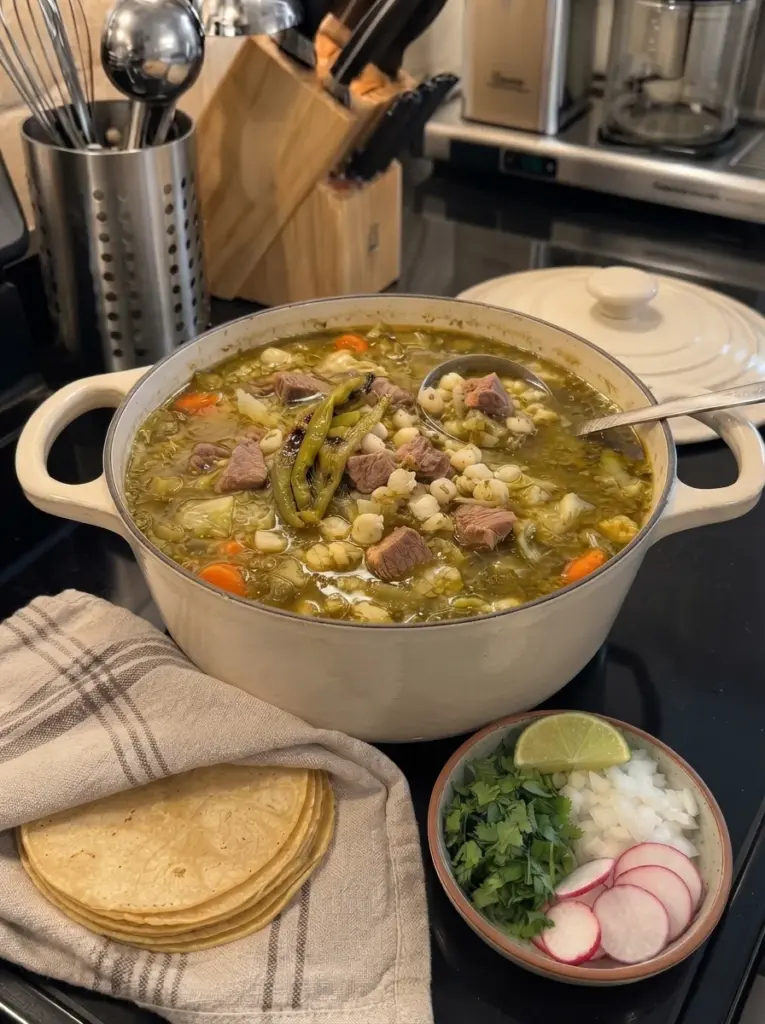
Hatch Green Chile Pork and Hominy Cabbage Caldo combines tender pork shoulder, roasted green chiles, white hominy, and cabbage in a savory chicken broth. Carrots add a little sweetness, while garlic, cumin, and Mexican oregano give the pot its warm, herbal flavor.
The pork simmers first so it has time to soften. Carrots and hominy go in later, followed by cabbage near the end. A squeeze of lime brightens the finished broth without overwhelming the roasted chile flavor.
Serve this spoonable, Southwestern-inspired meal in deep bowls with warm corn tortillas. It makes a substantial pot for family dinner, with leftovers that can be portioned for another meal.
Recipe at a glance: About 6–8 servings · 25 minutes prep · approximately 2–2½ hours cooking, longer if the pork needs it · approximately 2 hours 25 minutes–2 hours 55 minutes total.
Why You’ll Love This Caldo
- Roasted green chile flavor: Hatch chiles give the broth its defining pepper character.
- Tender pork: Shoulder suits the long, gentle simmer.
- Different textures: Hominy has a pleasant chew, cabbage becomes tender, and carrots add substance.
- A brothy meal: Eight cups of broth create a soup rather than a thick gravy.
- Flexible toppings: Cilantro, radishes, onion, and lime can be added at the table.
What Is Caldo?
Caldo means broth in Spanish and is used for many soups and brothy dishes. This recipe is a home-style interpretation inspired by Southwestern green chile cooking, rather than a claim of one definitive regional preparation.
Hominy is corn processed through nixtamalization, with a distinctive texture and flavor. This version uses cooked canned hominy. It shares some ingredients with pozole, but the article keeps the supplied caldo name and cabbage-in-the-pot method.
Ingredients
- 2 lb boneless pork shoulder, cut into 1-inch cubes
- 1 tablespoon olive oil, plus a little more only if needed for browning
- 1 medium white onion, diced
- 4 garlic cloves, minced
- 1½ cups roasted Hatch green chiles, peeled, seeded, and chopped
- 2 teaspoons ground cumin
- 1 teaspoon dried Mexican oregano
- ½ teaspoon smoked paprika
- 8 cups chicken broth, preferably low-sodium
- Two 15-ounce cans white hominy, drained and rinsed
- ½ medium green cabbage, cored and chopped into bite-size pieces
- 2 medium carrots, sliced
- 1 bay leaf
- Salt and black pepper, to taste
- Juice of 1 lime, added gradually to taste
Optional Toppings and Sides
- Chopped cilantro
- Diced white onion
- Sliced radishes
- Lime wedges
- Crumbled queso fresco
- Warm corn tortillas
Ingredient Notes
Pork shoulder: Choose a marbled boneless cut and trim large exterior fat pieces, leaving the internal marbling. Similar-sized cubes cook more evenly. Pork loin is much leaner and is not an equivalent substitute for this long simmer.
Hatch green chiles: Use already roasted, peeled, and chopped chiles. Freshly prepared, thawed frozen, or suitable jarred products can work. Drain excessive liquid and measure the prepared chile. Starting with raw peppers requires additional roasting and peeling time beyond the stated preparation estimate.
Heat level: Choose mild or hot chiles intentionally. A cup and a half of hot chile can make a notably spicy pot. Roasting adds toasted pepper flavor; its intensity varies by product.
Canned hominy: The cans contain fully cooked hominy. Drain and rinse before adding. Dry hominy requires a separate preparation and much longer cooking and is not a direct substitute here.
Cabbage: A half head varies in size. Use the stated half of a medium head, cut into manageable pieces, and adjust broth only if needed. Large additions may require a bigger pot and increase the yield.
Carrots: Slice evenly so they soften at a similar rate. Thick slices can need longer than thin ones.
Broth: Low-sodium chicken broth gives more control over seasoning. Pork, hominy, and chiles may also contribute salt depending on their preparation.
Lime: Lime size and juiciness vary. Start with part of the juice and taste before adding the rest.
Equipment and Pot Size
Use a heavy Dutch oven or stockpot of approximately 7–8 quarts, with room for the broth and final vegetables. A pot that is nearly full before adding cabbage makes stirring and simmering difficult.
Have a plate for browned pork, tongs, a wooden spoon, and a ladle ready. Browning in batches develops flavor more effectively than steaming the entire meat quantity in a crowded pot.
How to Make It
1. Brown the pork
Pat the pork dry and season lightly with salt and pepper. Heat the oil over medium-high heat. Brown in two or three uncrowded batches, approximately 5–7 minutes per batch, allowing color on several sides.
Transfer to a plate. There is no need to spend 3–4 minutes on every face of every cube; the original per-side wording can overstate the time needed. The centers remain uncooked at this stage.
2. Cook the aromatics
Reduce heat to medium. Add the onion and cook 4–5 minutes until softened. Add garlic, cumin, oregano, and paprika and stir for about 30 seconds.
If the pot is dry, add a little extra oil rather than letting the garlic and spices burn.
3. Add the chiles and deglaze
Stir in roasted chiles and cook 2–3 minutes. Add a small splash of the measured broth and scrape up the browned residue from the bottom. Discard burned black bits rather than dissolving them into the soup.
4. Simmer the pork first
Return the pork and accumulated juices. Add remaining broth and bay leaf. Bring to a simmer, reduce heat, and partially cover.
Cook gently for approximately 75–105 minutes, checking near the end. The pork should be almost fork-tender before you begin adding vegetables. If it remains firm, continue simmering longer. Occasional small bubbles are preferable to a vigorous boil.
Add hot broth or water sparingly if evaporation drops the liquid level excessively.
5. Add carrots and hominy
Once the pork is nearly tender, add carrots and drained hominy. Simmer about 15 minutes, until carrots begin softening. Hominy is already cooked; this stage heats it and lets it absorb broth flavor.
6. Add cabbage near the end
Stir in chopped cabbage and cook another 15–20 minutes, until tender and the pork separates easily with a fork. Thick carrot slices may need more time.
The cabbage will settle as it softens. Do not add large quantities of broth immediately just because it initially rises above the liquid; stir gently and give it a few minutes first.
7. Finish and serve
Remove the bay leaf. Add some lime juice, taste, then adjust salt, pepper, and remaining lime. Serve with optional fresh toppings and warm tortillas.
If adjusting heat with additional prepared chile, give it a few minutes to heat through before serving. Do not add raw pepper pieces at the last moment and treat them as equivalent to roasted chile.
Tips for Better Texture
Tenderness comes before the clock. Delay vegetables if the shoulder still feels tough.
Keep the simmer gentle. A hard boil can break up vegetables and reduce liquid too quickly.
Add cabbage late. It needs much less cooking than pork shoulder.
Use a spacious pot. This is a large brothy recipe with bulky cabbage at the finish.
Finish acidity gradually. Lime should brighten rather than dominate the broth.
Troubleshooting
| Problem | Practical fix |
|---|---|
| Pork remains tough | Continue simmering gently. Delay cabbage until it is nearly tender. |
| Cabbage becomes very soft | Add later or cut larger pieces next time. It cannot be made crisp again after overcooking. |
| Broth is too concentrated | Add hot unsalted broth or water in small amounts. |
| Flavor is bland | Check salt, then add a little lime juice. |
| Heat is too strong | Dilute with additional unsalted broth and suitable cooked ingredients, changing yield. Serve smaller portions with optional cheese. |
| Surface is greasy | Skim excess fat before serving. |
| Carrots are firm | Simmer longer until tender, checking cabbage so it does not overcook. |
Variations
Gentler caldo: Choose mild roasted chiles, not a smaller guessed quantity of a very hot product.
More vegetables: Add a modest amount of chopped zucchini near the end, checking for tenderness.
Pinto beans: Replace some hominy with drained, fully cooked pinto beans, adding near the end. This changes the intended hominy texture and serving volume.
Less smoky: Omit the paprika for a cleaner green chile flavor.
Potatoes and other substantial additions need their own timing and enough pot space. Keep the basic version as a starting point before expanding it heavily.
Serving Suggestions
Serve in deep bowls with cilantro, diced onion, sliced radishes, and lime wedges. Queso fresco is optional; use a pasteurized product and keep chilled until serving.
Warm corn tortillas make a simple accompaniment. A small cabbage slaw is not necessary because cabbage already fills the pot, but a fresh salad can provide a different texture.
Fresh toppings should go on individual bowls rather than being cooked into the entire batch.
Make-Ahead Instructions
For a fresher cabbage texture, cook the pork and chile broth until tender, then refrigerate promptly in shallow containers. Prepare the carrots, hominy, and cabbage separately for the serving day.
Reheat the pork and broth thoroughly to 165°F, add carrots and hominy, and simmer until carrots begin softening. Add cabbage and cook until tender. Allow enough time for these stages rather than treating the process as a quick warming step.
Storage time counts from the original cooking day; adding fresh cabbage does not restart it.
Storage and Reheating
Refrigerate within 2 hours of cooking, or within 1 hour above 90°F. Divide into shallow containers rather than cooling the whole stockpot on the counter. Store at 40°F or below for 3–4 days.
Freeze portions for up to 3 months for best quality. Leave room for expansion. Cabbage softens further after thawing, so frozen leftovers have a different vegetable texture.
Thaw in the refrigerator. Reheat on the stove, stirring, until leftovers reach 165°F; bring the soup to a boil for even heating. Add broth or water if needed, and finish with fresh toppings after reheating.
Frequently Asked Questions
Can I use canned green chiles?
They can make a variation, but not every canned green chile is Hatch-grown or roasted to the same degree. Check the label and expect flavor differences.
Can I use frozen roasted Hatch chiles?
Yes. Thaw, drain excess liquid, and measure the chopped prepared chiles.
Can I use dried hominy?
Not directly. The method is written for cooked canned hominy; dry hominy needs separate preparation.
Why add cabbage so late?
Pork shoulder takes much longer to soften. Adding cabbage near the end preserves its shape and avoids an unnecessarily long vegetable cook.
Can I use lean pork loin?
It is not an equivalent replacement. Lean loin can dry during the long simmer intended for shoulder.
Is this gluten-free?
The main ingredients do not require wheat flour, but verify broth, packaged chiles, and toppings according to your needs.
Recipe Card
Hatch Green Chile Pork and Hominy Cabbage Caldo
A brothy pork shoulder soup with roasted Hatch chiles, cooked white hominy, carrots, and late-added cabbage.
Prep: 25 minutes
Cook: Approximately 2–2½ hours, longer if pork needs it
Total: Approximately 2 hours 25 minutes–2 hours 55 minutes
Servings: About 6–8
Ingredients
- 2 lb boneless pork shoulder, cut into 1-inch cubes
- 1 tablespoon olive oil, plus more only if needed
- 1 medium white onion, diced
- 4 garlic cloves, minced
- 1½ cups roasted, peeled, seeded, chopped Hatch green chiles
- 2 teaspoons cumin
- 1 teaspoon dried Mexican oregano
- ½ teaspoon smoked paprika
- 8 cups low-sodium chicken broth
- Two 15-ounce cans white hominy, drained and rinsed
- ½ medium green cabbage, cored and chopped
- 2 medium carrots, sliced
- 1 bay leaf
- Salt and black pepper, to taste
- Juice of 1 lime, to taste
- Cilantro, onion, radishes, queso fresco, lime wedges, and tortillas, optional
Instructions
- Dry and season pork. Brown in oil over medium-high heat in batches, about 5–7 minutes per batch. Transfer to a plate.
- Cook onion over medium heat for 4–5 minutes. Add garlic and spices for 30 seconds.
- Add chiles for 2–3 minutes. Deglaze with a little measured broth.
- Return pork and juices, add remaining broth and bay leaf, and partially cover. Simmer gently 75–105 minutes or longer until pork is almost tender.
- Add carrots and hominy. Simmer about 15 minutes.
- Add cabbage and simmer 15–20 minutes until vegetables are tender and pork is fork-tender. Adjust liquid if necessary.
- Remove bay leaf, add lime gradually, adjust seasoning, and serve with optional toppings.
Notes
- Prepared roasted chiles are assumed; roasting raw peppers adds time.
- Delay vegetable additions if the pork still resists a fork.
- Canned hominy is already cooked.
- Exact nutrition has not been calculated; the original calorie estimate is not retained.
Final Thoughts
Give the shoulder time to soften, then finish the vegetables in stages. Late-added cabbage and a final squeeze of lime keep this hearty pot balanced, with roasted green chile flavor in every bowl.
Print
Hatch Green Chile Pork & Hominy Cabbage Caldo
- Total Time: Approximately 2 hours 25 minutes–2 hours 55 minutes
Ingredients
- 2 lb boneless pork shoulder, cut into 1-inch cubes
- 1 tablespoon olive oil, plus a little more only if needed for browning
- 1 medium white onion, diced
- 4 garlic cloves, minced
- 1½ cups roasted Hatch green chiles, peeled, seeded, and chopped
- 2 teaspoons ground cumin
- 1 teaspoon dried Mexican oregano
- ½ teaspoon smoked paprika
- 8 cups chicken broth, preferably low-sodium
- Two 15-ounce cans white hominy, drained and rinsed
- ½ medium green cabbage, cored and chopped into bite-size pieces
- 2 medium carrots, sliced
- 1 bay leaf
- Salt and black pepper, to taste
- Juice of 1 lime, added gradually to taste
Optional Toppings and Sides
- Chopped cilantro
- Diced white onion
- Sliced radishes
- Lime wedges
- Crumbled queso fresco
- Warm corn tortillas
Instructions
- Dry and season pork. Brown in oil over medium-high heat in batches, about 5–7 minutes per batch. Transfer to a plate.
- Cook onion over medium heat for 4–5 minutes. Add garlic and spices for 30 seconds.
- Add chiles for 2–3 minutes. Deglaze with a little measured broth.
- Return pork and juices, add remaining broth and bay leaf, and partially cover. Simmer gently 75–105 minutes or longer until pork is almost tender.
- Add carrots and hominy. Simmer about 15 minutes.
- Add cabbage and simmer 15–20 minutes until vegetables are tender and pork is fork-tender. Adjust liquid if necessary.
- Remove bay leaf, add lime gradually, adjust seasoning, and serve with optional toppings.
- Prep Time: 25 minutes
- Cook Time: Approximately 2–2½ hours, longer if pork needs it
Nutrition
- Serving Size: About 6–8