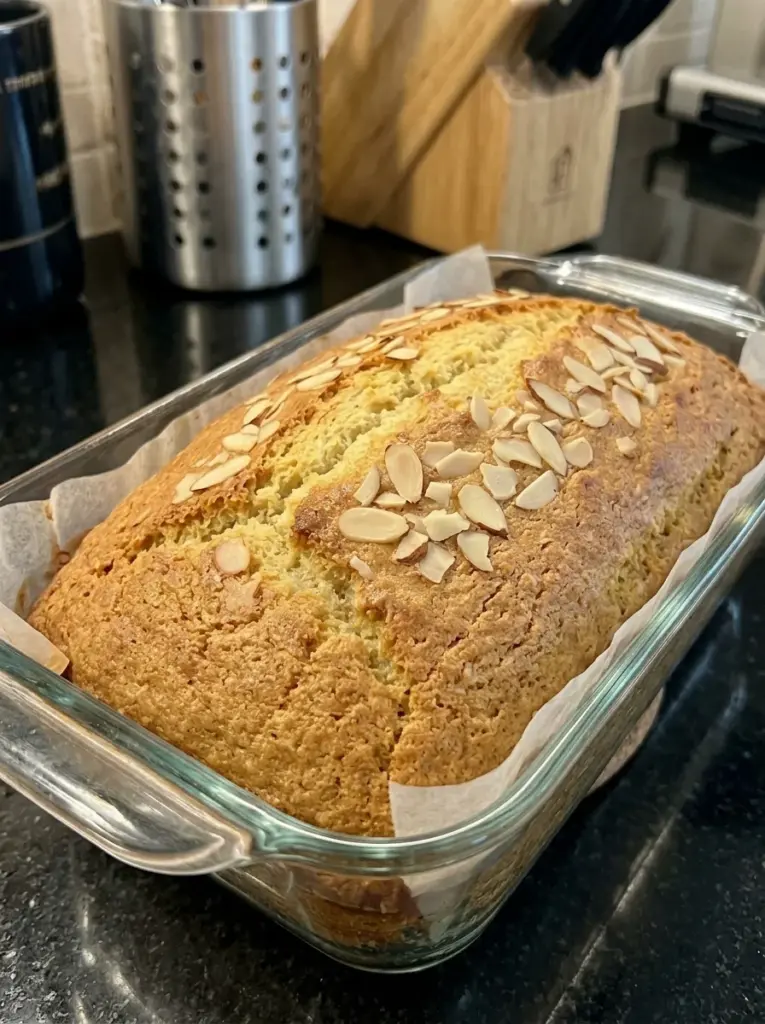
Soft, moist, lightly nutty, and incredibly simple to prepare, this 3-Ingredient Greek Yogurt Almond Bread turns just almond flour, Greek yogurt, and eggs into an easy homemade loaf with no yeast, kneading, or rising time required.
Almond flour provides the bread’s tender, nutty base, while Greek yogurt adds moisture and a subtle tang. Eggs bind everything together and give the loaf enough structure to slice once completely cooled.
Unlike traditional yeast bread, this is a quick bread. Simply whisk the ingredients together, transfer the batter to a loaf pan, and bake.
The finished loaf is especially good lightly toasted and served with butter, cream cheese, avocado, eggs, or savory sandwich toppings.
Why You’ll Love This Greek Yogurt Almond Bread
Only three ingredients. The basic loaf requires almond flour, eggs, and Greek yogurt.
No yeast required. There’s no proofing or rising time.
No kneading. Everything is mixed together in one bowl.
Naturally flourless. Almond flour replaces traditional wheat flour.
Moist and tender. Greek yogurt helps keep the crumb soft rather than dry.
Lightly nutty flavor. Almond flour gives the bread a pleasant, mild nuttiness.
Versatile. Enjoy it for breakfast, toast, open-faced sandwiches, or alongside eggs.
Freezer-friendly. Slice the cooled loaf and freeze individual portions for later.
Ready in under an hour. Preparation and baking take approximately 50 minutes.
What Makes This 3-Ingredient Bread Work?
With such a short ingredient list, every ingredient performs an important function.
Almond Flour
Finely ground almond flour provides the bulk of the loaf.
Unlike wheat flour, almond flour doesn’t contain gluten, so this bread won’t have the same stretchy or chewy structure as conventional sandwich bread.
Instead, it produces a moist, tender, slightly dense crumb with a mild nutty flavor.
Eggs
Four eggs provide essential structure.
As the bread bakes, the egg proteins set and help hold the almond flour and yogurt together.
The eggs also contribute moisture and richness.
Greek Yogurt
Greek yogurt adds moisture, creaminess, and subtle tang.
Its thick consistency works particularly well because it contributes moisture without making the batter excessively thin.
Together, these three ingredients create a simple batter that sets into a sliceable loaf as it bakes and cools.
Ingredients for 3-Ingredient Greek Yogurt Almond Bread
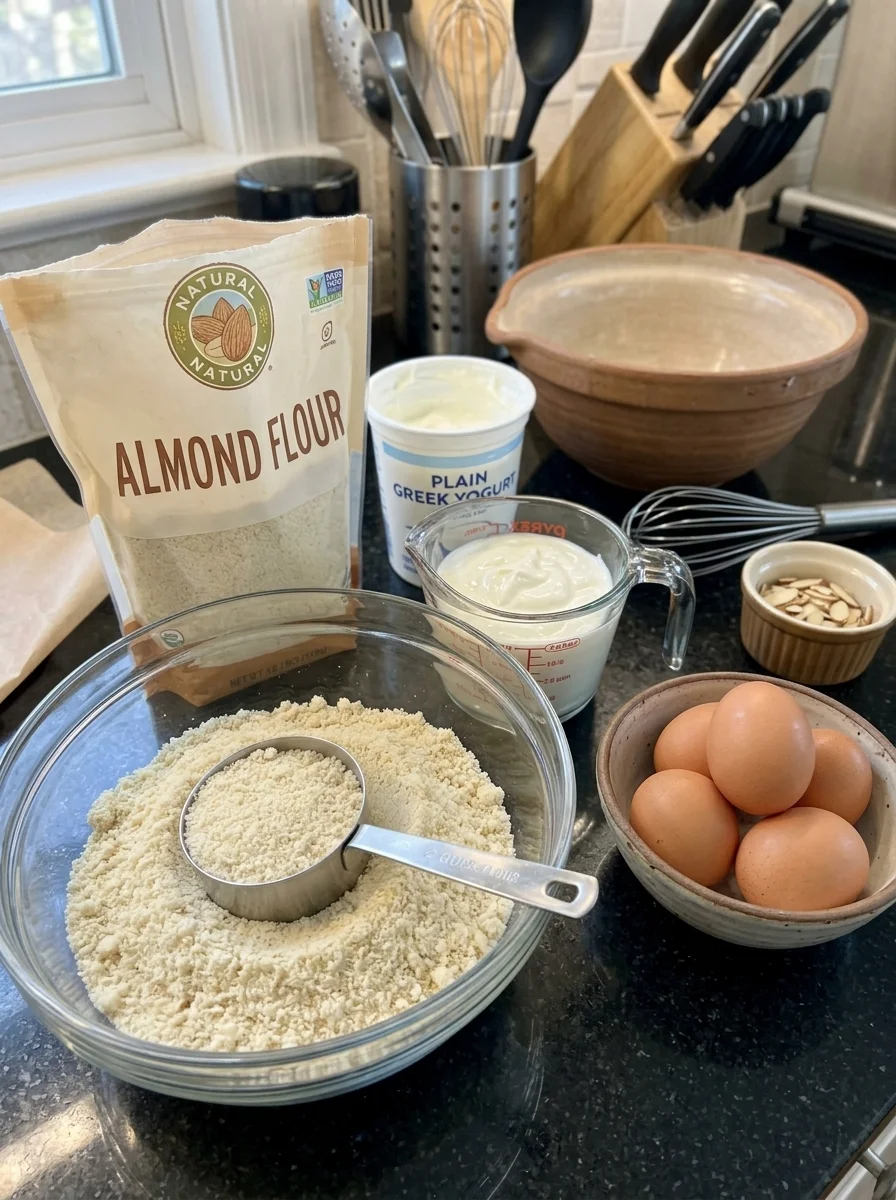
- 2 cups finely ground almond flour
- 4 large eggs
- 1 cup plain Greek yogurt
That’s it—just three basic ingredients.
Ingredient Notes
Finely ground almond flour: For the smoothest, most bread-like texture, use finely ground blanched almond flour rather than coarse almond meal. Coarse almond meal can produce a heavier, grainier loaf.
Large eggs: Eggs provide much of the structure in this recipe. Whisk them thoroughly before adding the yogurt.
Plain Greek yogurt: Use plain, unsweetened Greek yogurt. Its thick consistency helps create a moist batter without adding unnecessary sweetness.
Different brands and fat percentages of Greek yogurt contain different amounts of moisture, so the exact consistency of the batter can vary slightly.
How to Make 3-Ingredient Greek Yogurt Almond Bread
Step 1: Preheat the Oven
Preheat your oven to 350°F (175°C).
Line an 8×4-inch loaf pan with parchment paper.
Leave some parchment extending above the sides of the pan so you can easily lift the baked loaf out later.
Step 2: Whisk the Eggs 🥚
Crack 4 large eggs into a large mixing bowl.
Whisk until the yolks and whites are completely combined and the mixture looks smooth.
Thorough whisking helps distribute the eggs evenly throughout the batter.
Step 3: Add the Greek Yogurt
Add 1 cup plain Greek yogurt to the eggs.
Whisk again until the yogurt is fully incorporated.
The mixture should become smooth, creamy, and relatively uniform.
If your Greek yogurt is particularly thick, take a little extra time to whisk out any obvious lumps.
Step 4: Add the Almond Flour 🥜
Gradually add 2 cups finely ground almond flour.
Stir gently as you add it rather than dumping everything into the bowl at once.
Continue mixing until no obvious pockets of dry almond flour remain.
The finished batter should be thick, smooth, and spoonable.
Step 5: Rest the Batter
Allow the batter to sit for approximately 3 to 5 minutes.
This short resting period gives the almond flour time to absorb some of the moisture from the eggs and yogurt.
The batter may become slightly thicker as it rests.
Step 6: Transfer to the Loaf Pan
Pour or spoon the batter into the prepared 8×4-inch loaf pan.
Use a spatula to spread it evenly into the corners.
Smooth the surface so the loaf bakes as evenly as possible.
Step 7: Bake 🍞
Place the pan in the preheated oven.
Bake at 350°F (175°C) for approximately 35 to 40 minutes.
The loaf should become lightly golden on top and feel firm in the center when gently pressed.
Because ovens and loaf pans vary, begin checking near the lower end of the baking range.
If the center still appears very soft, give the loaf additional baking time and check again.
Step 8: Cool in the Pan
Remove the bread from the oven.
Let it cool inside the loaf pan for approximately 10 minutes.
This initial cooling period gives the structure time to settle before the bread is moved.
Step 9: Transfer to a Cooling Rack
Use the parchment-paper overhang to carefully lift the loaf from the pan.
Transfer it to a wire cooling rack.
Step 10: Cool Completely Before Slicing
Allow the loaf to cool completely before slicing.
This step is especially important with almond-flour bread.
The crumb continues setting as the bread cools. Cutting into it while very warm can make the center appear wetter or more fragile than it actually is.
Once cool, use a sharp serrated knife to cut the loaf into approximately 10 slices.
Time and Yield
Prep time: 10 minutes
Cook time: approximately 40 minutes
Total time: approximately 50 minutes
Yield: 1 small loaf
Servings: approximately 10 slices
Estimated calories: approximately 145 calories per slice
The exact nutrition will vary depending on the almond flour and Greek yogurt used.
What Texture Should You Expect?
It’s important to remember that this recipe contains no wheat flour, yeast, or gluten.
That means it shouldn’t be expected to have the same airy, chewy crumb as conventional sandwich bread.
Instead, the loaf is:
- Soft
- Moist
- Tender
- Slightly dense
- Lightly nutty
- Easy to toast
The eggs provide structure, while the almond flour produces a richer and more delicate crumb.
Cooling the bread completely is one of the most important steps for getting clean slices.
Tips for the Best Greek Yogurt Almond Bread
Use finely ground almond flour. This creates a smoother crumb than coarse almond meal.
Use plain Greek yogurt. Flavored or sweetened yogurt will change the flavor considerably.
Whisk the eggs thoroughly. Evenly beaten eggs help create a more consistent loaf.
Mix the yogurt until smooth. Break up any thick pockets before adding the almond flour.
Add the almond flour gradually. This makes it easier to create an evenly mixed batter.
Let the batter rest. Three to five minutes allows the almond flour to hydrate.
Use the correct pan size. An 8×4-inch loaf pan gives this small loaf a better height.
Don’t judge the loaf only by color. Almond-flour breads can brown while the center still needs more time.
Cool before slicing. The loaf becomes firmer and easier to slice as it cools.
Toast leftover slices. Toasting is an excellent way to refresh refrigerated almond bread.
Why Does Almond Bread Need to Cool Before Slicing?
Freshly baked almond-flour bread can be delicate.
When the loaf first comes out of the oven, the interior is still hot and the structure hasn’t completely stabilized.
As it cools, the eggs finish setting and moisture redistributes throughout the crumb.
Cutting the bread too early can result in:
- Crumbly slices
- A wet-looking center
- Compression
- Uneven texture
For the cleanest slices, wait until the loaf has cooled completely.
If you’re planning to use it for sandwiches or toast, this cooling period is particularly worthwhile.
How to Serve Greek Yogurt Almond Bread
Breakfast Toast 🍳
Lightly toast a slice and serve it with eggs.
Buttered Toast 🧈
Toast until the edges become lightly crisp and spread with butter while warm.
Avocado Toast 🥑
Top toasted slices with mashed avocado, salt, black pepper, and your favorite savory toppings.
Cream Cheese Toast
Spread with cream cheese for an easy breakfast or snack.
Egg Sandwich
Use two slices with eggs and cheese for a simple breakfast sandwich.
Open-Faced Sandwich
Because almond bread is more delicate than wheat bread, open-faced sandwiches work particularly well.
Try toppings such as:
- Turkey and cheese
- Chicken salad
- Egg salad
- Avocado and egg
- Tuna salad
- Cream cheese and cucumber
Alongside Soup
Serve toasted slices with soup as an alternative to conventional bread.
Toasting Almond Flour Bread
This bread becomes particularly delicious when toasted.
Refrigeration naturally firms the crumb, and toasting adds a little crispness to the exterior while warming the center.
You can toast individual slices in:
- A toaster
- A toaster oven
- An air fryer
- A skillet
Because almond flour contains natural fats, watch the bread carefully during toasting since it can brown relatively quickly.
Easy Flavor Variations
The basic recipe requires only three ingredients, but you can use it as a starting point for different flavors.
Keep in mind that anything added beyond almond flour, eggs, and Greek yogurt means the recipe is no longer technically three ingredients.
Everything-Seasoning Almond Bread
Sprinkle everything bagel seasoning over the batter before baking.
Herb Almond Bread 🌿
Add dried Italian herbs or finely chopped fresh herbs for a savory loaf.
Garlic Herb Bread
Add garlic powder and dried herbs for a simple savory variation.
Cheesy Almond Bread 🧀
Fold a small amount of shredded cheddar or Parmesan into the batter.
Seeded Almond Bread
Sprinkle sesame, sunflower, or pumpkin seeds over the surface before baking.
Cinnamon Almond Breakfast Bread
Add cinnamon for a warmer breakfast-style variation.
Is This a Traditional Sandwich Bread?
Not exactly.
Traditional sandwich bread usually depends on wheat flour, gluten development, and yeast to create its characteristic tall, airy, elastic crumb.
This recipe uses none of those ingredients.
It’s better described as a quick almond-flour loaf that can be sliced and used in many of the same ways as sandwich bread.
The texture will naturally be:
- More tender
- More moist
- Less chewy
- Less airy
- Slightly denser
If you understand those differences before baking, the result is much easier to appreciate for what it is—a very simple three-ingredient almond bread.
Troubleshooting Common Problems
Why is my bread too wet in the middle?
It may need additional baking time.
Different Greek yogurts contain different amounts of moisture, and loaf pans and ovens also vary.
Bake until the center is set, then allow the loaf to cool completely before evaluating the final texture.
Why did my bread crumble when I sliced it?
The loaf may still have been too warm.
Almond-flour bread becomes firmer as it cools.
Let it cool completely and use a sharp serrated knife.
Why is my bread dense?
Some density is normal for a loaf made from almond flour, yogurt, and eggs without yeast or gluten.
It won’t rise or develop the airy structure of traditional sandwich bread.
Why does my bread taste strongly of eggs?
Eggs are a significant structural ingredient in this three-ingredient recipe, so some egg flavor is possible.
Serving the bread toasted with savory toppings can balance it.
Why is my batter thicker than expected?
Almond flour and Greek yogurt vary between brands.
The almond flour also absorbs moisture as the batter rests, so some thickening is expected.
Why is my batter thinner than expected?
Your Greek yogurt may contain more moisture.
Allow the batter to rest for the full five minutes so the almond flour can absorb some of the liquid.
Why didn’t my bread rise very much?
This recipe contains no yeast or baking powder, so significant rising isn’t expected.
The eggs provide some structure, but the loaf will remain relatively compact compared with conventional bread.
Why did the top brown before the middle was finished?
Your oven may run hot or the loaf may be positioned too close to the upper heating element.
If the surface is browning too quickly while the center still needs time, loosely cover the top with foil and continue baking.
Storage Information 🧊
Because this bread contains both eggs and Greek yogurt, refrigerator storage is recommended.
Allow the loaf to cool completely before storing.
Place it in an airtight container or wrap it securely and refrigerate for up to 5 days.
For the best texture, toast refrigerated slices before serving.
Freezer Storage
This bread also freezes well.
Once completely cool:
- Slice the entire loaf.
- Arrange the slices so they’re easy to separate.
- Place them in a freezer-safe container or bag.
- Freeze for up to 2 months.
Individual slices can be thawed at room temperature or toasted directly from frozen.
Freezing the bread already sliced is much more convenient than freezing the entire loaf.
Frequently Asked Questions
Does this bread really need only three ingredients?
Yes. The basic recipe requires only almond flour, eggs, and plain Greek yogurt.
Does it need yeast?
No. This is a quick bread and requires no yeast or rising time.
Do I need baking powder?
Not for this specific three-ingredient recipe. Because there is no chemical leavener, expect a relatively compact loaf rather than a tall, airy sandwich bread.
Does it need to be kneaded?
No. Simply whisk and stir the ingredients together to create the batter.
Can I use almond meal?
Finely ground almond flour is preferable because it produces a smoother, lighter texture. Almond meal is generally coarser and can make the loaf more rustic and dense.
What kind of Greek yogurt should I use?
Use plain, unsweetened Greek yogurt. Different fat percentages can work, although the moisture and richness may vary.
Can I use flavored Greek yogurt?
Plain Greek yogurt is recommended, especially if you’re planning to use the loaf for savory toast or sandwiches.
Why should the batter rest?
A short 3-to-5-minute rest gives the almond flour time to absorb moisture from the yogurt and eggs.
What size loaf pan should I use?
An 8×4-inch loaf pan is recommended.
How do I know when the bread is finished?
The top should be lightly golden and the center should feel firm rather than liquid or jiggly.
Can I toast this bread?
Yes. Toasting is one of the best ways to serve it, particularly after refrigeration.
Can I use it for sandwiches?
Yes, although the crumb is more tender than traditional wheat sandwich bread. Cool it completely and cut moderately thick slices for better stability.
How long does it last?
Store the cooled bread in an airtight container in the refrigerator for up to 5 days.
Can I freeze it?
Yes. Slice it first and freeze for up to 2 months.
Final Thoughts
This Simple 3-Ingredient Greek Yogurt Almond Bread proves that homemade bread doesn’t always require yeast, kneading, proofing, or a long ingredient list.
With just almond flour, Greek yogurt, and eggs, you can make a soft, moist, lightly nutty loaf in approximately 50 minutes.
The texture is naturally different from traditional wheat sandwich bread—more tender, moist, and compact—but that makes it especially enjoyable toasted.
Let the loaf cool completely before slicing, then enjoy it with butter, cream cheese, avocado, eggs, or your favorite savory sandwich toppings.
And because it stores well in the refrigerator and can be frozen by the slice, it’s an easy bread to keep on hand for quick breakfasts, toast, and simple meals throughout the week.
Print
Simple 3-Ingredient Greek Yogurt Almond Bread
- Total Time: approximately 50 minutes
- Yield: 1 small loaf 1x
Ingredients
- 2 cups finely ground almond flour
- 4 large eggs
- 1 cup plain Greek yogurt
That’s it—just three basic ingredients.
Instructions
Preheat your oven to 350°F (175°C).
Line an 8×4-inch loaf pan with parchment paper.
Leave some parchment extending above the sides of the pan so you can easily lift the baked loaf out later.
Step 2: Whisk the Eggs 🥚
Crack 4 large eggs into a large mixing bowl.
Whisk until the yolks and whites are completely combined and the mixture looks smooth.
Thorough whisking helps distribute the eggs evenly throughout the batter.
Step 3: Add the Greek Yogurt
Add 1 cup plain Greek yogurt to the eggs.
Whisk again until the yogurt is fully incorporated.
The mixture should become smooth, creamy, and relatively uniform.
If your Greek yogurt is particularly thick, take a little extra time to whisk out any obvious lumps.
Step 4: Add the Almond Flour 🥜
Gradually add 2 cups finely ground almond flour.
Stir gently as you add it rather than dumping everything into the bowl at once.
Continue mixing until no obvious pockets of dry almond flour remain.
The finished batter should be thick, smooth, and spoonable.
Step 5: Rest the Batter
Allow the batter to sit for approximately 3 to 5 minutes.
This short resting period gives the almond flour time to absorb some of the moisture from the eggs and yogurt.
The batter may become slightly thicker as it rests.
Step 6: Transfer to the Loaf Pan
Pour or spoon the batter into the prepared 8×4-inch loaf pan.
Use a spatula to spread it evenly into the corners.
Smooth the surface so the loaf bakes as evenly as possible.
Step 7: Bake 🍞
Place the pan in the preheated oven.
Bake at 350°F (175°C) for approximately 35 to 40 minutes.
The loaf should become lightly golden on top and feel firm in the center when gently pressed.
Because ovens and loaf pans vary, begin checking near the lower end of the baking range.
If the center still appears very soft, give the loaf additional baking time and check again.
Step 8: Cool in the Pan
Remove the bread from the oven.
Let it cool inside the loaf pan for approximately 10 minutes.
This initial cooling period gives the structure time to settle before the bread is moved.
Step 9: Transfer to a Cooling Rack
Use the parchment-paper overhang to carefully lift the loaf from the pan.
Transfer it to a wire cooling rack.
Step 10: Cool Completely Before Slicing
Allow the loaf to cool completely before slicing.
This step is especially important with almond-flour bread.
The crumb continues setting as the bread cools. Cutting into it while very warm can make the center appear wetter or more fragile than it actually is.
Once cool, use a sharp serrated knife to cut the loaf into approximately 10 slices.
- Prep Time: 10 minutes
- Cook Time: approximately 40 minutes
Nutrition
- Serving Size: approximately 10 slices
- Calories: approximately 145 calories per slice