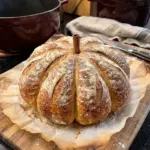
Description
Hands-on: 35–45 minutes across stages
Bulk fermentation: Approximately 4–7 hours, including folds
Cold proof: Approximately 8–14 hours
Bake: 45–55 minutes
Cool: At least 2 hours
Yield: 1 loaf, about 10–12 slices
Ingredients
Scale
- 4 cups bread flour, approximately 17 ounces
- 1 1/4 cups water, approximately 10 ounces by weight
- A scant 1/2 cup ripe 100%-hydration starter, approximately 3.5 ounces
- 1 1/2 teaspoons fine salt, approximately 0.3 ounce
- Flour for basket and shaping
- A trace of neutral oil for twine, optional
- Four 24–30-inch lengths food-safe, oven-rated 100% cotton kitchen twine
- Cinnamon stick for decoration after baking, optional
Instructions
- Mix starter, water, and flour. Cover and rest 30 minutes, then work in salt.
- Give three sets of gentle folds 30 minutes apart. Continue bulk fermentation until aerated and risen roughly half to three-quarters, adjusting to conditions.
- Preshape a round, rest 20 minutes, then shape a snug boule. Place seam-up in a floured basket, cover, and refrigerate 8–14 hours.
- Heat oven to 450°F and preheat a suitable Dutch oven only as permitted by its manufacturer. Arrange four twine lengths as evenly spaced spokes on suitable parchment.
- Turn cold dough seam-down onto the center. Bring opposite ends over the loaf and tie loosely, allowing room to expand. Trim long tails and score lightly if desired.
- Lower into the Dutch oven, cover, and bake 25 minutes. Uncover carefully, reduce to 425°F, and bake 20–30 minutes more, until deeply golden and baked through, generally about 205–210°F in the center.
- Cool on a rack. When safe to handle, cut and remove all twine, checking the underside and grooves. Cool at least 2 hours total before slicing.
- Add an optional cinnamon-stick stem only after baking and remove before cutting.
Storage: Keep fully cooled plain bread at room temperature for up to 2 days for quality, or freeze well wrapped for up to 3 months. Remove every string and decorative piece before serving.