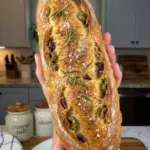
Ingredients
Here’s everything you’ll need to make these crisp, chewy olive baguettes and why each ingredient matters.
For the Dough
- 4 cups (480 g) bread flour — Provides the higher protein content needed to develop a strong, chewy baguette structure.
- 1½ tsp instant yeast — Gives the dough its rise and creates the airy interior.
- 1½ tsp fine sea salt — Seasons the bread and balances the salty flavor of the olives.
- 1 tsp honey or granulated sugar — Adds a subtle touch of sweetness and complements the savory olives.
- 1½ cups (360 g) lukewarm water — Hydrates the flour and creates a soft, slightly sticky dough.
- 1 tbsp extra-virgin olive oil — Adds richness and a subtle Mediterranean flavor.
For the Olives 🫒
- 1 cup (140–160 g) Kalamata olives, pitted — Adds rich, fruity, salty Mediterranean flavor.
- ½ cup green olives, pitted — Provides a brighter, slightly sharper olive flavor that complements the Kalamata olives.
- ½ tsp dried oregano, optional — Adds another layer of Mediterranean herb flavor.
- ½ tsp freshly ground black pepper — Gives the bread a subtle peppery warmth.
For Finishing
- Extra flour, for dusting — Prevents the soft dough from sticking during dividing and shaping.
- Olive oil, optional — Can be used for a subtle finishing touch.
- Flaky sea salt, optional — Adds extra crunch and salty flavor to the finished baguettes.
Instructions
The process takes a little time because the dough needs to rest and rise, but each individual step is straightforward.
Drain both the Kalamata and green olives thoroughly.
Place them between clean paper towels and gently press to remove as much surface moisture as possible.
Roughly chop the olives into small pieces.
Don’t skip the drying step. Excess olive brine introduces additional liquid into the dough and can leave the crumb immediately surrounding the olives wet or gummy.
In a large mixing bowl, combine the bread flour, instant yeast, fine sea salt, and honey or sugar.
Pour in the lukewarm water and extra-virgin olive oil.
Mix with a sturdy spoon, dough whisk, or your hands until everything comes together into a rough, shaggy dough.
Make sure there aren’t any large pockets of dry flour remaining.
The dough should be soft and slightly sticky rather than firm and dry.
Cover the bowl and allow the dough to rest for 20–30 minutes.
This simple resting period gives the flour time to fully absorb the water and makes the dough noticeably easier to stretch and strengthen.
Sprinkle the chopped Kalamata olives, green olives, oregano, and black pepper evenly over the dough.
With slightly damp hands, grab one side of the dough, gently stretch it upward, and fold it toward the center.
Rotate the bowl and repeat the process around the dough.
Continue gently folding until the olives are reasonably well distributed.
Avoid aggressively kneading the olives into the dough. Rough handling can crush them and tear the gluten structure you’re trying to develop.
Cover the dough and let it rest for another 20–30 minutes.
Perform a set of approximately four stretch-and-folds, rotating the bowl between each fold.
Cover and rest again.
Repeat this process 2–3 times.
With each set, you’ll notice the dough becoming smoother, stronger, and more elastic.
Cover the bowl and leave the dough at room temperature for approximately 1–2 hours.
The dough should become noticeably expanded, airy, and bubbly.
Don’t rely exclusively on the clock. Fermentation speed varies depending on the temperature of your kitchen and the activity of your yeast.
Lightly flour your work surface and carefully turn out the risen dough.
Divide it into 3 equal portions.
Gently shape each portion into a rough rectangle without aggressively pressing out all of the fermentation bubbles.
Cover the pieces and let them rest for approximately 15 minutes.
This short bench rest relaxes the gluten and makes final shaping easier.
Working with one piece at a time, gently flatten the dough into a rectangle.
Fold the upper third toward the center and gently seal it.
Bring the lower third upward and seal again.
Fold the dough lengthwise once more and carefully pinch the seam closed.
Turn the baguette seam-side down.
Using gentle pressure, roll from the center toward the ends until the baguette reaches approximately 12–14 inches long.
Repeat with the remaining portions.
Transfer the shaped baguettes to parchment paper or a well-floured baker’s couche.
Cover loosely and allow them to proof for approximately 30–45 minutes.
They should look noticeably puffier and lighter but shouldn’t dramatically double in size.
Preheat your oven to 450°F (230°C).
If you’re using a baking stone or baking steel, give it plenty of time to become thoroughly heated.
Place an empty heat-safe metal pan on the lower oven rack. You’ll use this to create steam during the beginning of baking.
Immediately before baking, use a bread lame or very sharp knife to make 3–4 shallow diagonal cuts across each baguette.
Make confident, quick cuts rather than repeatedly dragging the blade through the dough.
When possible, avoid scoring directly through large exposed olive pieces.
Transfer the baguettes to the hot oven.
Carefully pour approximately 1 cup of hot water into the preheated metal pan and immediately close the oven door.
Bake the baguettes with steam for approximately 10 minutes.
The humid environment delays crust formation during the beginning of baking, allowing the loaves to expand before developing their crisp exterior.
After the first 10 minutes, carefully remove the steam pan if practical.
Continue baking for another 10–15 minutes, or until the baguettes are deeply golden brown with a crisp exterior.
Don’t remove them while they’re still pale. A deeper golden crust provides significantly better flavor and crunch.
Transfer the baked baguettes to a wire cooling rack.
Allow them to cool for at least 20–30 minutes before slicing.
Although freshly baked bread is tempting, the interior is still finishing its setting process after leaving the oven. Cutting immediately can compress the crumb or make it seem gummy.