
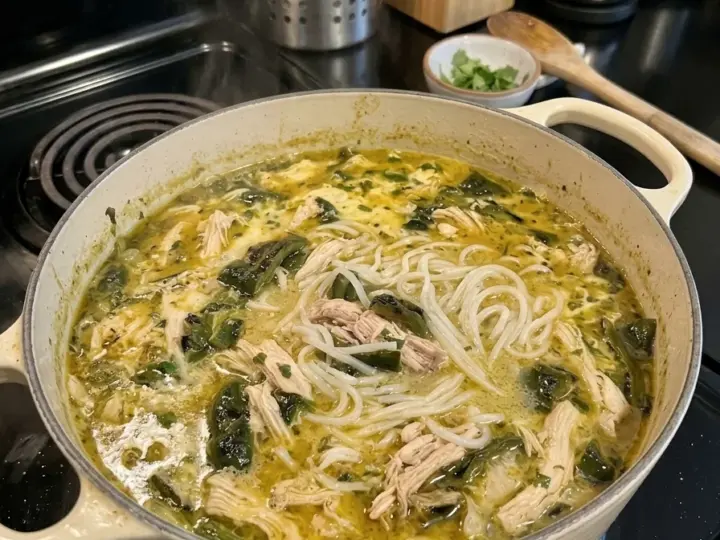
Roasted poblano peppers, tender chicken, and melted Monterey Jack give this creamy soup a comforting chile relleno-inspired flavor. Flat rice noodles add a silky texture, while a blended pepper-and-cream base turns the broth pale green and velvety. A few roasted pepper strips remain whole so every bowl includes both a smooth sauce and tender pieces of poblano.
The cheese and roasted peppers are the connection to chile rellenos. This is a Mexican-inspired fusion soup, rather than a traditional preparation of stuffed, battered chiles. Rice noodles make it a particularly satisfying bowl for anyone who enjoys creamy chicken soup with a little smoky pepper flavor.
The method is straightforward once the peppers are roasted: soften the onion, simmer and shred the chicken, prepare the noodles, and finish the broth gently with the creamy poblano mixture and cheese. The most useful decisions are when to add the dairy and whether to cook the noodles separately.
This article expands the supplied recipe with timing and storage guidance. It has not been independently kitchen-tested. Noodle brands, pepper size, chicken thickness, and cheese all affect the final consistency, so use the doneness checks alongside the suggested times.
What to Expect
The soup should have a creamy, spoonable broth with shredded chicken, soft roasted poblano strips, and tender rice noodles. Monterey Jack melts into the base, adding body and a mild cheese flavor. It may produce a little stretch, but a completely smooth restaurant-style cheese sauce is not guaranteed without a different formulation.
Poblanos are often relatively mild, but individual peppers vary. Roasting develops their flavor and loosens the skins; it does not reliably remove their heat. Taste a small piece of cooked pepper before deciding how much additional jalapeño or hot garnish to offer.
The noodles absorb broth as they stand. A freshly served bowl may be pleasantly soupy, while leftovers can become much thicker. Cooking and storing the noodles separately gives the most control, particularly if you plan to save part of the batch.
Ingredients
Chicken and Soup
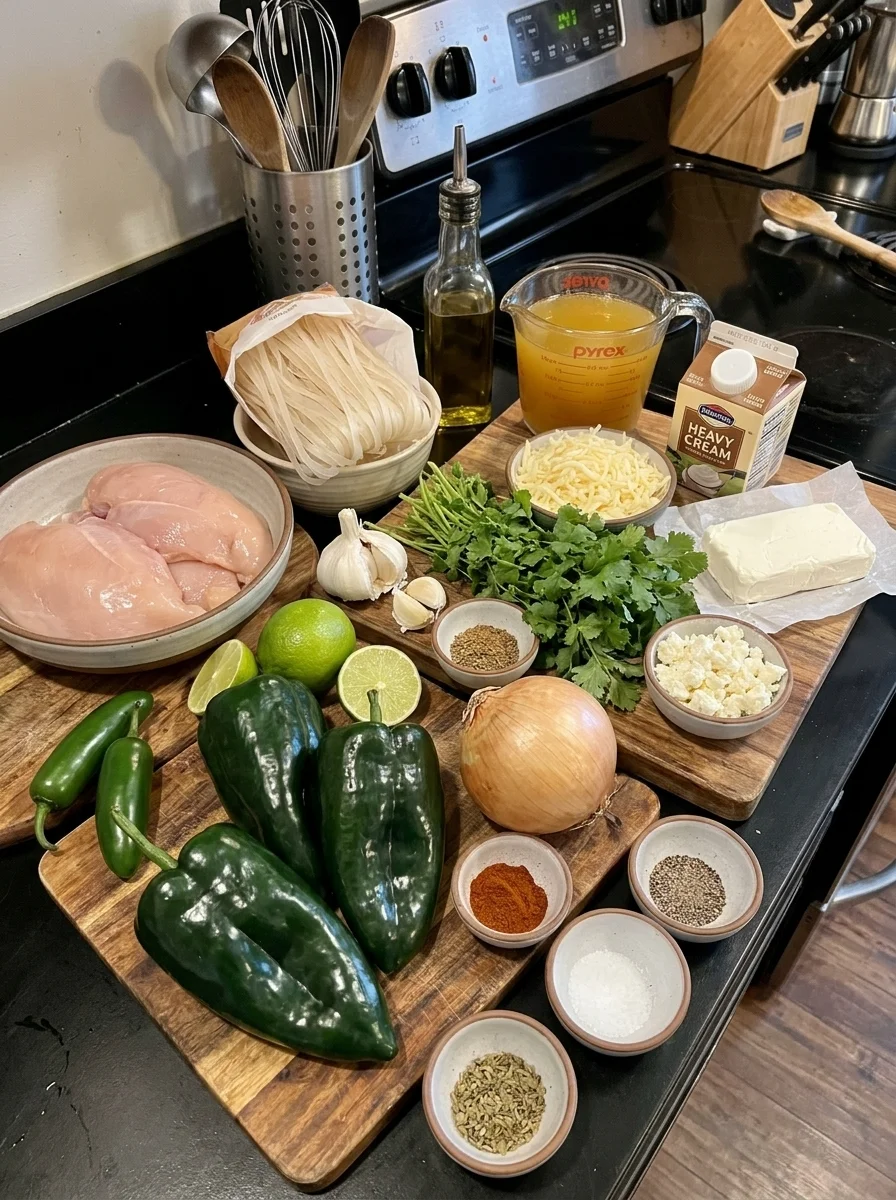
- 1 1/2 pounds boneless, skinless chicken breasts or thighs
- 8 ounces flat rice noodles
- 4 large poblano peppers, roasted, peeled, and seeded; divide two for strips and two for the blended base
- 1 medium yellow onion, diced
- 4 garlic cloves, minced
- 5 cups chicken broth for the soup pot
- 1 tablespoon olive oil
- 1 teaspoon ground cumin
- 1 teaspoon dried Mexican oregano
- 1/2 teaspoon smoked paprika
- 1/2 teaspoon black pepper
- Up to 3/4 teaspoon salt, to taste
Creamy Poblano Cheese Base
- 2 of the 4 prepared poblanos listed above
- 1 cup heavy cream, or half-and-half for a less rich variation
- 4 ounces cream cheese, softened and cubed
- 1/2 cup additional chicken broth, cool or lukewarm for blending
- 1 1/2 cups shredded Monterey Jack cheese, divided: 1 cup for the soup and 1/2 cup for serving
Optional Toppings
- Crumbled queso fresco made with pasteurized milk
- Chopped fresh cilantro
- Additional roasted poblano pieces
- Sliced jalapeños
- Lime wedges
Broth total: The recipe uses 5 1/2 cups, with five cups in the pot and an additional half cup in the blender. Keep extra broth available if needed to adjust the consistency, especially when cooking noodles directly in the soup.
Pepper total: There are four poblanos in the base recipe, not six. The two peppers listed under the creamy base are part of the original four. If you want extra roasted pepper garnish beyond the reserved strips, roast an additional pepper or set aside a small amount from the four.
Ingredient Notes
Chicken breasts or thighs
Both cuts work, but thickness affects the cooking time. A very thick chicken breast may take longer than a thinner thigh even if the weight is similar.
Use the recipe’s timing as a guide and check the thickest part with a thermometer. Chicken should reach 165°F before shredding. Avoid simmering breasts unnecessarily after they are cooked, since they can become dry.
For a shortcut, use cooked shredded chicken. Build and simmer the broth first, then add the cooked meat late enough to heat through without prolonged cooking. This changes the schedule and may change the amount of salt needed.
Rice noodles vary considerably
Flat rice noodles come in different widths and thicknesses. Some require a soak followed by a brief finish; others are boiled. A universal five-to-seven-minute instruction is not reliable for every package.
Read the package before beginning. For the most predictable result, prepare the noodles separately according to the manufacturer’s directions and divide them among serving bowls.
If cooking in the soup, use a product whose directions support that method. Add it before the dairy and be prepared to add extra broth. Noodles that need a vigorous boil are easier to cook separately than in the finished cheese broth.
Freshly shredded Monterey Jack
Shredding a block makes it easier to add the cheese gradually and may help it blend more evenly. Packaged shredded cheese can also work, but anticaking ingredients and brand differences can affect texture.
Keep the final half cup for individual bowls rather than blanketing the entire pot with cheese. This makes the portions easier to serve and avoids leaving a cooling cheese layer across the surface.
Heavy cream and half-and-half
Heavy cream gives the richest result. Half-and-half produces a lighter broth but is more sensitive to overheating. Neither should be subjected to a hard boil once added to this soup.
Cream cheese contributes both tang and body. Soften and cube it before blending so it incorporates without large lumps.
Salt and broth
Chicken broth, cream cheese, Monterey Jack, and queso fresco all contribute sodium. Start with less than the full salt amount if your broth is salted, then adjust after the cheese melts.
The blender does not need an additional unmeasured pinch of salt. Use the listed amount across the whole recipe and taste at the end.
Equipment
Use a large Dutch oven or soup pot, a blender, a baking sheet suitable for broiling, tongs, a cutting board, and two forks for shredding. A food thermometer is useful for the chicken.
A separate saucepan and colander make noodle preparation easier. Although the soup base cooks in one pot, separately prepared noodles are a practical choice when texture and leftovers matter.
The creamy base can be blended with cool or lukewarm ingredients. There is no need to use steaming broth, which complicates handling in a closed countertop blender. Cool the roasted peppers before blending and follow the appliance instructions.
How to Make the Soup
1. Roast the poblanos
Place the peppers on a broiler-safe baking sheet. Broil, turning with tongs, until blistered and charred on all sides. The exact time depends on the broiler and the distance from the heat.
Watch closely rather than leaving the peppers unattended. A few blackened patches are expected on the skins; avoid burning the flesh until it is brittle.
Transfer to a bowl and cover for about ten minutes. This steam rest loosens the skins and makes peeling easier.
2. Peel, seed, and divide
When cool enough to handle, rub or peel away the loose skins. Remove the stems and seed clusters.
Cut two peppers into short, bite-sized strips. Reserve the other two for blending. Short strips are easier to eat with the noodles than long, unbroken ribbons of pepper.
Avoid rinsing away all the roasted juices unless necessary to remove stubborn skin. A few small flecks of char are fine, but remove loose, heavily burnt skin that could make the broth bitter.
3. Blend the creamy base
Place the two reserved peppers in the blender with the cream, softened cream cheese, and half cup of cool or lukewarm broth. Blend until smooth, scraping down as needed.
The mixture should be creamy and evenly green. If a few tiny pepper pieces remain, they are less important than avoiding large cream-cheese lumps.
Set the base aside briefly while cooking, or refrigerate if preparation will be delayed. Do not leave the dairy mixture sitting out throughout a long make-ahead session.
4. Sauté the onion and spices
Heat the olive oil in the soup pot over medium heat. Add the diced onion and cook about four to five minutes, stirring, until softened.
Add the garlic, cumin, Mexican oregano, and smoked paprika. Stir for about 30 seconds, just until fragrant.
If the garlic begins browning quickly, lower the heat. The spices need only a brief warm-up before the broth is added.
5. Simmer the chicken
Pour in the five cups of broth. Add the chicken, black pepper, and part of the salt if needed. Bring to a gentle simmer, then reduce the heat and partially cover.
Begin checking after about 18 minutes, allowing longer for thick pieces. Maintain a gentle simmer rather than a rolling boil.
Check the thickest part of each large piece for 165°F. Remove cooked pieces as they finish if their sizes differ considerably.
6. Shred and return
Transfer the chicken to a clean cutting board or plate and shred into manageable strands with two forks. Return it to the broth with the sliced poblanos.
If the broth has reduced noticeably, add a splash of extra broth before finishing. Remember that noodles will absorb more liquid if they are cooked directly in the pot.
7. Prepare the rice noodles
For the recommended separate method, cook or soak the noodles according to their package directions while the chicken simmers. Drain and keep ready for prompt serving.
Divide the noodles among bowls instead of leaving them in a large hot mass where they can stick together. If preparing ahead, follow the package’s cooling guidance and refrigerate promptly.
For the direct-in-pot method, add the noodles to the broth before the dairy. Cook only as directed for that product, stirring gently to separate them. Stop when just tender, since they continue softening in the hot soup.
8. Incorporate the creamy base
Reduce the heat to low. Stir in the blended poblano mixture gradually.
Warm gently until the soup is hot throughout, stirring to keep the dairy from catching on the bottom. Avoid a hard boil. If the base was refrigerated, allow enough gentle heating time rather than compensating with very high heat.
If the soup looks thicker than desired, add a little extra broth. Make the adjustment before adding all the cheese so you can judge the final richness more easily.
9. Melt the Monterey Jack
Take the pot off the heat or keep it at the lowest setting. Add the one cup of shredded Monterey Jack in small handfuls, stirring until each melts before adding the next.
Do not dump the cheese into rapidly boiling liquid. Excess heat can encourage clumping, oil separation, or a grainy texture.
The goal is a creamy broth with melted cheese incorporated throughout. A little cheese stretch is possible; avoid promising a perfectly emulsified queso sauce from ordinary melting cheese alone.
10. Taste and assemble bowls
Taste the finished soup and adjust the salt and black pepper. Add extra broth if needed.
If the noodles were prepared separately, ladle the chicken and poblano broth over the noodles in each bowl. Sprinkle the reserved half cup of Monterey Jack across the servings, then add optional queso fresco and cilantro.
Serve lime wedges separately so each person can add a little brightness. A large amount of acidic juice stirred into a hot dairy pot can affect texture, so individual additions are easier to control.
Keeping the Broth Smooth
Blend the cream cheese thoroughly before it enters the pot. Large cold cubes stirred directly into a noodle-filled soup can be difficult to incorporate evenly.
Lower the temperature before adding dairy and cheese. A gentle heat is enough to warm the cream and melt finely shredded Monterey Jack.
Add cheese gradually. Smaller additions give it a chance to melt instead of gathering into one large clump.
Serve soon after finishing. Prolonged heating and repeated reheating make a cheese soup less predictable, particularly when noodles remain in the pot absorbing liquid.
If the broth becomes stringy or slightly separated, remove it from the heat and stir gently. A splash of warm broth may loosen it, but vigorous boiling is unlikely to repair the texture.
Managing the Noodles
For immediate family-style serving, direct cooking can be convenient if your noodle package supports it. Keep extra broth nearby and avoid letting the finished pot stand for a long time.
For meal prep, separate noodles are preferable. Store them apart from the creamy chicken soup and combine only the portions you plan to eat.
The noodle weight is dry weight. Eight ounces of cooked noodles is a much smaller amount than eight ounces dry, so check the package measurement before starting.
Very wide noodles can be cut or broken into shorter lengths if desired, but handle cooked noodles gently so they do not turn into fragments in the broth.
Make-Ahead Options
Roast, peel, and slice the peppers a day ahead and refrigerate them in a covered container. Keep the blending peppers separate from the strips if that helps assembly.
You can prepare the chicken-and-broth base ahead, cool promptly, and refrigerate. Reheat the base thoroughly before reducing the heat and adding the cream mixture and cheese.
Prepare noodles close to serving for the best texture, or keep cooled, cooked noodles refrigerated separately. Do not soak them in the finished broth overnight if you want a soup-like consistency the next day.
For a gathering, set out garnishes separately and assemble smaller batches of bowls. This gives guests control over the heat and keeps the cheese garnish from accumulating on top of the whole pot.
Serving Ideas
The chicken, noodles, and creamy broth make a substantial bowl. A crisp green salad or cucumber salad offers a fresh contrast without adding another rich component.
Warm corn tortillas can be served alongside if desired, though the noodles already supply a starchy element. A little cilantro and lime usually do more for the finished flavor than a large quantity of additional cheese.
For more heat, offer sliced jalapeños or a little hot sauce at the table. Poblano heat varies, so tasting before adding extra chile is more reliable than assuming the soup is mild.
Use queso fresco as a garnish rather than expecting it to melt into the broth like Monterey Jack. It adds a crumbly, salty contrast.
Storage and Reheating
Refrigerate leftovers promptly in shallow covered containers at 40°F or below and use within three to four days. Store noodles separately when possible and keep fresh garnishes apart.
Do not leave the soup out for more than two hours, or more than one hour when the surroundings exceed 90°F. Follow USDA leftover handling guidance.
Reheat gently on the stovetop, stirring, until the soup reaches 165°F throughout. A food thermometer is more useful than judging by steam. Add broth as needed to loosen the sauce, especially if noodles were stored in it. See USDA reheating guidance.
Avoid prolonged boiling after reheating. The safety temperature can be reached without leaving the soup at a rolling boil that damages the dairy texture.
For freezing, the best starting point is the chicken, broth, onion, spices, and peppers before adding dairy, cheese, or noodles. Freeze that base for up to two to three months for best quality. Thaw in the refrigerator, reheat, and finish with freshly prepared creamy base, cheese, and noodles. Fully finished soup can separate and the noodles may soften after thawing.
Variations
Less rich finish: Use half-and-half instead of heavy cream. Expect a thinner broth and take extra care to avoid overheating.
Rotisserie chicken: Add cooked shredded chicken to the developed broth and heat through before finishing. Adjust salt because prepared chicken can already be well seasoned.
More roasted pepper: Add an extra roasted poblano if you enjoy a stronger pepper flavor. Keep the amount of added liquid under control.
Gentle smoky heat: Add a small pinch of chipotle powder to the spices. Start modestly so it does not overwhelm the roasted poblanos.
Different noodle: Another noodle changes cooking time, liquid absorption, and possibly the gluten status. Prepare it separately rather than assuming the rice-noodle timing applies.
Troubleshooting
The soup is much too thick
Noodles absorb liquid and cheese adds body. Stir in extra broth gradually until the soup reaches your preferred consistency. Next time, keep the noodles separate.
The cheese clumped
The broth may have been too hot, or the cheese may have been added too quickly. Remove from the heat and stir gently. Gradual additions at a lower temperature are the better preventive step.
The noodles are mushy
They may have cooked too long or stood in hot broth after becoming tender. Follow the package instructions and serve promptly. Separate storage helps protect the texture of leftovers.
The soup tastes bitter
Loose burnt pepper skin or scorched garlic can contribute bitterness. Remove heavily charred skins and keep the garlic from darkening during the sauté step.
The chicken is dry
Breasts can become dry from prolonged simmering after reaching temperature. Check early and remove pieces as they finish rather than waiting for every piece to cook on the same schedule.
Frequently Asked Questions
Are there four peppers or six?
Four total. Two are sliced and two are blended. Extra garnish peppers are optional additions, not part of the base amount.
Is the soup gluten-free?
Rice noodles are often made without wheat, but check their label along with the broth, spices, and other packaged ingredients. Do not assume the finished dish is suitable for strict gluten avoidance without verifying products and preparation surfaces.
Does this taste exactly like a chile relleno?
It shares roasted poblano and cheese flavors, but it does not include a stuffed pepper or fried batter. It is a creamy soup inspired by that combination.
How many servings does it make?
Plan on about six substantial bowls, or eight smaller portions. Yield depends on added broth, noodle preparation, and garnish amounts.
What is the estimated nutrition?
With heavy cream, cream cheese, Monterey Jack, and eight ounces of dry noodles, this is a rich soup. A rough ingredient-based estimate is about 550–650 calories and 30–40 grams protein per one-sixth batch before generous optional toppings. Half-and-half, chicken cut, cheese weights, and portion sizes change the totals. Calculate from your labels if precision matters.
Print
Chile Relleno Chicken & Creamy Poblano Rice Noodle Soup
Description
- Prep: About 25–30 minutes, including pepper handling
- Cooking: About 30–40 minutes, with some roasting and noodle work overlapping
- Total: Approximately 55–70 minutes
- Servings: About 6 substantial bowls or 8 smaller bowls
- Method: Stovetop soup with roasted peppers
Ingredients
Chicken and Soup
- 1 1/2 pounds boneless, skinless chicken breasts or thighs
- 8 ounces flat rice noodles
- 4 large poblano peppers, roasted, peeled, and seeded; divide two for strips and two for the blended base
- 1 medium yellow onion, diced
- 4 garlic cloves, minced
- 5 cups chicken broth for the soup pot
- 1 tablespoon olive oil
- 1 teaspoon ground cumin
- 1 teaspoon dried Mexican oregano
- 1/2 teaspoon smoked paprika
- 1/2 teaspoon black pepper
- Up to 3/4 teaspoon salt, to taste
Creamy Poblano Cheese Base
- 2 of the 4 prepared poblanos listed above
- 1 cup heavy cream, or half-and-half for a less rich variation
- 4 ounces cream cheese, softened and cubed
- 1/2 cup additional chicken broth, cool or lukewarm for blending
- 1 1/2 cups shredded Monterey Jack cheese, divided: 1 cup for the soup and 1/2 cup for serving
Optional Toppings
- Crumbled queso fresco made with pasteurized milk
- Chopped fresh cilantro
- Additional roasted poblano pieces
- Sliced jalapeños
- Lime wedges
Broth total: The recipe uses 5 1/2 cups, with five cups in the pot and an additional half cup in the blender. Keep extra broth available if needed to adjust the consistency, especially when cooking noodles directly in the soup.
Pepper total: There are four poblanos in the base recipe, not six. The two peppers listed under the creamy base are part of the original four. If you want extra roasted pepper garnish beyond the reserved strips, roast an additional pepper or set aside a small amount from the four.
Instructions
1. Roast the poblanos
Place the peppers on a broiler-safe baking sheet. Broil, turning with tongs, until blistered and charred on all sides. The exact time depends on the broiler and the distance from the heat.
Watch closely rather than leaving the peppers unattended. A few blackened patches are expected on the skins; avoid burning the flesh until it is brittle.
Transfer to a bowl and cover for about ten minutes. This steam rest loosens the skins and makes peeling easier.
2. Peel, seed, and divide
When cool enough to handle, rub or peel away the loose skins. Remove the stems and seed clusters.
Cut two peppers into short, bite-sized strips. Reserve the other two for blending. Short strips are easier to eat with the noodles than long, unbroken ribbons of pepper.
Avoid rinsing away all the roasted juices unless necessary to remove stubborn skin. A few small flecks of char are fine, but remove loose, heavily burnt skin that could make the broth bitter.
3. Blend the creamy base
Place the two reserved peppers in the blender with the cream, softened cream cheese, and half cup of cool or lukewarm broth. Blend until smooth, scraping down as needed.
The mixture should be creamy and evenly green. If a few tiny pepper pieces remain, they are less important than avoiding large cream-cheese lumps.
Set the base aside briefly while cooking, or refrigerate if preparation will be delayed. Do not leave the dairy mixture sitting out throughout a long make-ahead session.
4. Sauté the onion and spices
Heat the olive oil in the soup pot over medium heat. Add the diced onion and cook about four to five minutes, stirring, until softened.
Add the garlic, cumin, Mexican oregano, and smoked paprika. Stir for about 30 seconds, just until fragrant.
If the garlic begins browning quickly, lower the heat. The spices need only a brief warm-up before the broth is added.
5. Simmer the chicken
Pour in the five cups of broth. Add the chicken, black pepper, and part of the salt if needed. Bring to a gentle simmer, then reduce the heat and partially cover.
Begin checking after about 18 minutes, allowing longer for thick pieces. Maintain a gentle simmer rather than a rolling boil.
Check the thickest part of each large piece for 165°F. Remove cooked pieces as they finish if their sizes differ considerably.
6. Shred and return
Transfer the chicken to a clean cutting board or plate and shred into manageable strands with two forks. Return it to the broth with the sliced poblanos.
If the broth has reduced noticeably, add a splash of extra broth before finishing. Remember that noodles will absorb more liquid if they are cooked directly in the pot.
7. Prepare the rice noodles
For the recommended separate method, cook or soak the noodles according to their package directions while the chicken simmers. Drain and keep ready for prompt serving.
Divide the noodles among bowls instead of leaving them in a large hot mass where they can stick together. If preparing ahead, follow the package’s cooling guidance and refrigerate promptly.
For the direct-in-pot method, add the noodles to the broth before the dairy. Cook only as directed for that product, stirring gently to separate them. Stop when just tender, since they continue softening in the hot soup.
8. Incorporate the creamy base
Reduce the heat to low. Stir in the blended poblano mixture gradually.
Warm gently until the soup is hot throughout, stirring to keep the dairy from catching on the bottom. Avoid a hard boil. If the base was refrigerated, allow enough gentle heating time rather than compensating with very high heat.
If the soup looks thicker than desired, add a little extra broth. Make the adjustment before adding all the cheese so you can judge the final richness more easily.
9. Melt the Monterey Jack
Take the pot off the heat or keep it at the lowest setting. Add the one cup of shredded Monterey Jack in small handfuls, stirring until each melts before adding the next.
Do not dump the cheese into rapidly boiling liquid. Excess heat can encourage clumping, oil separation, or a grainy texture.
The goal is a creamy broth with melted cheese incorporated throughout. A little cheese stretch is possible; avoid promising a perfectly emulsified queso sauce from ordinary melting cheese alone.
10. Taste and assemble bowls
Taste the finished soup and adjust the salt and black pepper. Add extra broth if needed.
If the noodles were prepared separately, ladle the chicken and poblano broth over the noodles in each bowl. Sprinkle the reserved half cup of Monterey Jack across the servings, then add optional queso fresco and cilantro.
Serve lime wedges separately so each person can add a little brightness. A large amount of acidic juice stirred into a hot dairy pot can affect texture, so individual additions are easier to control.